
Vietnam switched off its 2G masts on 15 September, four of its undersea cables faulted in August, and a local SIM now has to survive an identity check – what that leaves you for data
Contents:
Vietnam pulled the plug on the last of its 2G base stations this month – permanently, on the fifteenth – and the 900 MHz spectrum they sat on goes back to the state to be auctioned for 4G and 5G.
The country has decided its mobile network runs on 4G and 5G and nothing older – in a year when 15.9 million international visitors arrived in the first eight months alone, 14.4% up on 2025.
Below: what each of the three options asks of you, what the paperwork now wants, and why hotel Wi-Fi here can be quick on a Vietnamese site and slow on a call to London.
👉 The plans themselves: Vietnam data packages.
The masts that went quiet on 15 September

It came in two moves. October 2024 took the first cut: operators stopped serving handsets that could do nothing but GSM. This month finished the job on the rest.
For most visitors this changes nothing: any phone of the last several years finds 4G. It matters for the cheap spare handset carried as a backup, which here now has nothing to fall back on.
What replaced it is good. Viettel, Vinaphone and MobiFone – between them the overwhelming majority of Vietnamese subscriptions – had over 40,000 5G base stations by early 2026, reaching around 90% of the population.
Ninety per cent of the population is not ninety per cent of the map, and Vietnam’s people are not spread evenly across it. In the northern mountain provinces the reporting on the shutdown noted that basic handsets were still in everyday use. Download the offline map before the road starts climbing.
Four cables, and why an evening online can feel slow
No coverage map shows this: domestic internet and international internet are two different experiences here, and the second rides on a handful of submarine cables.
In late August 2026 four were in trouble at once. SJC2 and AAE-1 faulted almost simultaneously on 25 August, AAG was already carrying an unresolved problem, and Intra-Asia went down too. Operators put the combined loss at around 30% of Vietnam’s international capacity; repairs on Intra-Asia were expected in early September, and for the other three no date was published. Traffic was rerouted, partly onto a land route through Laos to Singapore – which works, and is not what the network was built around.
The point is not that Vietnam was broken in August, but that a handful of cables is a thin thread – and when one parts, it hits exactly what a visitor uses: a call home, a streaming service, a cloud backup. Vietnamese services stay quick throughout, because that traffic never leaves the country. Download the map offline and it stops mattering.
What your own plan charges once you land
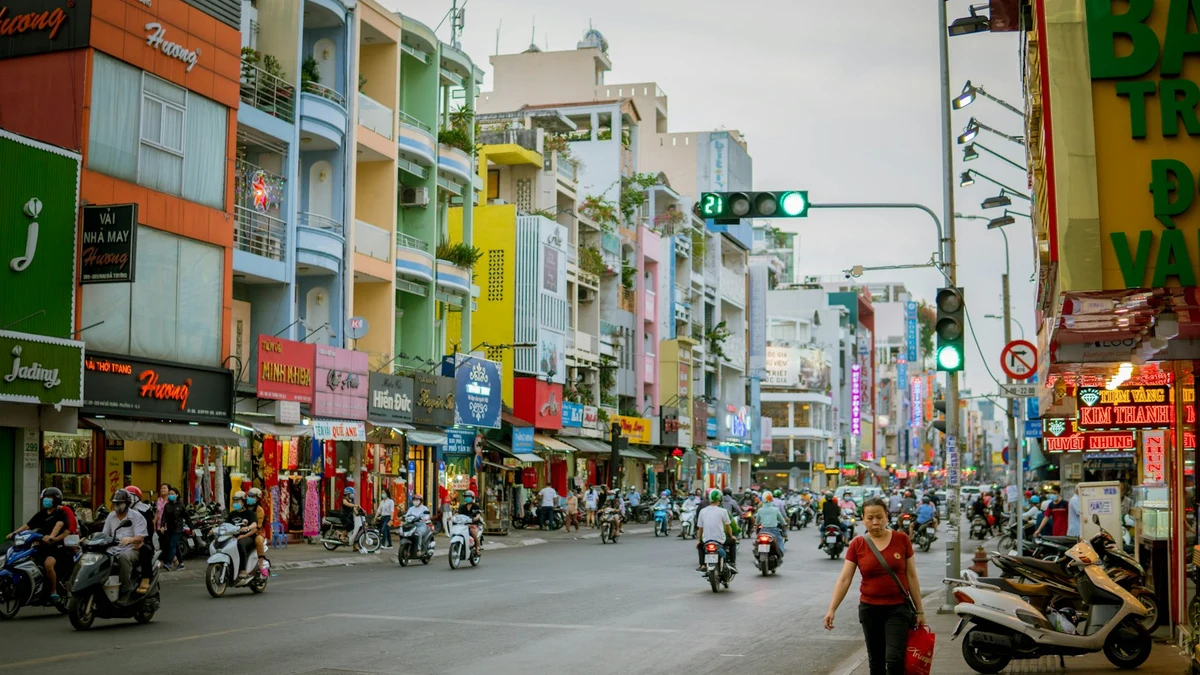
Start with the honest bit. Inside the European Union, roaming costs an EU resident nothing extra, and most have stopped thinking about the subject entirely. An EU allowance dies at the Union’s border, though, and Vietnam is a long way past it.
Vietnam sits outside every default inclusive-roaming zone we could find, so a British number needs a daily add-on here: across the major UK networks those out-of-Europe passes ran from about £2 to about £8 a day (Uswitch survey, June 2026), a four-fold spread. One large US carrier prices its worldwide day pass at $12 a line, $6 for Canada and Mexico (its own travel pages, September 2026).
Roaming keeps one advantage: your own number stays live, so bank codes arrive normally. For three days on expenses that may win; for longer, the arithmetic is not close.
A Vietnamese SIM is now an identity record
Since Decree 49/2017 every Vietnamese SIM has had to carry a named owner. For a visitor the name comes off the passport, photocopied at the counter before the card will do anything. What changed is the machinery behind that counter. Decree 163/2024, in force since December 2024, told carriers to verify subscriber identity against the National Population Database, and a ministry circular effective 15 April 2026 set out how re-verification runs, including for numbers registered on a foreign passport. Legal commentary on the circular says such a record can have its outgoing service suspended.
None of this is aimed at tourists, but it has two consequences. The first: the pre-activated SIM sold from a stall is already registered to somebody else – exactly what the verification checks. It may work a week, or stop mid-trip with no counter to return to.
The second is time: an official outlet, your passport, a photograph of it, and a queue that is longest at the hour your flight lands. In exchange you get the cheap thing – tourist bundles roughly in the ₫90,000–₫250,000 band for seven to thirty days, which at the mid-September 2026 rate of about ₫26,000 to the dollar is near $3.50–$9.60. Treat that as an order of magnitude, not a price list: the carriers publish no English tourist tariff. For a month on the ground it is the cheapest data here; for nine days with an onward flight you pay in queue time for a saving you may not notice.
What a travel eSIM does differently here
Think of it as a SIM you download. You pay, a QR code lands in your inbox, the handset pulls the profile in, and it then rides Vietnamese masts a local card would use too – as a visiting guest, not a registered customer. That is precisely why none of the paperwork above reaches you, and why the card already in the phone carries on taking calls while the data goes elsewhere.
The drawbacks, stated plainly:
- Data only: no Vietnamese number, so anything that will send a code to nothing but a local mobile is out.
- Support is not universal. iPhone XS onwards and current Google and Samsung flagships are fine; mainland-Chinese iPhones usually are not. Our device list is the arbiter.
- Roaming must be enabled inside the travel profile itself, or the handset shows a bar and moves nothing.
- Across a long stay, per gigabyte, a local card still wins.
👉 How the three compare away from Vietnam: eSIM vs local SIM vs roaming.
Torrum packages for Vietnam, and the block that covers a loop
Vietnam is sold as a country block: an allowance with a validity window, bought before you fly. The prices live on the cards below, because a price typed into an article goes stale.
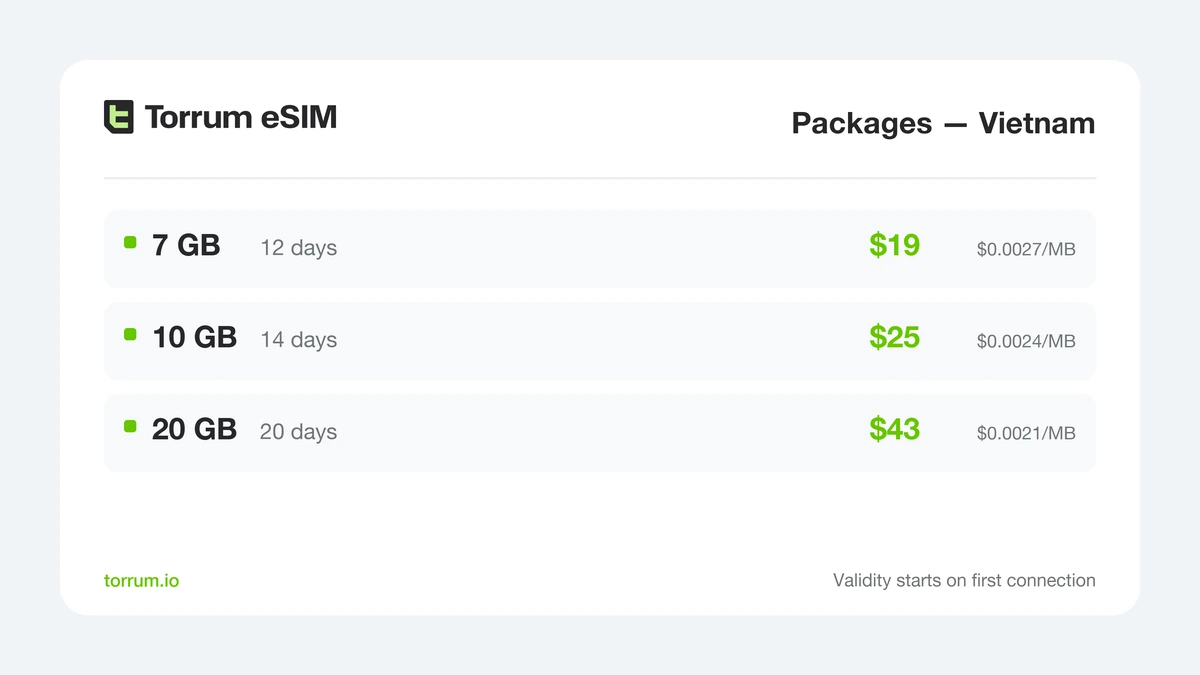
Three country blocks. What binds you here is the date on the block, not the gigabytes.
Two mechanics matter. The countdown begins with the first registration on a network, not with the payment, so buying a week ahead costs nothing. And the window, not the allowance, is what you are really buying: a block ends on its own date, spent or not. Only a metered Pay-per-MB balance waits on the account for the trip after this one.
Vietnam is rarely visited on its own, though – usually it is the long leg of a route through Cambodia, Laos or Thailand. For that there is a regional block covering a list of Asian destinations, Vietnam among them.
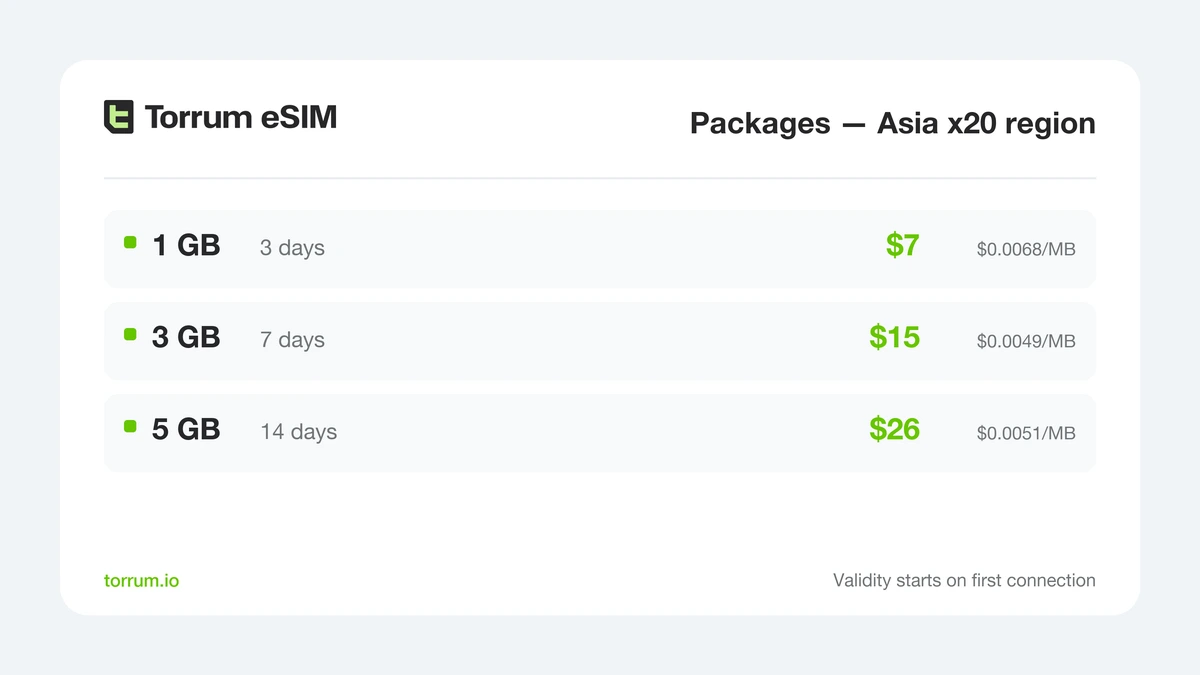
The Asia regional block: fewer gigabytes, one profile that survives the bus into Cambodia or Laos.
Make the trade knowingly: the regional block tops out at a much smaller allowance than the largest Vietnamese one, so it suits many borders and modest use, not a month of video from one address. Both sit on the same page – Vietnam and the Asia region. Torrum also runs a global Pay-per-MB balance and an Unlimited plan.
Forty-five days, ninety days, and a block shorter than both
British, German, French, Italian, Spanish, Japanese, South Korean and Scandinavian passports get 45 days visa-free here, and more European nationalities joined on the same terms in August 2025 under a scheme running to August 2028. Americans, Canadians and Australians have no exemption and apply for the e-visa instead – up to 90 days. Check before booking; the list has been revised before.
Here is the collision: the longest Vietnamese data block is shorter than three weeks, while a 45-day exemption or a 90-day e-visa invites you to stay far longer – and plenty of people accept.
Under three weeks, one block covers everything. Beyond that you are either buying a second block or you have reached the point where a Vietnamese SIM pays for itself, passport queue and all. A travel profile is a tool for a trip, not a residency.
Wi-Fi in Vietnam: everywhere, and only half an answer

Free Wi-Fi is easy to find in Vietnam. Cafés hand out the password with the coffee, and the airports advertise it as standard: at Ho Chi Minh City’s Tan Son Nhat the airport’s own services company promises a free network across all public areas of both terminals, around the clock, with no session limit stated. Hanoi’s Noi Bai lists free internet among its services without saying more.
Then the gaps appear. A free network is a shared network, and an arrivals hall at peak is the worst version of that. Café Wi-Fi handles messages and is unpredictable for anything leaving the country – the cable problem again. And it is useless in the two places you most want a map: the taxi and the road.
Before the airport: the order this has to happen in
An eSIM has to be fetched over the internet – which is awkward in an arrivals hall, where the internet is the thing you do not have yet.
- Will the handset even accept an eSIM? That question can end the whole approach, so settle it first on our compatibility list.
- Open an account with Torrum – Google, Apple or Telegram will do – then choose Vietnam alone or the Asia region if borders are involved.
- Pay by card. Top-ups begin at $10 and a single transaction caps out at $100.
- Scan the QR onto the phone while a home network is still under you – screen by screen in the app guide.
- Enable Roaming within the profile itself. Left off, a perfectly good eSIM shows no service.
- After landing, drop flight mode and let it register. The window opens there, not at checkout.
Something misbehaving? Our Telegram bot replies over airport Wi-Fi.
Vietnam compared: picking between the three
| Vietnam, three ways | Your own plan, roaming | A card from a Vietnamese counter | A travel eSIM |
|---|---|---|---|
| Working when you land | Yes, automatically | After a counter and a passport | Yes, if installed at home |
| Handing over a document | Nothing asked | Passport, copied and filed against the number | Nothing asked |
| Affected by SIM re-verification rules | No | Yes – the number is a tracked record | No |
| Cost for a 10-day trip | £2–£8 a day from the UK, about $12 a day on a US day pass | Cheapest per gigabyte | One fixed price, paid before departure |
| Your home number stays live | Yes | No, unless the phone holds two SIMs | Yes – home SIM untouched |
| Vietnamese phone number | No | Yes | No |
| Crossing into Cambodia, Laos or Thailand | Yes, at whatever each country costs on your own tariff | No – another card at every crossing | Yes, on the regional block |
| Best suited to | Two or three days, expensed | A stay of a month or more | One to three weeks, or a route |
Four Vietnamese trips, four answers
Nine days, Hanoi to Ha Long and back. One country block, bought at home, carrying the least data you can realistically justify.
Three weeks the length of the country. Hanoi, Hue, Hoi An, Ho Chi Minh City – still one country block, but check the validity against your return date, because a block that runs out two days early is not the same trip.
The Indochina loop. Vietnam plus Cambodia, plus Laos or Thailand – what the Asia regional block is for: one profile that does not care which border the bus just crossed. If the route leans on one of those, our Thailand guide and Bali guide take it from the other end.
Two months working remotely from Da Nang. This is where a Vietnamese SIM wins. Register properly at an official outlet, and keep a travel profile to get you from the airport to that shop with a working map.
👉 Sizing the allowance: working out what a trip actually uses.
FAQ
My spare handset is ancient. Will it connect?
Not if GSM is all it speaks. Those networks went dark for good this month, so a handset without 3G or 4G has nothing left to find.
Is a passport needed just to get online here?
For a card bought in Vietnam, yes – the counter registers it against your passport. Roaming and travel eSIMs ask for nothing.
Why can my hotel Wi-Fi be fast for local sites and slow for everything else?
Vietnam’s international traffic runs over a handful of submarine cables, and in late August 2026 four were faulted at once, cutting roughly 30% of that capacity. Domestic traffic is unaffected; a video call is not.
Has Vietnam got 5G?
It has – over 40,000 base stations by early 2026, reaching roughly nine people in ten by population. Population is not territory.
One profile across Vietnam, Cambodia and Laos – possible?
All three sit inside the Asia regional block, so yes. A Vietnam-only block stops dead at the border.
How long does Vietnam let you stay?
As things stood in September 2026: 45 days visa-free for a list including the UK, Germany, France, Italy, Spain, Japan and South Korea, while Americans, Canadians and Australians take the e-visa route.
Installed fine, no data. What now?
Almost always it is Roaming left switched off inside that profile. Enable it there; the app guide shows the screen.
What about the cheap cards sold on the street?
Pre-activated ones carry somebody else’s name on the record the verification checks – and they can go dead without warning.
Does an unfinished block carry over?
No – a block ends on its own date, spent or not. Only a metered Pay-per-MB balance waits for the next trip.
Does this work as a plan where I live?
No – the Terms of Use limit the service to travel and exclude the country you normally live in.
Last word: the network is fine, the paperwork is the work
Vietnam’s domestic network is in good shape: the 2G era ended this month and 5G reaches nine people in ten. The two real constraints sit elsewhere – undersea cables that decide how the rest of the world feels from here, and a registration regime that has turned the local SIM into administration.
Under three weeks: buy a country block at home, install it on your own Wi-Fi, land with a working map. A route through the neighbours: the regional block, and stop thinking about borders. Staying put for longer than that: do the passport queue once, properly. Roaming answers only the short trip somebody else is paying for.
👉 Start here: Vietnam data packages.


 Continue with Google
  Continue with Telegram

