
Three ways to get data abroad: what roaming, a local SIM and a travel eSIM really cost in money, paperwork and your own phone number
Contents:
Most arrivals halls have a counter selling local SIM cards. For a fast-growing group of travellers, walking up to it is pointless – their phone has nowhere to put one.
Three ways exist to have working data abroad, and they differ in who sends the bill, what document you must produce, and whether your own number survives the trip. Which one fits turns less on the destination than on the handset in your pocket and the country that issues its bill.
👉 For readers who want the destination version instead, the plan list runs country by country.
Same masts, three different contracts
No mast anywhere is marked “for visitors”. Abroad, your phone attaches to a network owned by a company in that country, and what separates the three options is the paperwork behind that attachment.
On your home plan, your operator has bought wholesale access from that network and resells it to you, with a margin, weeks later. On a travel eSIM the profile joins those same networks the way any foreign line does, except that its price was fixed before you left, in the currency you pay in. A local SIM is the odd one out: you stop being a visitor and become a domestic customer, which makes it the only one of the three that is not roaming at all.
One consequence carries through the whole article. Coverage cannot separate roaming from a travel eSIM – the antennas are shared. Money, paperwork and your phone number can. Anyone promising a better signal from a data plan is describing something a data plan cannot do.
What your own operator charges to follow you abroad
The price of roaming turns on two things, and neither is the country you picked for the holiday: where your bill is issued, and whether the destination falls inside a zone your operator already treats as home.
An EU line inside the EU pays no supplement. Roam-like-at-home covers the 27 member states plus Iceland, Liechtenstein and Norway, with Ukraine and Moldova added on 1 January 2026, and runs to 30 June 2032 (Regulation (EU) 2022/612). Your operator must also cut data off by default once extra charges reach about €50, and any surcharge past the fair-use allowance is capped by law, falling to €1 per gigabyte from 2027 (European Commission roaming pages, checked September 2026).
A British line lost that. Post-Brexit, daily EU roaming fees returned on three of Britain’s four biggest networks, typically £2.50–3 for each day used in 2026; the remaining one keeps EU use inside most monthly bundles, capped at 25 GB (UK operator price lists compared, September 2026).
A US line pays per day, per handset. Published day passes for international use sit at $10–15 for every day the phone is used abroad, one carrier limiting how many days it will bill within a cycle (international roaming price comparisons, September 2026). Two handsets for a fortnight is a three-figure line item before anyone opens a map.
Notice what does the work in the first case: a ceiling somebody legislated. Outside a regulated zone none exists.
👉 The British side of this has a page of its own: what a fortnight in Europe now adds to a UK bill.
The counter is where the shelf price stops being true

Domestic prepaid data is, almost everywhere, the cheapest data in the country. That part of the local-SIM argument is simply true.
The shelf price is not the price you pay. Some 160 governments require every prepaid line to be tied to an identified buyer – at the counter, an identity document, a form, and in some countries a fingerprint (GSMA Mobile Policy Handbook, updated October 2025). Know which side of that line you come from: the same handbook notes that the Czech Republic, the UK and the US decided against mandating registration, so travellers used to buying a SIM off a rack are the ones most surprised abroad.
Then the costs nobody quotes. The airport kiosk charges an airport margin; the city shop that does not charges you the journey and the queue. A late landing meets a closed counter.
Where a local SIM genuinely wins is duration: stay a month in one country and the errand amortises.
The newest iPhones cannot take a local SIM at all
This is the part that has quietly rewritten the comparison, and it is hardware rather than opinion.
Apple has been removing the SIM tray. Every iPhone 14, 15 and 16 sold in the United States is eSIM only, and with the iPhone 17 generation the same applies to handsets bought in the United States, the US Virgin Islands, Canada, Mexico, Japan, Guam, the United Arab Emirates, Saudi Arabia, Bahrain, Kuwait, Qatar and Oman (Apple Support, checked September 2026).
Read that list as a map of who travels. On the newest iPhones bought in North America, the Gulf and Japan there is no slot to put a local SIM into, and for their owners the three options are two.
The mirror case deserves a sentence: a phone that does have a tray may still be carrier-locked, and a foreign SIM will sit in it doing nothing. The first question is settled by the device compatibility list; the second only the operator that sold you the handset can answer.
What a travel eSIM actually is, and why you need not pick just one

An eSIM is a chip already soldered into the phone; a travel plan is a profile written onto it, downloaded rather than posted. A code loads it, a second entry shows up among your lines, and no plastic changes hands.
Its limits deserve stating plainly. It carries data, not identity: no local number comes with it. And by its terms it is a plan for being away, never a cheaper tariff at your own address.
What it does not ask is that you give anything up, which is where most guides go wrong. Any dual-line phone runs two lines at once, and the pairing beats every single answer above.
Apple documents it directly: two eSIMs can be active at once on supported models, and with both on, the travel eSIM carries data while the home line stays live for messages and internet calls (Apple Support, checked September 2026). Recent flagship Android handsets do the same.
Why bother? Because of what people discover too late. The verification code from your bank goes to the number your bank has on file, and that number lives on your home line. Pull that SIM out for a local one and the codes stop arriving in the week you need them most: car-hire desks, payment pages, an airline app rebooking a missed connection.
So: a division of labour. Your own line for identity, its mobile data off so it cannot quietly bill you; the travel line carrying the rest. The one thing it cannot solve is a form insisting on a local number – that stays a local-SIM job.
Torrum plans: three shapes, one worked example
Three shapes, and the split between them is not geography: two ask you to name a number in advance, one does not. Spain does duty as the example; swap the country on the plans page and the same three appear. Buying early costs nothing – validity is triggered by the first foreign network, not by the receipt.
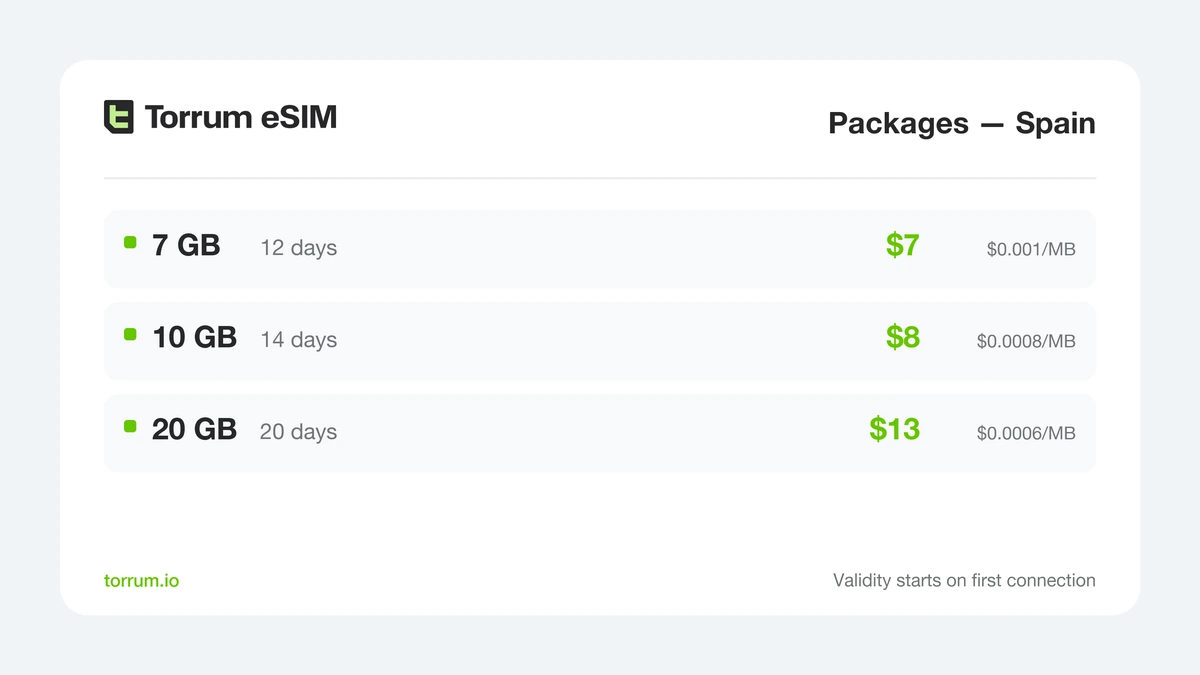
Spain at the three sizes the plan page offers. Read the right-hand column, not the price: the larger the block, the less each megabyte inside it costs.
A package answers the itinerary that stays in one country, once you have a rough figure. If you have not, our guide to sizing a trip’s data appetite derives one from your phone settings.
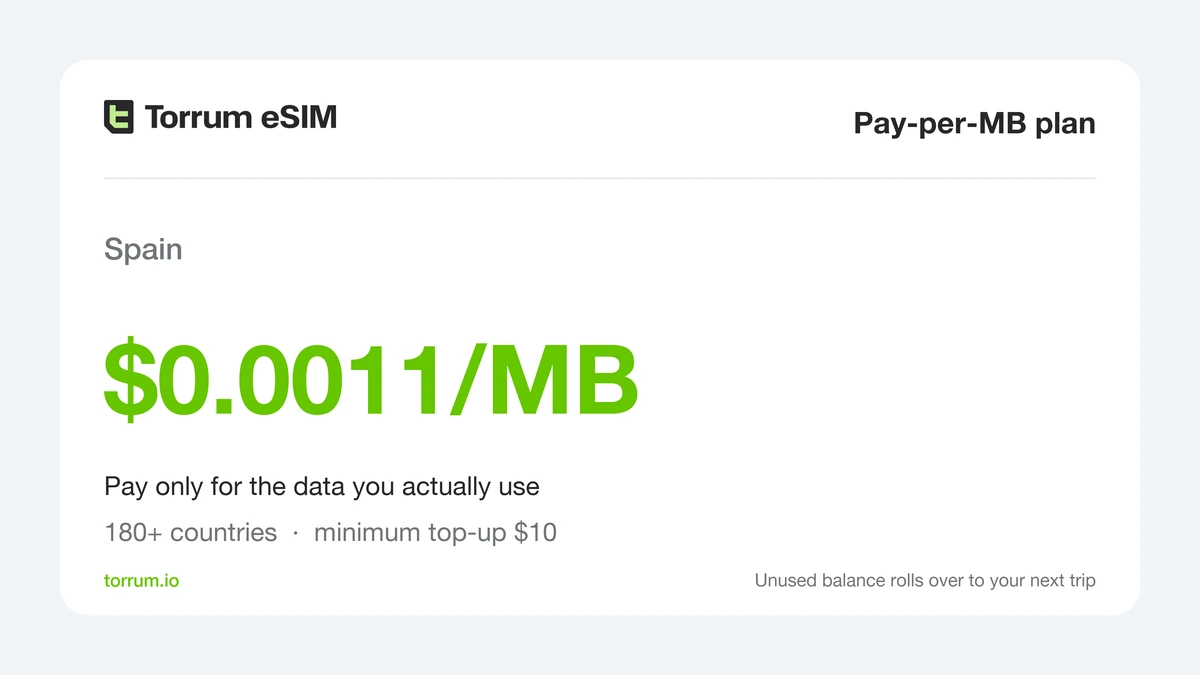
The only shape with no size to choose and no date to beat: Pay-per-MB reads the meter, Spain at $0.0011 a megabyte. Stop travelling and the balance simply waits for you.
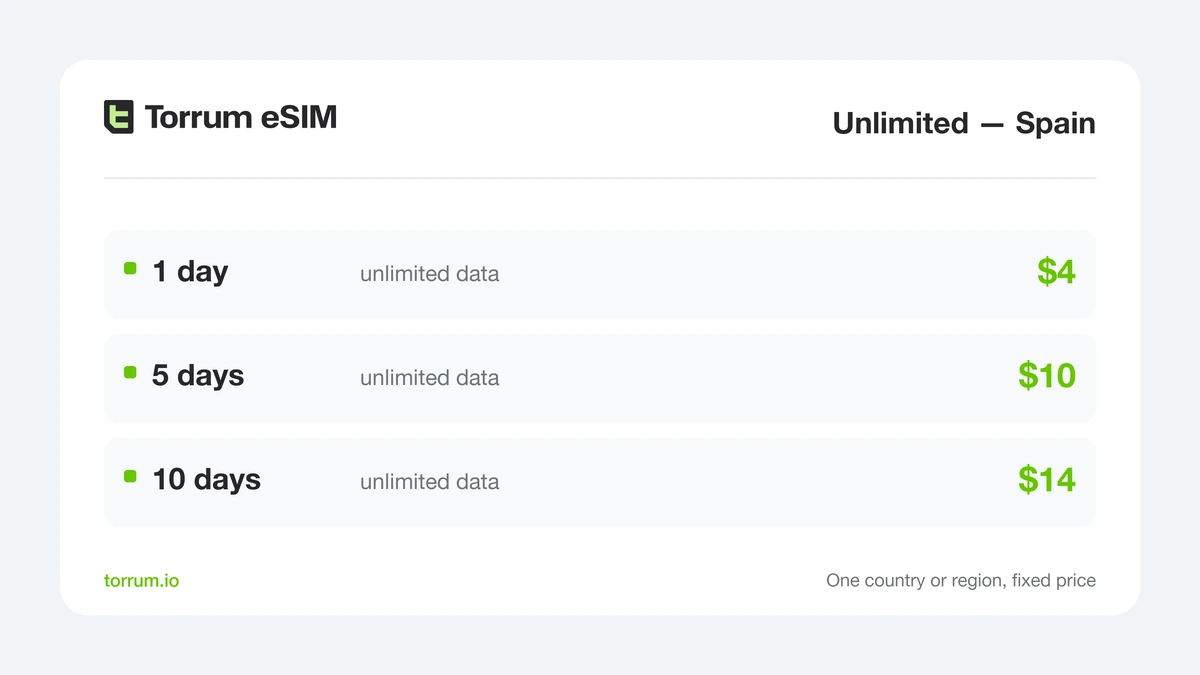
Unlimited prices the calendar instead of the traffic: a heavy Tuesday and a quiet Wednesday cost the same, which is what a week of video calls actually wants.
Six questions, and you stop at the first that answers
Work down the table and stop at the first row that answers yours. The order matters: the top rows decide for you, the lower ones are choices.
| Ask yourself | The answer that changes things | What it means |
|---|---|---|
| Where is my phone bill issued? | An EU line, on a trip inside the zone | Buy nothing. Roaming is already included |
| Does my phone have a SIM tray? | No, or it is carrier-locked | The local-SIM option does not exist for you |
| Do I need a local phone number? | Yes – a form or a delivery demands one | Only a local SIM provides that |
| How long am I staying? | A month or more in one place | A local SIM, and the errand pays for itself |
| One country, or several? | One | A country package, sized to your estimate |
| One country, or several? | Several, or undecided | A regional package, or a metered balance that ignores borders |
| How good is my data estimate? | Honestly, no idea | Buy days instead of gigabytes |
Two of these rows close the question on hardware or paperwork rather than money – the tray and the local number. No amount of spending changes either answer.
👉 Crossing borders rather than staying put? Our multi-country guide works a three-nation route through the same logic.
Head to head: roaming, a local SIM, a travel eSIM
| What you are comparing | Roaming on your own plan | A local SIM | A travel eSIM |
|---|---|---|---|
| Working the minute you land | Yes | No – a shop and a form first | Yes, or within minutes on terminal Wi-Fi |
| Who has to approve you | Nobody | The operator, against an ID document | Nobody |
| Phones with no SIM tray | Works | Not possible | Works |
| The number people call you on | Unchanged | Replaced by a local one | Unchanged, on the line you keep |
| Price known before departure | Rarely | No | Yes, settled at home |
| An EU line on a trip inside the EU | Already paid for | A second bill for nothing | A second bill for nothing |
| A month in a single country | Poor value long before it ends | Cheapest available | Competitive, rarely cheapest |
| A route across several countries | Priced country by country | A new SIM at each border | One regional purchase |
Count the outright wins and the table is less balanced than it looks. Roaming takes one row outright – the EU line that never leaves the zone, where there is nothing left to buy. The local SIM takes one, the month in a single country. Everything else is either an outright win for the last column or a tie with roaming, and those ties are precisely the rows where roaming, outside a free-roaming zone, charges by the day for the same result.
Landed already, with no plan and no signal?

None of this must happen before departure – it is only cheaper that way.
- Leave your own mobile data off. Switching it on “just to check something” is the expensive move: a per-day pass charges the whole day for a two-minute look.
- Use the terminal Wi-Fi instead. Most international airports offer some, and installing a profile needs very little of it.
- Set up and pay. Sign-in uses Google, Apple or Telegram – whichever account exists already – and the smallest permitted top-up appears at checkout. Choose by itinerary: a single country, a region, or a balance if the route is still open.
- Install, then flip one switch. The QR code from your order installs the profile without further input; if a screen looks unfamiliar, the walkthrough has a photograph of it. Afterwards, one switch: the travel profile needs Data Roaming turned on, and your own line needs nothing. The Telegram support bot takes over if one stalls.
At the departure gate all four take about as long as boarding does – and even in the arrivals hall they beat the queue.
FAQ
Is a travel eSIM just roaming under another name?
Technically it roams, on the same local networks. What differs is the contract: the price is agreed in advance rather than billed later.
Can I keep my own phone number while using a travel eSIM?
Yes. Your existing line stays installed and still receives messages and calls to the number people already have, while the travel line handles data.
My phone has no SIM tray. What are my options?
Roaming or an eSIM. Every iPhone 14 to 16 sold in the US is eSIM only, as is the iPhone 17 generation across a dozen countries and territories.
Is a local SIM always the cheapest?
On a long stay in one country, usually. On a one or two-week trip the airport margin, the queue and the document check cancel it out.
Do I need a passport to buy a prepaid SIM abroad?
In most of the world, yes – roughly 160 governments insist a prepaid line be tied to an identified buyer. The UK and US are exceptions, which is why their travellers get caught out abroad.
Will I still get my bank’s SMS verification codes?
Only on the line that owns the number. Keep your home line in the phone and they keep arriving; replace it with a local SIM and they stop.
Can two eSIMs run at once?
On supported models, yes – which is what lets the home line and the travel line coexist.
What happens to my plan when I cross a border?
A single-country package ends at that country’s frontier. A regional one covers the whole region, and a metered balance ignores frontiers altogether, charging the local rate wherever you are.
Does my EU plan need anything for a trip inside the EU?
No. Inside the zone an EU line is billed on home terms, subject to its fair-use allowance – and nothing sold here improves on free.
Does it work at home as well?
No. That is what the terms say, not what the hardware does: the plan is sold for travel, never as a tariff at your own address.
Final thoughts: pick the shape, not the brand
Strip out the marketing and the decision is small. Your bill’s country of origin sets the roaming price; your handset decides whether a local SIM is installable at all; the stay decides whether the errand is worth it. The rest is sizing.
What has changed is not the price of data but the shape of the phone. With the tray disappearing from whole markets, the old advice to “just grab a SIM when you land” now fails before it is tested. Two lines, one of them downloaded, survives that shift.
👉 Start where your trip does: a single country on the packages list, one destination worked through end to end, or a balance for a route you have not finished planning.


 Continue with Google
  Continue with Telegram

