
Mobile data in Croatia: what roaming costs, where the coast road leaves the EU, and which plan still works on day trips to Kotor and Mostar
Contents:
Croatia logged 110.1 million tourist overnights and more than 21.8 million arrivals in 2025, its first year past the 110-million mark, according to the national tourist board’s eVisitor data. Dubrovnik and Split were among the busiest destinations.
On the map it looks like a single-country holiday. On the phone it may not be: the coast road dips into Bosnia and Herzegovina at Neum, and common day trips from Dubrovnik end in Montenegro or in Mostar. Both countries sit outside the EU.
So this guide starts from the borders. Home roaming, a Croatian tourist eSIM and a travel eSIM each behave differently when the car crosses one.
👉 Know your dates already? Compare the Croatia packages before you read on.
Who pays for roaming in Croatia, and who does not
EU and EEA residents. Croatia is an EU member, so your home plan works there under the EU’s roam-like-at-home rules, with no daily surcharge. Readers from Germany, Austria or Italy need nothing new – until the route leaves the EU, which the next two sections cover.
From the UK. Since Brexit, most large British networks charge again in the EU, typically around £2 to £2.47 per day, and one big network still includes EU use (figures compiled by Uswitch in November 2025). Over a fortnight on the Dalmatian coast that is up to about £35 per phone. Our UK-to-EU roaming guide goes through fair-use caps and zones.
From the US. A leading US network sells its international pass at $12 per calendar day of use, and every additional phone on the account that connects adds $6 (pass terms as published on 29 September 2026). A 10-day trip for a couple adds up to $180.
Nine kilometres of Bosnia on the coast road
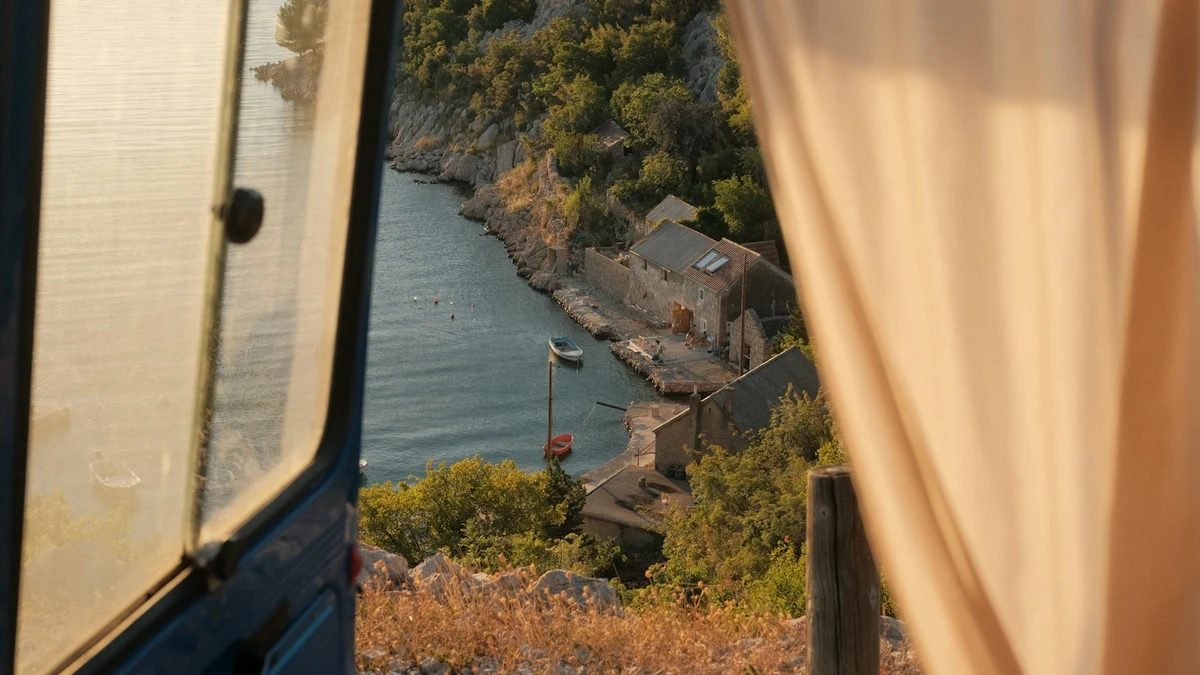
Between Split and Dubrovnik, the old coastal highway crosses Bosnia and Herzegovina’s short strip of coast at Neum. Wikivoyage puts the road section at 9 km between the Klek and Zaton Doli border posts.
Since 26 July 2022, the Pelješac Bridge lets drivers go around it without leaving Croatia. The older road through Neum is still open, and still crosses two borders.
Wikivoyage notes that the Dubrovnik region has boosters on either side of Neum to keep phones on Croatian networks – yet a phone can still latch onto a Bosnian one. And Bosnia is not covered by EU roaming rules, so the bill changes even for EU residents.
Easy precautions for the Neum stretch:
- check whether your route uses the bridge or the Neum road before you set off;
- on the Neum road, turn mobile data off until Zaton Doli, or lock the phone onto a Croatian operator in its network settings;
- a Torrum Croatia package does not cover Bosnian networks, so keep data off there unless you hold a Pay-per-MB balance for it.
Kotor and Mostar: day trips past the EU line
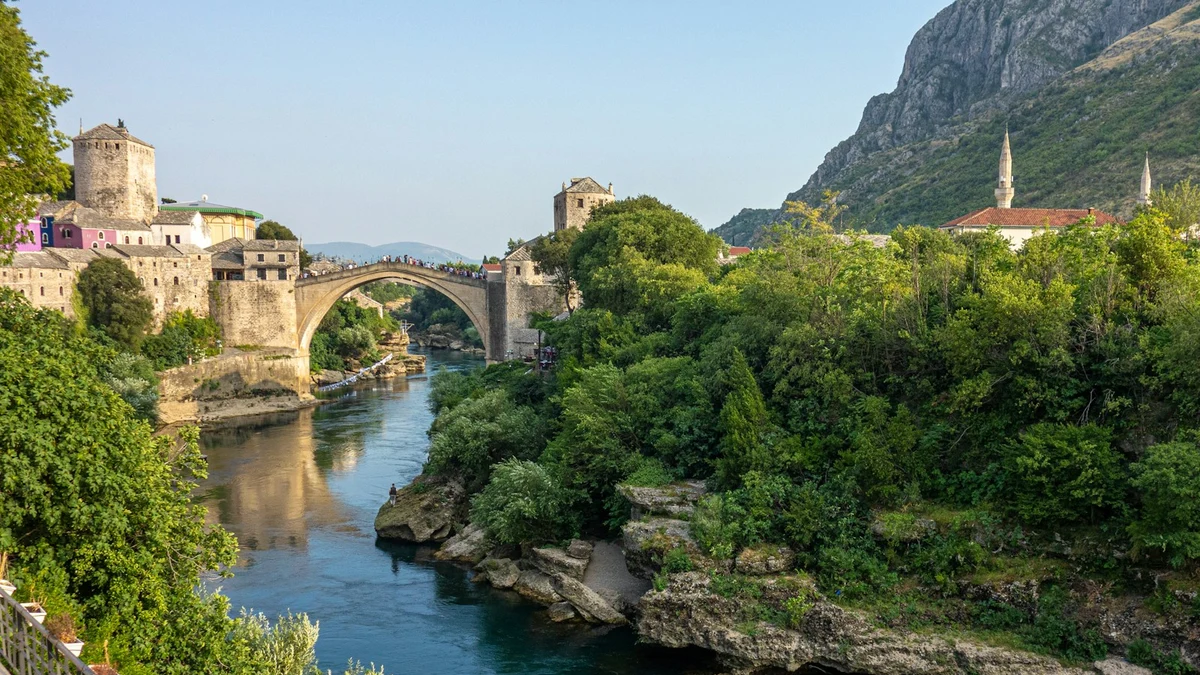
Montenegro’s Bay of Kotor and Mostar’s Old Bridge are two well-known excursions from Dubrovnik. Both mean a full passport check at an EU external border.
That check now includes biometrics for visitors from outside the EU. According to the European Commission, the Entry/Exit System has run at full scale across Schengen borders from 10 April 2026; non-EU travellers on short stays have their fingerprints and a facial image recorded instead of a passport stamp.
For your phone, both day trips are a trip abroad:
- EU residents: Montenegro and Bosnia fall outside roam-like-at-home. Look up your operator’s rates for them first;
- HT’s tourist eSIM: not usable abroad, by its own terms (see below);
- Torrum: both the Croatia package and the 32-country Europe bundle stop at the border too. For the day, add a Montenegro package or a Bosnia and Herzegovina package, or keep a small Pay-per-MB balance – its per-megabyte rates in both countries are several times the Croatian one.
The cheapest option is preparation: save the bus ticket, offline maps and the return pick-up point before you leave Croatia, and use café Wi-Fi on the other side.
Croatian tourist eSIMs you can order from home
Croatia has three mobile networks: Hrvatski Telekom (HT), A1 Hrvatska and Telemach. The first two sell tourist eSIMs online, with QR codes by email – so in Croatia, a local line no longer means a queue in a shop.
What their visitor pages listed on 29 September 2026 (dollar figures use the European Central Bank’s reference rate that day, $1.1355 to the euro):
- HT: unlimited data for 3 days for €11 (about $12.50), 10 days for €15 with a second eSIM included, or 120 GB for 90 days for €25; each comes with 100 local minutes;
- A1: 3 days unlimited for €10.90, 30 days for €29, and a 10-day unlimited deal for €14.90 that comes as two SIMs.
That is honest value, especially for couples. Two conditions matter, though:
- HT’s is for Croatia only. Its terms for the tourist tariff state that it is not available abroad in roaming, so Neum, Kotor or Mostar are not covered;
- HT’s renews itself. HT says a plan switches itself back on for another period whenever the account holds enough credit. Check the balance before you leave.
You also get a Croatian number, not your own. If you need your home number reachable for bank codes, a dual-SIM phone keeps both.
Torrum plans for Croatia
Croatia sits in Torrum’s lowest price tier. Country packages count their days from the first connection in Croatia, not from purchase, and expire on their last day even if data remains.
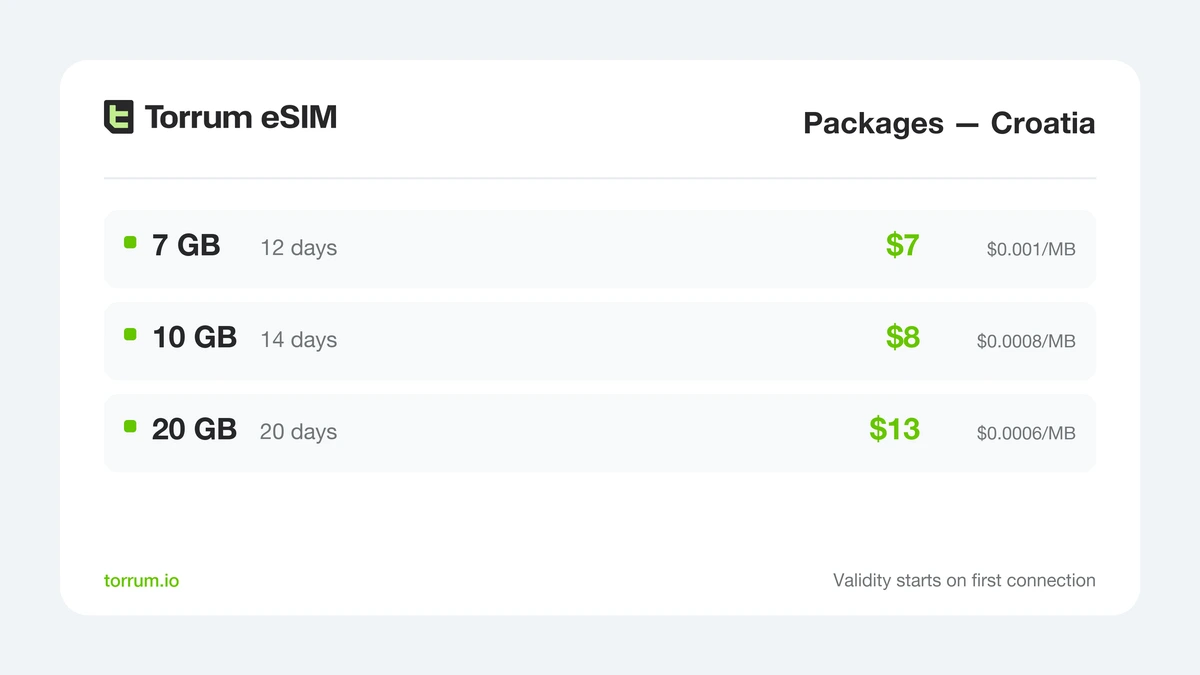
Croatia Packages: set gigabytes over set days, from twelve days to three weeks on the coast.
If the route also crosses Slovenia or continues into Italy, the Europe x32 package covers all three on one profile; our multi-country Europe guide shows which borders it handles.
For a heavy-data week – navigation all day, video calls, photos going up from every beach – Unlimited sells Croatia by the day.
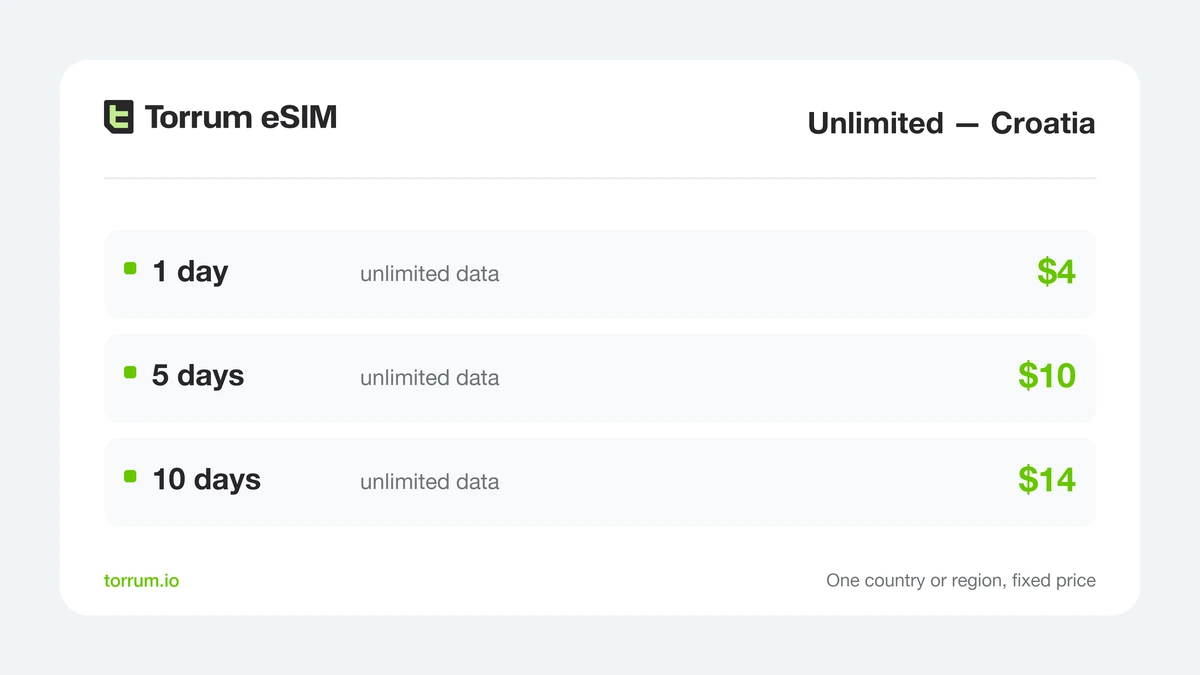
Croatia Unlimited: no data counting, priced by the number of days.
For light or irregular use, Pay-per-MB meters each megabyte instead, at $0.0011 per MB in Croatia, from a prepaid balance with top-ups starting at $10.
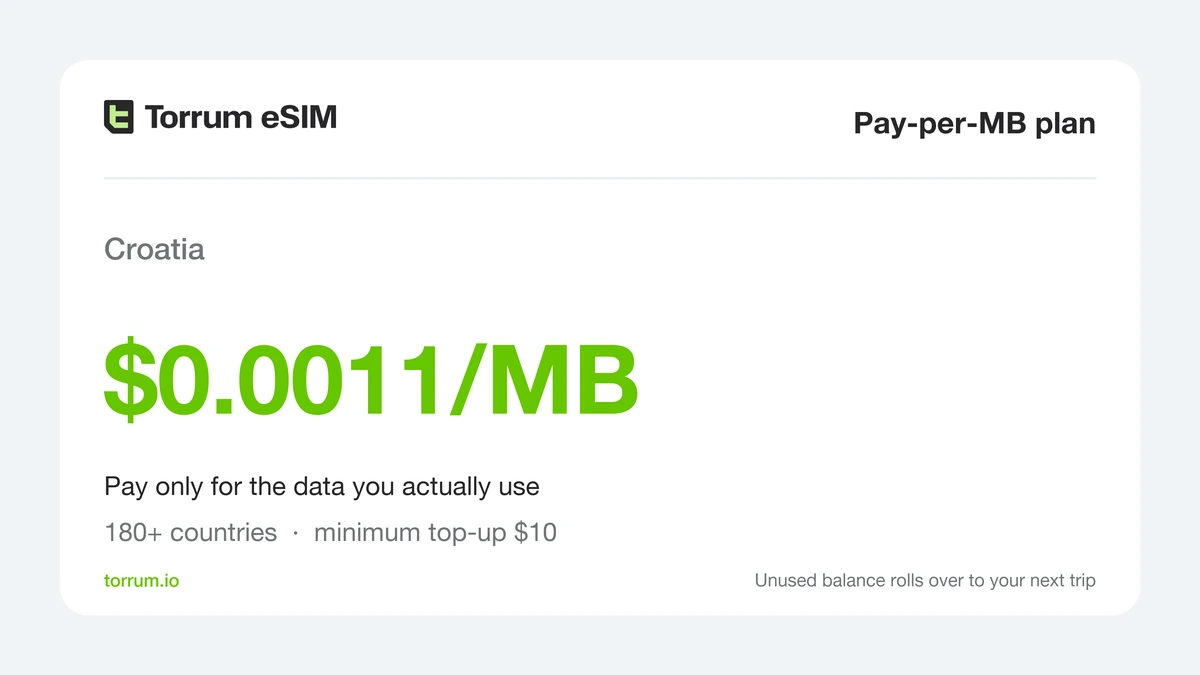
Pay-per-MB in Croatia: a metered balance for short stays and irregular use.
Not sure how many gigabytes a fortnight needs? The data-use guide helps you estimate it from your own phone.
Setup at home, data on the tarmac
- Look up your model and check it is not tied to one carrier on the compatibility page.
- Create your Torrum login; existing Google, Apple and Telegram logins are accepted.
- Buy the Croatia plan that fits – or Europe x32 for a longer route – with a bank card.
- Before leaving, on your home Wi-Fi, add the eSIM from the QR code attached to your Torrum order; the screen-by-screen guide covers both iPhone and Android.
- Let the new line carry data; calls and texts stay on your regular card.
- When you land in Split, Zadar or Dubrovnik, switch on roaming for the eSIM line.
No connection on arrival? The Torrum Telegram bot answers over any Wi-Fi, including the hotel’s.
Yachts, islands and open-water crossings

Plenty of Croatian holidays happen on the water. The tourist board’s count even includes nautical charter guests, recorded through a separate eCrew system.
On longer crossings over open water, the picture changes: far from land a phone may join the ship’s own satellite service, which the EU’s roaming price limits do not reach (Your Europe, the EU citizens’ information site). Ship networks are absent from every Torrum plan.
On a sailing week, that means:
- download charts, weather and marina details in port, not mid-channel;
- before a long ferry crossing, disable roaming for the home SIM;
- if the skipper relies on a phone for navigation, keep charts downloaded and a backup on board.
Croatia connectivity compared: roaming, tourist eSIM, Torrum
| Question | Home roaming | HT tourist eSIM | Torrum Croatia |
|---|---|---|---|
| EU resident cost | Included | Not needed | Not needed |
| UK or US visitor cost | Daily fee | Low, per period | Low, per package |
| Neum road (Bosnia) | Bosnian roaming rates | Not available abroad | Not covered |
| Kotor or Mostar day | Depends on your plan | Not available abroad | Add a local package |
| Slovenia or Italy onward | Depends on your plan | Not available abroad | Europe x32 covers it |
| Renews automatically | No | Yes, if balance allows | No |
| Calls to your usual number | Yes | Yes, with the home card as second line | Yes, with the home card as second line |
Five Croatian itineraries and the plan for each
A week in Split and the islands. One Croatia package from Torrum or a local tourist eSIM; both are cheap here. EU residents can simply roam.
Split to Dubrovnik by car. Take the Pelješac Bridge, or go offline between Klek and Zaton Doli.
Dubrovnik with a day in Kotor. A Croatia package, plus Montenegro data for the Kotor hours – a small package or metered credit.
Zagreb, Ljubljana and Venice. Europe x32 covers the whole line; HT’s tourist eSIM would stop at the first border.
A long summer on the coast. For weeks in one place, a Croatian tourist line with its long validity is hard to beat, especially if the route never leaves the country.
FAQ
Is roaming free in Croatia for EU residents?
Yes. Croatia is in the EU, so roam-like-at-home rules apply to EU and EEA plans there.
Will my phone roam in Bosnia on the drive to Dubrovnik?
It can, on the 9 km through Neum. Use the Pelješac Bridge, or turn data off on that stretch.
Does a Torrum Croatia package work in Montenegro?
No. Buy a separate Montenegro package or use Pay-per-MB for the day in Kotor.
Do Croatian tourist SIMs work in Bosnia or Montenegro?
HT’s tourist tariff terms say it is not available abroad in roaming. Plan for a separate option on day trips.
Can I buy a Croatian tourist eSIM before I fly?
Yes. HT and A1 both sell theirs online and send the QR code by email; HT’s works only inside Croatia.
Who runs the mobile networks in Croatia?
Hrvatski Telekom, A1 Hrvatska and Telemach. A Torrum eSIM connects through local networks as a roaming partner.
Is Slovenia included in the Croatia package?
No. A trip that adds Slovenia or Italy fits the Europe x32 bundle better.
Does the Croatia package start on the day I buy it?
No, its days begin with the first connection in Croatia. Any data left on the last day expires with it.
Is there signal on Croatian ferries?
Near the coast, phones use land networks. On long crossings a ship’s satellite service may take over, and Torrum does not sell access to those.
What is the new EU system at the Montenegro border?
From April 2026, Schengen’s Entry/Exit System records fingerprints and a photo for non-EU visitors instead of a passport stamp.
Is Torrum an option for Croatian residents?
Only for their trips abroad. Under its terms, a customer’s home country is excluded.
Can I keep my home number while using a Croatian eSIM?
Yes, if your phone takes two lines. Keep the home card active for voice and texts, and disable its roaming data.
Final thoughts: plan for the borders, not the beaches
Inside Croatia, getting online is cheap for almost everyone: EU residents roam free, and tourist eSIMs and travel eSIMs cost little. What catches travellers out is the edge of the map – nine kilometres of Bosnian coast, a day in Kotor, a ferry out of range.
If your holiday stays in Croatia, pick whichever option you find easiest. If it touches Neum, Montenegro, Mostar or another EU country, choose a plan that says what happens at each border.
👉 Ready for the coast? Pick a Croatia package, and add a Montenegro plan for the day in Kotor.


 Continue with Google
  Continue with Telegram

