
Bali's tourist levy arrives as a QR code in your inbox, Indonesian SIM cards now want a passport at the counter, and the signal still stops on the water between the islands
Contents:
Bali’s tourist levy cannot be paid in cash. It is Rp 150,000 a person, settled by card or QR, and what comes back is a barcode that lives in your email – which is a fair summary of the trip as a whole. Here the phone is the paperwork.
That sets the tone. Rides, menus, dive bookings, the ferry to the next island and the voucher itself all live on the handset – and Bali is a long way from home for most of the people holding one. Australians alone accounted for 1.63 million of the 6.95 million direct foreign arrivals recorded in 2025; Britain came fifth, at 317,520 (BPS-Statistics Indonesia Bali Province, February 2026).
👉 If you only want the prices: Indonesia, all three plans.
The levy you cannot pay in cash

The levy is separate from your visa. It is charged once per trip rather than once per entry, and the province wants it settled before you leave Indonesian territory.
Pay online before you fly, at a counter at the airport or seaport, or through a hotel, agent or attraction registered in the provincial system. Cards, bank transfer, UnionPay and QRIS all work. Cash does not, anywhere.
The receipt is a QR voucher emailed to you – worth pulling onto the phone before you fly rather than leaving it in an inbox. Exemptions cover diplomatic and official visas, crew, students, family-reunion and golden visas, and holders of an Indonesian stay permit.
Worth knowing before you go looking for it: the scheme runs from the provincial .go.id site, and the only other legitimate places to pay are those counters and the hotels, agents and attractions registered with it.
Roaming into Indonesia: what the card-paying markets pay
Nothing here is free by regulation. Indonesia sits outside every roam-like-at-home zone, so what Bali costs your line is purely a matter of what your contract says.
From Australia, the biggest source market by a distance, day passes run roughly A$5–10 for each day you connect, with two to two-and-a-half gigabytes included (Australian carrier price surveys, March–September 2026). That works out at roughly $3.60–7.10 on the euro reference rate published for 15 September 2026. For a fortnight, on two phones, it is a line item.
From North America the add-on model is the same shape but dearer: most day passes land between $10 and $12, and each handset that wakes up counts separately (carrier price lists surveyed in September 2026).
A British line lands in the same rest-of-world bracket once Europe is behind it. Roaming is the one option that asks no decision of you, and that is precisely what it charges for.
👉 The three options weighed up with no destination attached: eSIM, local card or roaming.
What an Indonesian SIM costs, and what the counter adds
Indonesian data is genuinely cheap, and that has to be said out loud by anyone selling an alternative. Dated price surveys from September 2026 put a tourist starter pack at around Rp 150,000 for roughly 25 GB over thirty days – about $8.50.
The catch is the counter, not the network. Those same surveys spread starter packs across Rp 100,000 to Rp 250,000 – roughly $5.65 to $14 – depending on where they are sold. The shop sets that number, and arrivals is where a tired traveller meets a shop.
What else it costs you. Registration is the gate now: Indonesia’s 2026 rules want a passport at the counter and keep the card inactive until it clears. The tray holds one card in most phones, so whichever number your bank uses stops ringing for the duration. And there is a dead stretch between stepping off the aircraft and finding a counter that is open.
When it still wins: weeks spent in one spot – a case the article comes back to below.
Three operators, one island, and a statistic that gets misread
Indonesia has consolidated down to three national operators, the most recent merger having closed in 2025, and a travel profile is cleared onto several of their networks rather than committing to one. On an archipelago this size that matters more than it ever would in Europe.
Be careful with the headline numbers, though. The most quoted figure, 5G Availability, was 52.8% for the network that leads on that metric and 44.6% for the next, in July 2026 (Opensignal). That is the share of time 5G handset owners spend connected to 5G – not the share of the country covered, and not the share of people who can get it. Read as coverage it is wildly optimistic.
The honest summary: 4G is what carries the trip, and the Coverage Experience award went to reach rather than to the fastest 5G. On this trip reach is the prize.
The boat is where the signal goes

Most Bali trips are not confined to Bali. Nusa Penida, the Gilis, Lombok and, for the ambitious, Komodo all involve a crossing – and the crossings are where the phone stops being useful.
Open water is open water. A strait is not somewhere anyone builds for, and no plan buys a mast that is not there – which is also the stretch where having more than one network to fall back on is worth most, because it is the stretch furthest from help.
Buy the ticket, save the pier location and pull the map down while there is still a mast in sight. Then take the hour off.
How the eSIM behaves once you land
Nothing goes into the tray. A travel eSIM arrives as a download, sits beside the card already in your phone, and wakes up the first time an Indonesian mast answers – which is also the moment the validity starts counting, not the moment you paid.
From then on the handset is carrying two numbers at once. Yours keeps ringing and keeps receiving the codes your bank sends; the Indonesian one carries data only, billed at whatever plan you chose.
Where it falls short is worth knowing first. Older handsets, and phones sold into the mainland-Chinese market, often cannot take a downloaded profile at all – the device list settles that in a second. There is no +62 number attached, so anything that will only text an Indonesian mobile stays out of reach.
👉 Still guessing how many gigabytes you need? Last month’s own usage answers it.
What Indonesian data costs on each plan
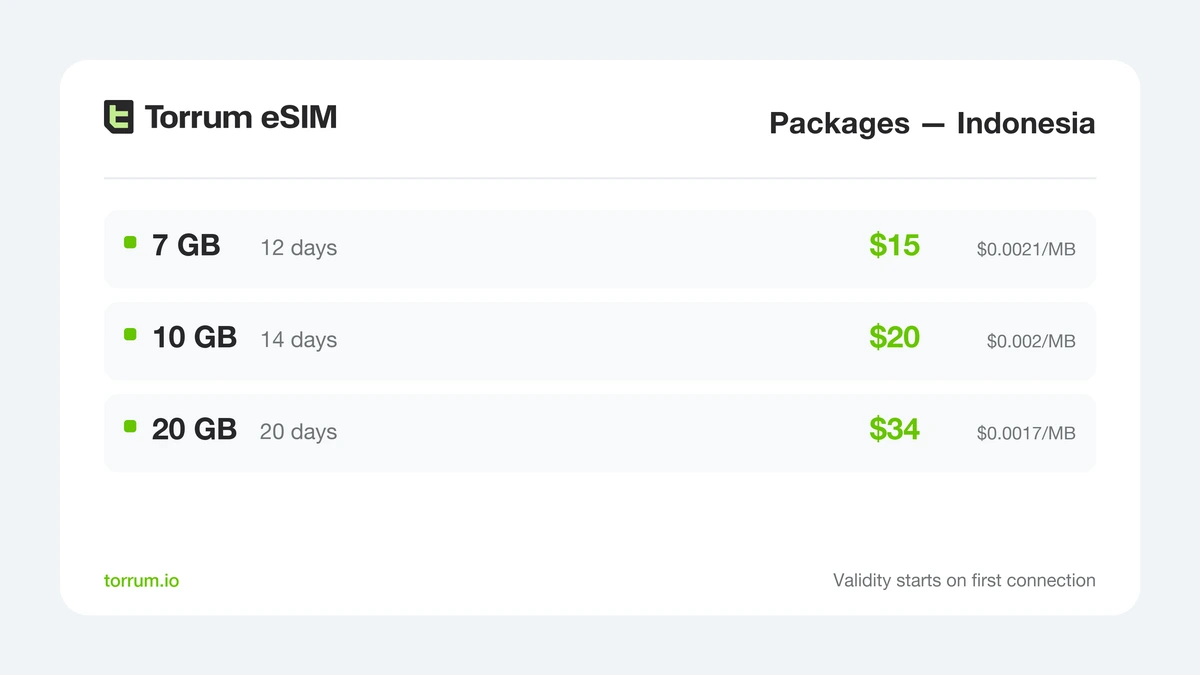
Three blocks, and the dates do the choosing: take the validity the trip actually needs, then the smallest allowance you can honestly defend.
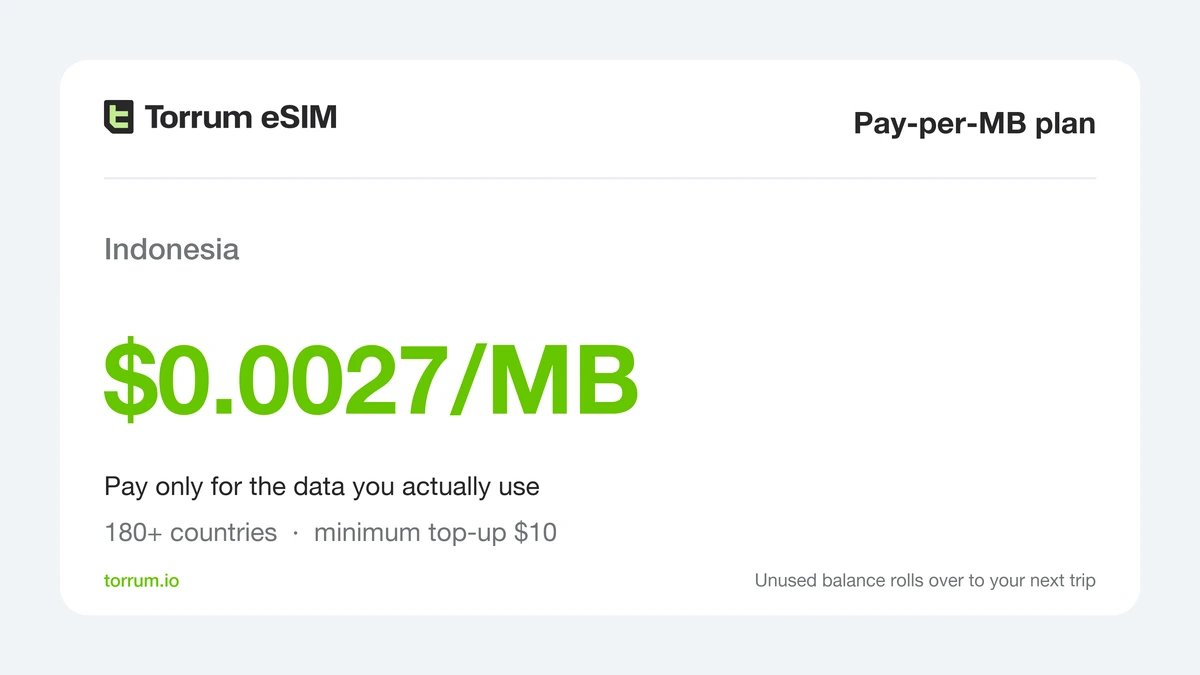
Nothing is committed in advance: on Pay-per-MB the account reads $0.0027 for every megabyte Indonesia actually moves, and days in a dry bag read nothing at all.
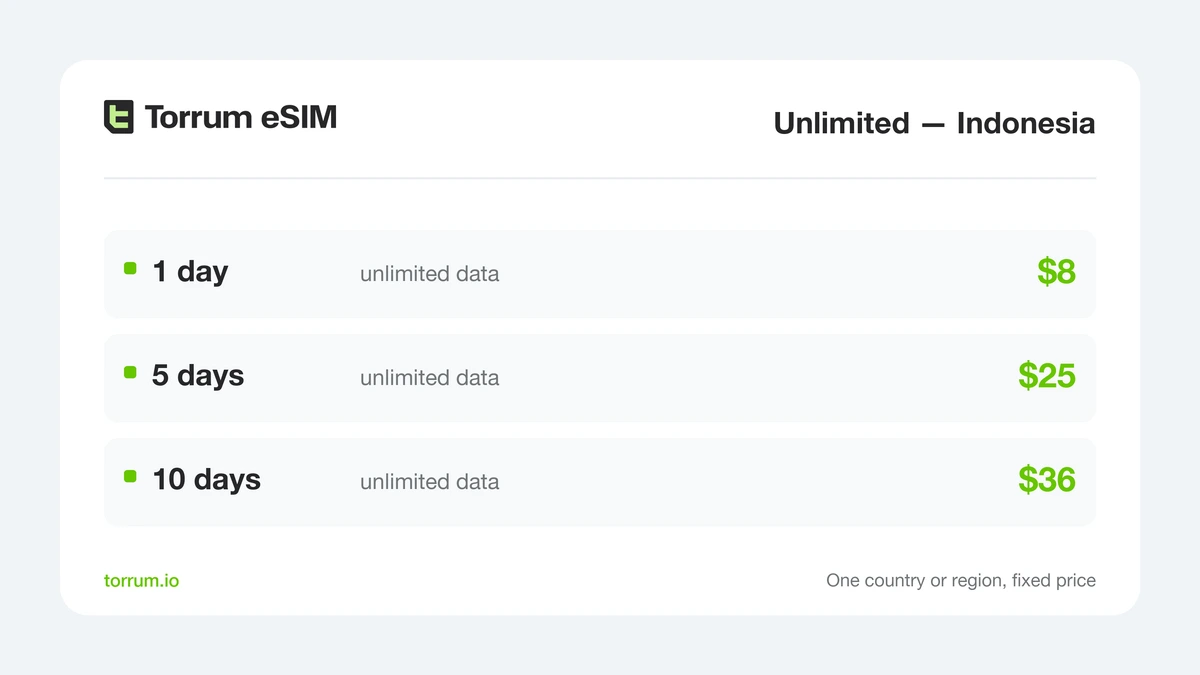
Unlimited is bought in days rather than gigabytes – the shape that fits a stretch where the phone is the office and nobody wants to watch a counter.
Indonesia also sits inside the regional Asia package, next to Singapore, Malaysia, Thailand, Vietnam, Japan and the rest of the list on that page. That plan is built for a route: its ceiling is lower, and measured per megabyte of package allowance it runs about three times the Indonesian one. For Bali on its own, the country package wins by a wide margin.
👉 If Bangkok really is on the ticket: what Thailand costs, and the form you fill in first.
Past ninety days, the answer changes

Bali collects long stays, and that changes the maths twice over.
The first is plain arithmetic. Stay put for a month and an Indonesian pack wins outright on price, and pretending otherwise would help nobody.
The second is a rule people meet late. A foreign handset running on Indonesian networks beyond roughly ninety days is expected to have its IMEI registered – free below a modest customs value – and an unregistered device can lose local service after that. Paperwork rather than a trap, but paperwork that lands three months into a stay.
Worth stating plainly: a travel plan is for travelling, and it was never meant to stand in for a home tariff where you actually live. Once Bali stops being a trip and starts being an address, the local card and its paperwork are the right answer.
Wi-Fi in Bali: the café is the infrastructure
Bali runs on other people’s Wi-Fi. Cafés, warungs, co-working spaces, villas and dive shops tend to have something, because a good part of the island’s economy assumes its visitors are working.
Its weakness is that it does not move. The scooter ride, the ferry, the temple down an unmarked track and the hour spent lost are exactly the moments Wi-Fi cannot help – and exactly when a map matters most.
Airport Wi-Fi is fine for arranging a transfer, and useless as a plan for a fortnight.
Five minutes, before you leave home
Do it at the kitchen table, on home Wi-Fi, in this order.
- Confirm the phone can take a profile – one look at the device list and you know.
- Sign in through Apple, Google or Telegram – no new account to invent.
- Pick the plan the itinerary points at – Indonesia on its own, the Asia region if Singapore or Bangkok is on the ticket, or the meter if the island-hopping is still hypothetical.
- Card, QR, done – payment returns a code, the code installs the profile.
- One switch at the end – the downloaded profile wants Data Roaming enabled; your own line wants nothing touched.
Every one of those screens is photographed in the walkthrough. Anything that still argues back goes to the support bot.
The three options against a Bali itinerary
| The Bali situation | Your own line, roaming | A card bought in Indonesia | A Torrum eSIM |
|---|---|---|---|
| Opening the emailed voucher on arrival | Works, at your tariff’s rate | Nothing yet, the card is behind the counter | Works from the first mast |
| Walking out of arrivals already online | Yes | Only after the counter | Yes |
| Buying at the airport rather than in town | Not applicable | Whatever that counter charges | The same price either way |
| Passport handed over to register | No | Yes, and the card stays dead until it clears | No |
| Crossing to Nusa Penida or the Gilis | Dead on the water either way | Dead on the water either way | Dead on the water, free on the meter |
| Reaching more than one Indonesian network | Depends on the agreement | No, you picked one | Yes |
| Codes from your bank | Still arrive | Silent, unless the phone takes two cards | Still arrive |
| Ninety days and still here | Ruinous | What you should be on, IMEI registered | Outside its purpose |
| Reading the total in advance | Guesswork | Until the pack empties | Fixed by the package, or metered to the megabyte |
What each kind of Bali trip needs
Take the first line that fits; they run hardest constraint first.
Three months or longer. An Indonesian card bought in town, plus the IMEI registration that comes with staying.
Singapore or Bangkok on the same ticket. The regional Asia plan – the one case where it beats buying twice.
Days with the phone in a dry bag. Pay-per-MB, because a dive day should bill as the nothing it used.
Five days, or ten, with the phone as the office. Unlimited – those are the blocks it sells – and tether without counting.
Bali plus Lombok and the Gilis. A mid-size country package. The crossings cost you nothing and the islands cost you a little more attention.
Ten days of cafés, temples and traffic. The smallest Indonesian package; that is fewer gigabytes than it feels like.
FAQ
Do I have to pay the Bali tourist levy?
Every foreign tourist does, at Rp 150,000 per person, once per trip. Holders of diplomatic, official, student, family-reunion and golden visas are exempt, as are crew and holders of an Indonesian stay permit.
Can I pay the levy in cash on arrival?
No. The province requires cashless payment – card, bank transfer, UnionPay or QRIS – online before you travel, at an airport or seaport counter, or through a registered hotel or agent.
What if I lose the levy voucher?
It is emailed to you as a QR code, and the provincial site has a resend function for exactly this – so book with an address you can still open from the road.
Does a UK or Australian plan include Indonesia for free?
No. Indonesia is outside every roam-like-at-home zone, so Bali costs whatever your own contract says – commonly a day pass for each day you connect.
Is there signal on the crossing to Nusa Penida or the Gilis?
Not reliably. Open water drops out whatever you are paying, so get the map and the ticket onto the phone before you step on the boat.
Is 5G worth planning around in Bali?
No. The widely quoted 5G figures describe the share of time 5G owners spend on 5G, not how much of the country is covered. 4G is what carries the trip.
Do I need to register my phone’s IMEI?
Not for a normal holiday. The requirement applies to a foreign handset used on Indonesian networks beyond roughly ninety days; registration is free below a modest customs value and done through customs.
Is identification required for a local prepaid card?
Yes – Indonesian prepaid cards are tied to an identity document when they are sold, which a downloaded profile never asks for.
Will a 3G-only handset get data here?
Assume not. The largest network finished moving its 3G traffic onto 4G in mid-2023, so a device without 4G is left relying on whatever happens to remain elsewhere.
Does an unfinished package roll over to the next trip?
No – a package expires on its own date, used or not. A metered balance is the opposite: whatever you have not spent simply waits until the next trip calls on it.
Is Bali inside the Asia regional plan?
It is, alongside the other Asian destinations printed under that plan on the packages page. But per megabyte of allowance it runs about three times the Indonesian package, so it only pays when the trip genuinely crosses borders.
Final thoughts: the honest order of operations
Bali is cheap once you are standing in it and expensive on the way in. Connectivity follows the same curve: the local card is unbeatable over months and worth very little on the morning you land.
So, in order: settle the levy online before you fly, because it is cashless and the QR code is what gets asked for. Look up what your own tariff actually charges instead of assuming. For a holiday, load the profile while you are still at home and leave arrivals already connected. And if Bali is turning into an address, buy locally and do the paperwork – that is the honest answer, and it is not the one we sell.
👉 One evening of admin, and the island stops being an obstacle: the Indonesia packages.


 Continue with Google
  Continue with Telegram

