
Store-only SIM rules, forint data prices and two non-EU borders: how to stay online in Hungary in 2026
Contents:
Budapest Airport handled a record 19.6 million passengers in 2025. Many visitors do not expect that a Hungarian prepaid SIM needs ID: at Telekom and Yettel, a foreigner goes to the operator’s store, shows a passport and signs in person.
You can roam on your home plan, queue at a store for a local SIM, or install a travel eSIM before you leave. This guide compares the three with 2026 prices and covers what is specific to Hungary: Budapest’s tap-to-pay metro, the motorway e-vignette, Lake Balaton and two neighbours outside the EU.
👉 Already booked? See the plans for Hungary.
The rule that surprises visitors: Hungarian SIMs need ID
A 2016 change to Hungary’s telecoms law requires an identity check before a prepaid SIM can be used. Unverified cards were cut off on 1 July 2017, and each person can hold only a limited number of prepaid lines.
The operators apply it to visitors in plain words. Magyar Telekom says foreigners must buy a prepaid plan in a Telekom store, sign the contract in person and show a passport, ID card or driving licence. Yettel says foreigners can activate a SIM “only in Yettel stores”.
In practice that means a store visit during opening hours, which is hard after a late flight.
None of this applies to roaming or a travel eSIM: they use Hungarian networks as a visitor, with no Hungarian contract.
What a Hungarian prepaid SIM costs in forints
Hungary is in the EU but uses the forint (HUF), not the euro. We converted at the Hungarian National Bank rate for 26 October 2026: $1 = 327.49 HUF.
There are three networks. Magyar Telekom and Yettel (formerly Telenor) are the long-standing ones. The third has traded as One since January 2025; it used to be Vodafone. Prices below come from each operator’s own prepaid page, checked on 27 October 2026.
- Telekom Domino: unlimited data for 7 days costs 3,590 HUF (about $11), and 3 days cost 2,090 HUF (about $6.40). These day passes are bought for a Domino prepaid SIM.
- Yettel prepaid: a 30-day unlimited data pack is 9,000 HUF in the Yettel app (about $27.50); 5 GB for 30 days is 3,000 HUF (about $9).
- One Tuti: the SIM costs 500 HUF online or 1,500 HUF in a One store; a 20 GB pack for 30 days is 4,990 HUF (about $15).
For a month of heavy use, a Hungarian SIM is the cheapest option. For a city break, the store visit costs time and saves little.
Pros:
- the lowest price for a stay of three weeks or more;
- a Hungarian number for local services and texts;
Cons:
- store only, with a passport and a signature;
- a separate base plan and data pack to understand, mostly on Hungarian-language pages.
Roaming in Hungary: it depends where your SIM is from
The country you fly from matters less than where your SIM is registered.
EU and EEA SIMs. Hungary is in the EU, so “roam like at home” applies. You use your normal allowance with no daily fee, within fair-use limits. Most EU visitors do not need anything extra, unless they go to Serbia or Ukraine (see below).
UK SIMs. Since Brexit, most British networks charge for EU roaming again. Which? found Europe add-ons of about £2 to £2.60 a day in April 2026, while a few plans still include Europe. Our guide to UK roaming in Europe lists the details.
US SIMs. The big US carriers charge about $10–12 a day for an international day pass (carrier pages, checked October 2026). A five-day Budapest trip costs $50–60 for one phone.
Canadian SIMs. Expect CA$16–18 per day of use with the big Canadian carriers, as MobileSyrup reported on 3 March 2026.
Roaming keeps your number active, which is useful for bank codes. You can still get those texts with a data eSIM: our guide to keeping your number abroad explains how.
Install before you fly: four steps
- Check the device list and make sure your phone is not locked to a carrier;
- Sign in with Google, Apple or Telegram, choose a Hungary package, Unlimited days or Pay-per-MB credit, and pay by card;
- Scan the QR code on home Wi-Fi and turn on data roaming for the Torrum line; the installation guide has screens for iPhone and Android;
- After landing, choose Torrum as your mobile data line. Keep your own SIM switched on for calls and texts.
Stuck at any step? Torrum support on Telegram answers in English.
Torrum plans for Hungary
The Torrum profile for Hungary connects through all three national networks: Telekom, Yettel and One. Where Telekom fades, Yettel or One may still be strong, and the eSIM can switch between them.
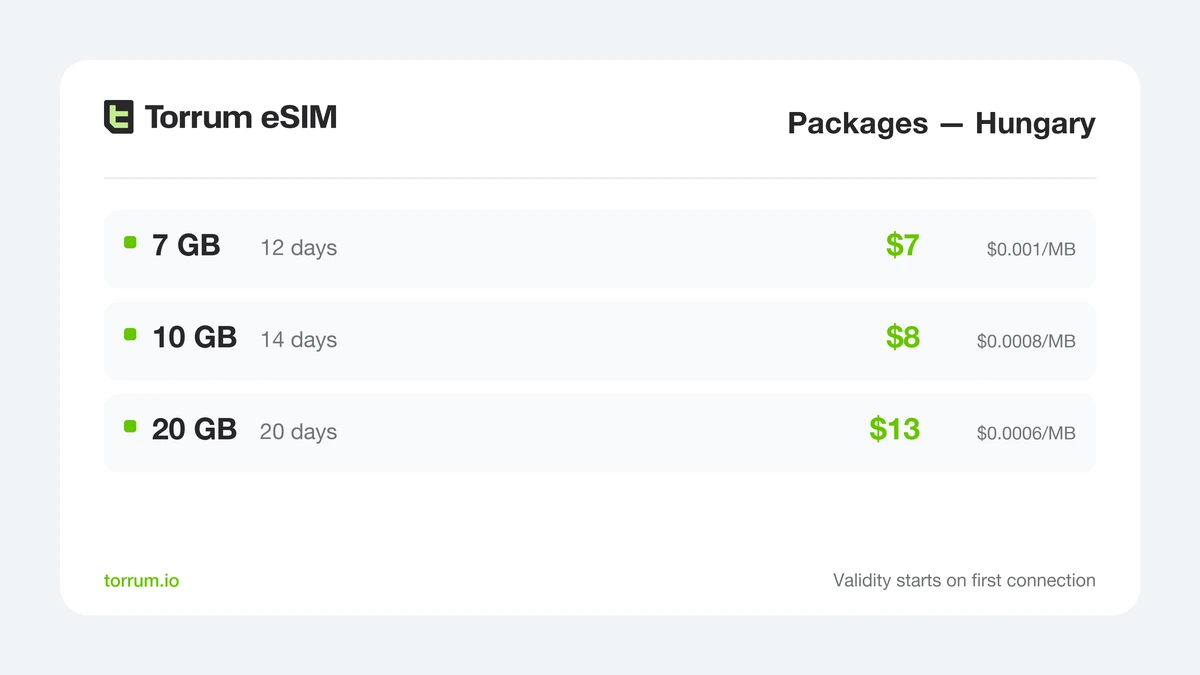
From a Budapest long weekend to three weeks between the capital and the lake.
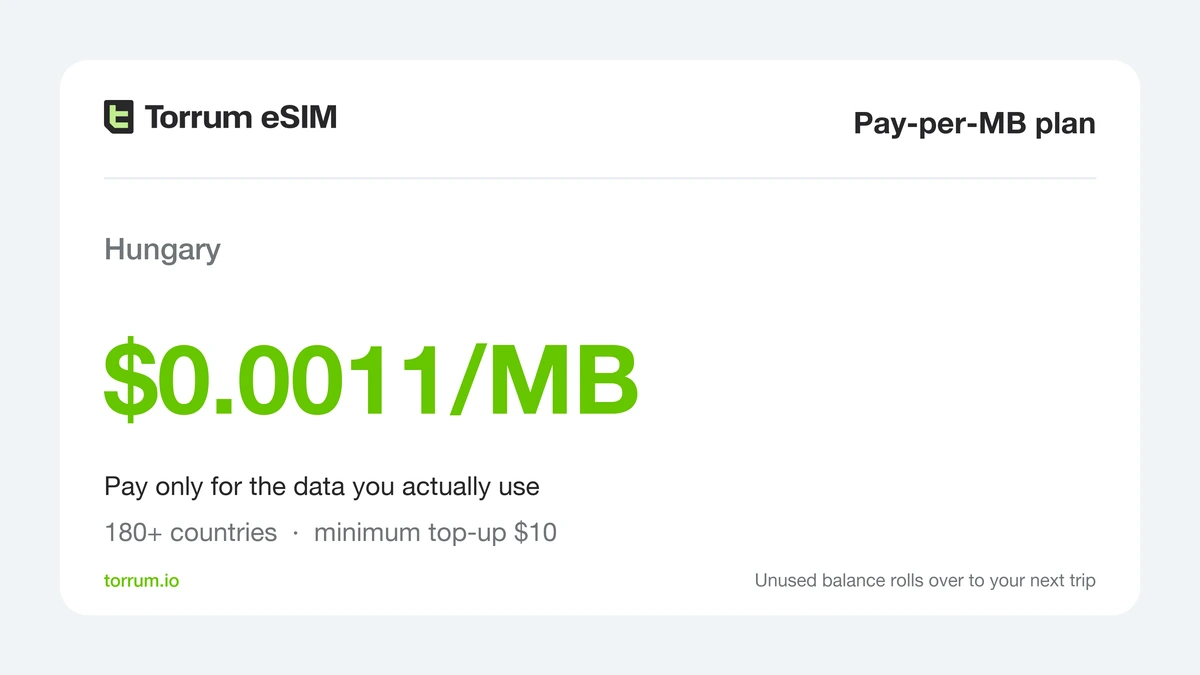
Pay only for what you use, in Hungary and across the border in Slovakia or Austria.
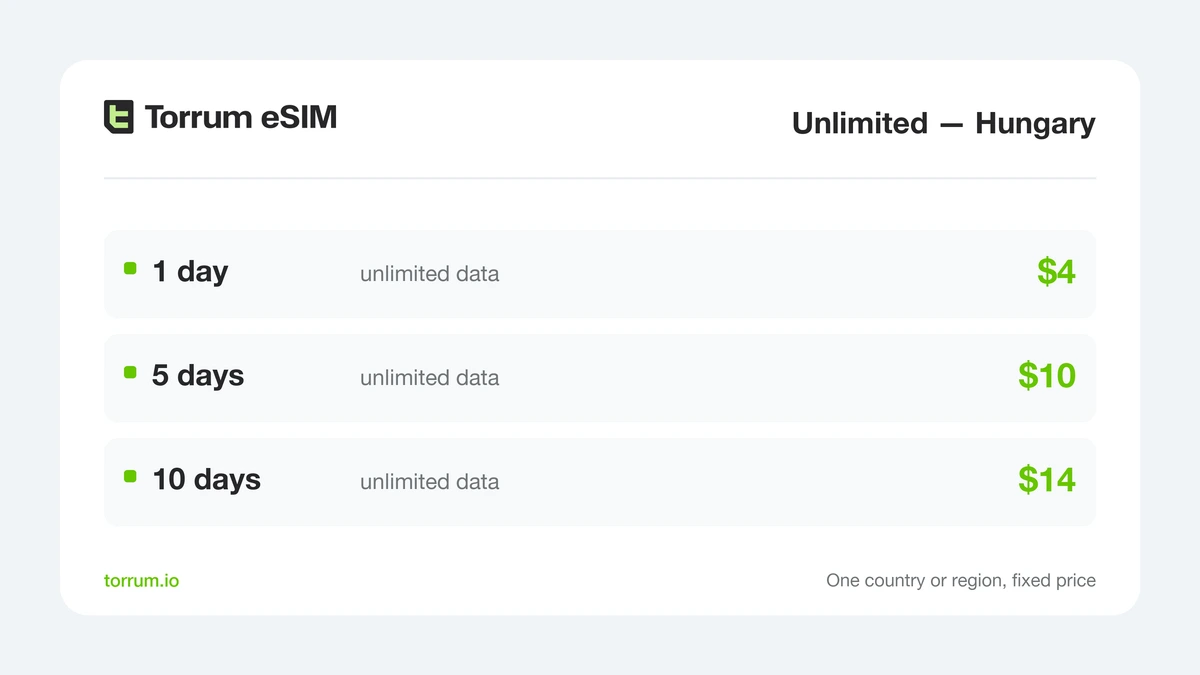
For conference days, hotspot work or live video from the Danube.
Sizing it. A Budapest weekend of navigation, BKK tickets and social posts fits in a few gigabytes; a laptop on a hotspot can burn through that in an afternoon. Our data calculator guide breaks it down by app.
A package starts counting with its first connection in Hungary, so you can buy it weeks ahead. It ends on its last day even if data is left. Pay-per-MB costs $0.0011 per MB in Hungary, paid from credit topped up from $10; unused credit can later go towards a package. Unlimited gives a set number of days at a fixed price.
For up to 20 days, our 20 GB package costs less than One’s 20 GB pack plus its SIM. For a month of unlimited data, Yettel is cheaper.
Two limits: you get data, not a Hungarian phone number, and your phone must support eSIM.
Budapest on your phone: Pay&GO, the 100E bus and the baths

Budapest’s transport authority, BKK, sells a single ticket for 500 HUF (about $1.50). A 24-hour pass costs 2,750 HUF (about $8.40) and a 72-hour pass 5,750 HUF (about $17.60).
Tap to pay. Since 22 April 2026, the Pay&GO system lets you tap a bank card, phone or watch at the entrances of all four metro lines and on the 100E airport bus. It sells single tickets only, and BKK plans the full network rollout from 2028.
The airport bus. The 100E runs from the airport to the city centre for 2,500 HUF (about $7.60), and you can pay for it with a tap of your card at the door.
Passes and trams. For a 24-hour or 72-hour pass, use the BudapestGO app or a ticket machine. Buying in the app at a tram stop is where a working data connection pays off.
The thermal baths. Széchenyi is open; Gellért closed on 1 October 2025 for renovation and is expected to reopen in 2028. If you book a bath ticket online, save the QR code to your photos before you go: your phone will spend most of the visit in a locker.
Driving in Hungary: the e-vignette and parking by phone
Hungarian motorways need an e-vignette, the e-matrica. There is no sticker: the toll is linked to your number plate, and cameras check it. For a car, a 10-day e-vignette costs 6,900 HUF in 2026 (about $21).
The official seller is the national toll company’s website, ematrica.nemzetiutdij.hu, and vignettes are also sold through apps and at fuel stations. Buy before you join the motorway, and check that the plate number is exactly right.
Parking in Budapest and many towns is paid by text message or through an app run by the national mobile payment company. We could not confirm that the SMS method works from a foreign SIM, and a data eSIM has no number to text from. Plan to use a parking app with a card, or the street machines where they remain.
Lake Balaton in high summer

Lake Balaton is Hungary’s summer coast, and coverage around it is good. Yettel, for example, puts its outdoor 4G population coverage above 99% and has 5G in many lakeside resorts. In high summer the lake fills up, and Yettel itself has noted heavy network load during big events such as the Balaton Cross swim.
On a peak Saturday in Siófok or Balatonfüred, expect slower speeds rather than no signal; upload videos in the evening.
The Danube Bend: one bridge from Slovakia

North of Budapest, the Danube Bend links Szentendre, Visegrád and Esztergom. At Esztergom the river is the border: the Mária Valéria Bridge takes you on foot to Štúrovo in Slovakia in a few minutes.
A Hungary package works only in Hungary. Once your phone joins a Slovak network, it stops until you return. Slovakia and Austria have the same Pay-per-MB rate as Hungary, so a little Pay-per-MB credit covers the walk across the bridge or a day in Vienna. For a longer loop through Vienna, Bratislava and Prague, the Europe regional package covers all of them. Our Czech Republic guide covers the Prague end of that route.
Serbia and Ukraine: the two borders where roaming gets expensive
Hungary borders seven countries. Five are in the EU; Serbia and Ukraine are not. That changes the cost for everyone, including EU visitors.
EU roaming stops at the Serbian border. In June 2026 the EU authorised talks to extend “roam like at home” to six Western Balkan countries, Serbia included. No start date has been agreed, so for now an EU SIM in Serbia pays its operator’s non-EU rate.
Your phone can cross before you do. Hungary’s telecom regulator, NMHH, warns that near the Serbian and Ukrainian borders a phone may connect to a stronger foreign network on the Hungarian side. Around Szeged, close to the Serbian border, that can mean non-EU roaming charges without leaving the country.
Two simple habits prevent it:
- in the network settings, turn off automatic selection and choose Telekom, Yettel or One by hand;
- if the phone still shows a Serbian or Ukrainian network, switch on airplane mode and use Wi-Fi until you move away from the border.
With Torrum. A Hungary package does not work on a Serbian network, so a stray connection stops the package data. Pay-per-MB credit, if you hold it, is charged at the higher Serbian rate. If you do plan a trip to Novi Sad or Belgrade, add a separate Serbia package; data there costs more than in Hungary. International trains on the new Budapest–Belgrade line were expected from December 2026 but had not started when we checked in October.
If your data stops near any border, our eSIM troubleshooting guide shows how to pick the network manually.
Free Wi-Fi: the airport, the Railjet and the cafés
Budapest Airport. The terminals have free Wi-Fi; check any session limit on the login screen.
Trains to Vienna. ÖBB Railjet trains between Budapest and Vienna offer free Wi-Fi in all classes, and RegioJet trains do too.
Cafés and ruin bars. Most cafés and hotels have Wi-Fi, usually with a password on the receipt or the wall. Open networks are fine for maps, but avoid banking on them.
None of it covers the tram stop or the lake shore.
Hungary compared: roaming, a local SIM or Torrum
| Feature | Roaming | Hungarian prepaid SIM | Torrum eSIM |
|---|---|---|---|
| How you get it | Already in your phone | In an operator store, with ID and a signature | Online, at home |
| Cost for a week | EU SIMs: free; UK, US, Canadian SIMs: a daily fee | Telekom unlimited week: about $11 on a Domino SIM | A 7 GB package or 5 Unlimited days |
| Cost for a month | Daily fees add up | Yettel unlimited about $27.50, or One 20 GB about $15 plus the SIM | Our longest package is 20 days; a local SIM is better value here |
| Networks in Hungary | A single partner network | Only its own network | Telekom, Yettel and One |
| Hungarian number | No | Yes | No |
| Near the Serbian border | Risk of non-EU charges | Risk of non-EU charges | Package data stops; Pay-per-MB credit is charged at the Serbian rate |
| Day trip to Slovakia or Austria | EU SIMs: free; others: the same daily fee | EU roaming included | Pay-per-MB or the Europe regional plan |
| First message after landing | From the jet bridge | After finding an open store | From the jet bridge |
Weekend, lake week or a month: which option
Three or four days in Budapest. The 7 GB Hungary package covers maps, BKK tickets, bath bookings and photos.
Budapest plus a week at Balaton. Take 10 or 20 GB, depending on how many videos you post. Load offline maps for the lake roads.
Adding Vienna or Bratislava. Two capitals in three days are easier on the Europe regional package; our multi-country Europe guide explains the border crossings.
A conference or a work day on video. One or five days of Unlimited lets you share a hotspot without counting gigabytes.
A month or longer. Visit a Yettel or One store with your passport; on long stays a local SIM is cheaper. A little Pay-per-MB credit keeps you online until you get there.
FAQ
Can I buy a Hungarian SIM at the supermarket?
Not one that works straight away. Telekom and Yettel tell foreigners to buy or activate in their stores with a passport or ID.
Which networks does Torrum use in Hungary?
All three: Telekom, Yettel and One.
What happened to Vodafone Hungary?
It became One in January 2025. Older guides that mention Vodafone mean the same network.
Can I pay for the Budapest metro with my card?
Yes, for single tickets. Pay&GO works at the entrances of all four metro lines and on the 100E airport bus.
Is EU roaming free in Serbia?
No. Serbia is outside the EU roaming area, and talks to include it had no agreed date in October 2026.
Why did my phone connect to a Serbian network in Hungary?
Near the border a foreign signal can be stronger. Choose a Hungarian network by hand, or use airplane mode and Wi-Fi.
Does a Hungary package work in Vienna or Bratislava?
No. Slovakia and Austria need Pay-per-MB credit or the Europe regional plan.
Do I need data for the motorway e-vignette?
You need to be online to buy it, unless you buy it at a fuel station. Buy it before you join the motorway.
Will my 3G-only phone work?
No. All three Hungarian operators switched off 3G between 2022 and 2023, so phones need 4G or 5G for data.
Which emergency number should I call?
Call 112. It is free from any phone and covers the police, fire service and ambulance.
I live in Hungary. Can I use Torrum at home?
No. Torrum is a roaming service for trips abroad, so if Hungary is home, sign up with Telekom, Yettel or One.
Final thoughts: decide at home, not at the store counter
Hungary’s networks are fast in Budapest and around Balaton. The real decisions are about paperwork and borders: a local SIM means a store visit with your passport, and EU roaming stops in Serbia.
If your trip fits inside 20 days, install the eSIM at home and skip the store and the paperwork. If you are staying a month, the Yettel or One counter is worth the queue. And if Serbia is on the route, sort that leg out before you reach the border.
👉 Flying into Budapest soon? Choose your Hungary eSIM.


 Continue with Google
 Continue with Telegram

