
The Portuguese SIM nobody asks your name for, the 3G that is already gone, and the four networks behind the mast your phone actually finds
Contents:
Measured by nights spent by non-residents, Portugal’s largest foreign market is Britain – 17.7% of them in 2025, and still first through 2026 – with the United States in the top three (Turismo de Portugal / INE).
Which is awkward, because those are also the two nationalities whose phones may start charging by the day on arrival. A German or Dutch line does not. A British or American one often does.
So: the three ways out of that, written around what Portugal is actually like – four networks, a prepaid card you can still buy without showing anybody a passport, and no 3G at all.
👉 In a hurry? The Portuguese plans are here.
What Portugal costs your phone depends on where the bill lands
Good news for one group. If your line is billed inside the European Union, Portugal costs nothing extra: the roam-like-at-home rules under Regulation 2022/612 run to 30 June 2032. Skip this section.
A British line. Brexit put European roaming back on the price list, and the networks that reinstated it charge around £2.00–2.75 a day on current tariffs, while some still include Europe at no extra cost – which is why two people on the same beach get very different bills (Uswitch roaming comparison, updated 2 June 2026).
An American or Canadian line. The advertised travel add-ons run $10–12 a day for every line that gets used, and one of them stops counting after ten such charges in a billing period, at roughly $120 (published carrier rates, September 2026). Put two phones through a fortnight in the Algarve and that is real money spent on keeping familiar numbers – which is roaming’s only virtue: it asks nothing of you.
👉 The British side of this in detail: what European roaming costs a UK phone after Brexit.
Four networks, and the newest one out-builds the incumbent

Portugal runs on four mobile networks rather than the usual three: the former state incumbent MEO, NOS and Vodafone, plus the late arrival Digi, whose group held under three per cent of mobile accesses in the third quarter of 2025.
The interesting part is what the newcomer has built. At the end of the second quarter of 2026 Portugal had 16,142 active 5G base stations, 11.7% more than a year earlier: Vodafone 5,627, NOS 4,912, then Digi on 2,864 – ahead of the incumbent’s 2,739, though MEO grew fastest over the year at 32.8% (ANACOM, Q2 2026, reported 7 September 2026).
Two things follow. 5G has reached every one of Portugal’s 308 municipalities, Digi 307 of them – presence, not a promise about whichever road you are on. And the biggest brand is not the biggest builder, so the ranking a visitor half-remembers is useless. A travel profile sidesteps the question anyway: it rides the three long-established networks under a roaming agreement, so what you choose is a price, not an operator.
Nobody has to ask who you are – for now
Buying a prepaid SIM in Portugal does not legally require you to identify yourself. Some 160 governments worldwide have mandated prepaid SIM registration (GSMA Mobile Policy Handbook, updated October 2025). Portugal is not among them.
That is about to change. On 30 May 2026 the Council of Ministers approved a bill making identification of prepaid mobile users compulsory, alongside obligations on operators to block spoofed messages. It went to the Assembly of the Republic and, at the time of writing, has not been passed.
Practically: today the counter may simply hand a card over, though a shop can still ask for ID as its own policy. Reading this after the bill passes, assume the check exists and bring the passport.
What a Portuguese prepaid card actually costs
Portuguese mobile data is cheap. Pretending otherwise, in an article that would rather sell you something else, would be dishonest. From the incumbent’s own English price pages, checked 10 September 2026: prepaid internet packs start at €2.50 a week for 50 GB and €3.75 for 100 GB, while uncapped bundles for a laptop run €10 for 15 days and €35 for 35 – about $2.90, $11.65 and $41 at the European Central Bank’s rate of 9 September 2026. The visitor-branded card from another of the long-established three carries 25 GB with 500 domestic minutes and texts, valid 30 days from first use.
What that buys. Gigabytes nothing else in the country undercuts, and a Portuguese number that delivery apps and booking systems accept.
What it costs in time. The phone is offline from the aircraft door until you reach a shop, airport counters keep airport hours and prices, your own SIM comes out unless the handset has two slots, and your number changes for the trip. Worth it over a month; rarely over six nights.
Airport Wi-Fi that does not want a Portuguese number
Lisbon and Porto both list free Wi-Fi as a standard terminal service, and getting on does not require a Portuguese phone number. Worth saying plainly, because the trap elsewhere is a confirmation code texted to a local number you do not have yet – a closed loop that leaves you online only in theory.
Beyond the terminal it is what you would expect: cafés and hotels fine, apartment Wi-Fi as good as the building, nothing usable on the train south. It solves the taxi, not the week.
There is no 3G left to fall back on

Portugal has been retiring 3G since September 2023. The incumbent finished by the end of January 2024, the second network started phasing its own out in May 2024 and the third in July 2024, with the freed spectrum handed to 4G and 5G.
One hard consequence: a handset that cannot do 4G drops to 2G, which will not carry a map, let alone anything else. The elderly spare phone kept for holidays is close to a camera now, which is why the supported devices list deserves two minutes before departure.
Reach follows population here as everywhere: the empty interior, the high ground and the deeper valleys are where any network thins. Portugal is small enough that those are afternoons out rather than expeditions, which is exactly why people get caught by them.
The profile version, and its four limits
Nothing is inserted into a travel eSIM phone. A data profile arrives over the internet, attaches to the Portuguese networks as a roaming guest, and bills at whatever the plan said – while the SIM already in the handset carries on with calls and bank codes as if nothing had happened.
Since the countdown starts at the first Portuguese connection rather than at checkout, buying well ahead of the flight costs nothing. Four limits go with that.
Hardware. Most phones sold in the last few years qualify; iPhone models sold in mainland China are the usual exception, and a few regional Android editions ship without it. The device list settles it in seconds.
No local number. Maps, messaging and internet calls do not care; a delivery app that insists on texting a +351 number does.
Long stays. Beyond about a month in one town the Portuguese packs above win on arithmetic, and no framing changes that.
Scope. This is a product for being abroad, not a substitute for a home tariff.
👉 The same three choices, argued out with no particular country in mind: eSIM, local SIM or roaming.
Three ways to pay for Portuguese data
Everything hinges on how predictable the trip is. A package asks you to commit to a number of gigabytes, a meter asks nothing of you, and Unlimited asks only for dates.
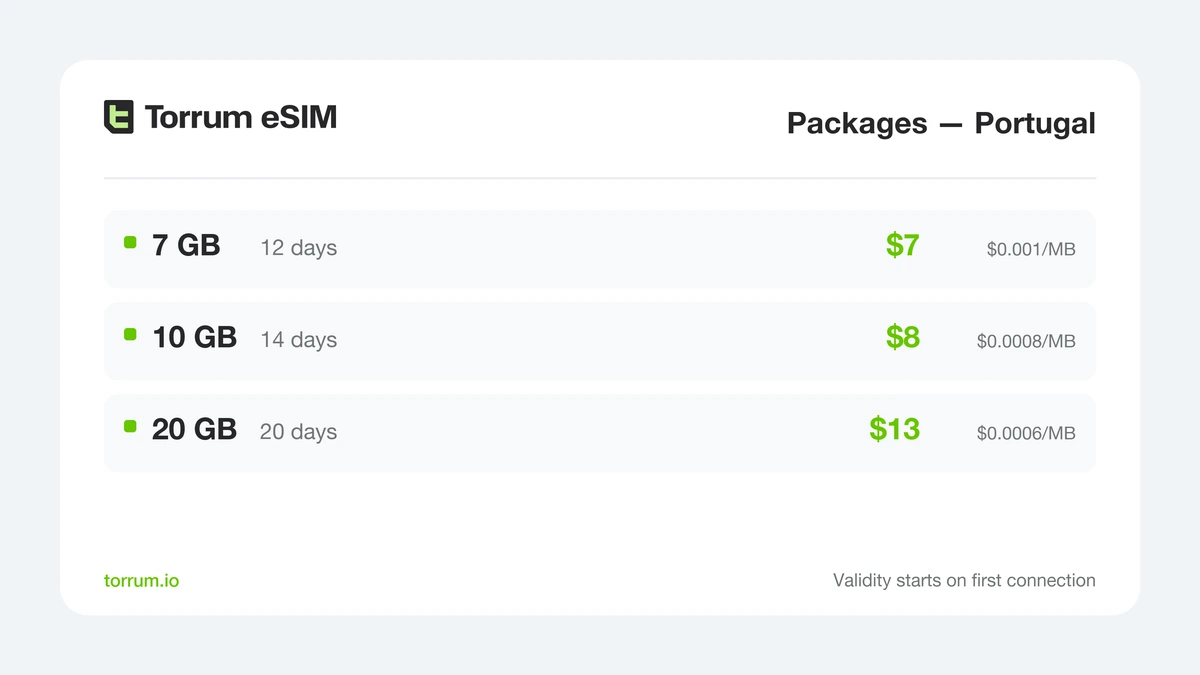
Three Portuguese packages. Match the validity to your dates first, then take the smallest volume that survives an honest estimate.
Most people overestimate badly; our guide to reading it off your own phone usually argues you down a tier.
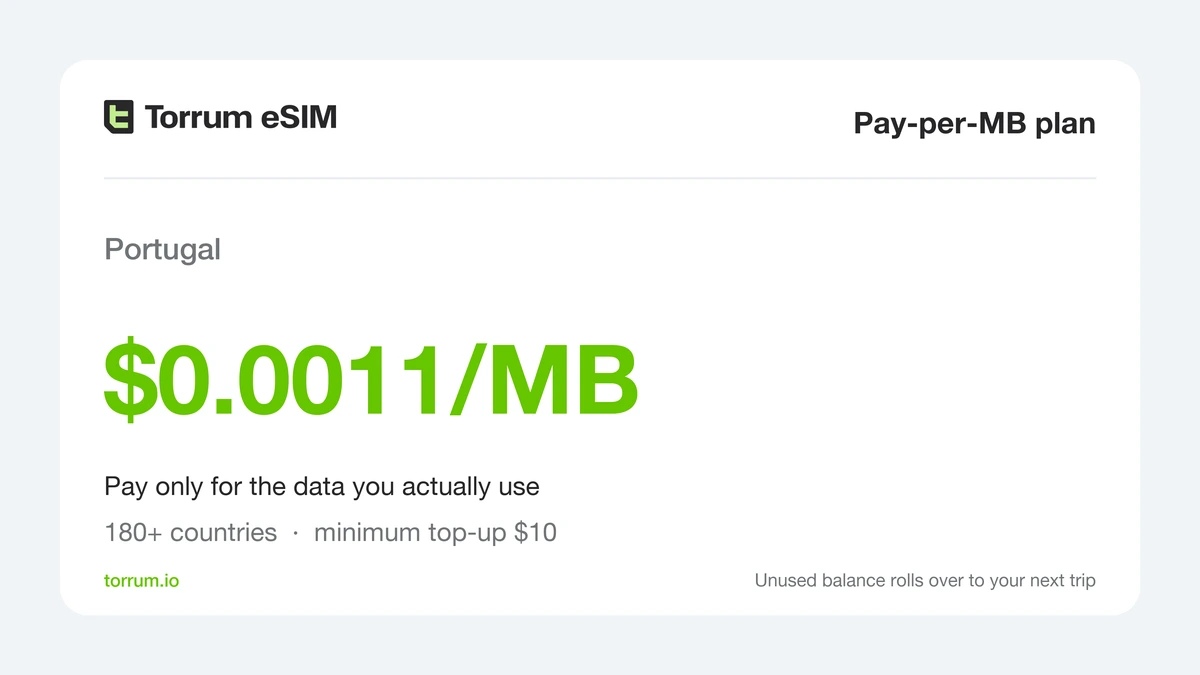
There is no allowance to run down and no clock to beat with Pay-per-MB. Portugal is metered at $0.0011 per megabyte, and an untouched balance is not lost – it waits.
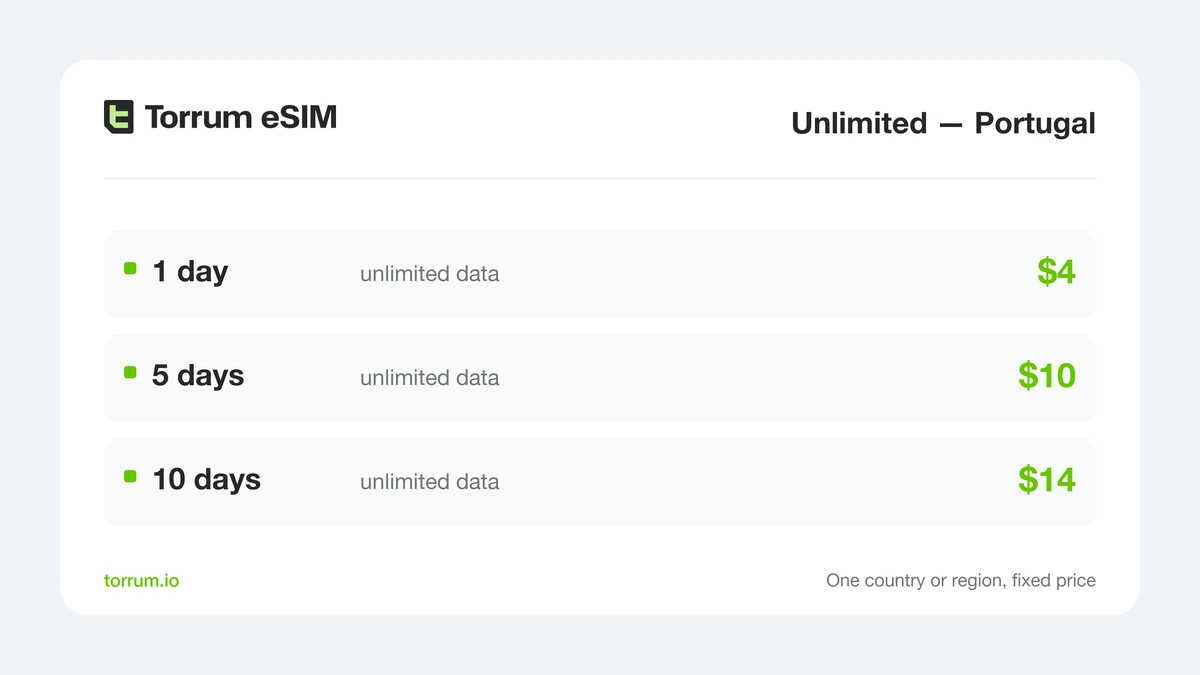
Unlimited is priced in days rather than gigabytes. A conference day, or a week of working off the phone, are the two cases where counting megabytes wastes a trip.
Five ways to visit Portugal, and what each one needs
Six nights in Lisbon and Sintra. The smallest country package. Urban reach is the best Portugal has, and your first gigabyte estimate is almost certainly too high.
A fortnight in the Algarve with the family. One package per handset that actually needs data; the rest live on the villa Wi-Fi. This is the trip where day passes outspend the car hire.
Porto, the Douro, and a few days over the border. A Portugal-only plan stops at the line; the regional Europe package covers both countries and thirty more on one profile – the answer for anything shaped like a route.
One day of meetings in Lisbon. A single Unlimited day, so a laptop hotspot is not a budgeting exercise.
A winter month in one Algarve town. Buy a Portuguese card on arrival. At €2.50 a week for a large allowance nothing else competes, and there is no honest way to argue round it.
The country plan reaches 1,400 km into the Atlantic

Portugal is not only the rectangle on the map. Funchal lies roughly 975 km out from Lisbon and Ponta Delgada about 1,450, and both archipelagos are Portugal for mobile purposes – same networks, same country code. A Portugal package works on São Miguel as it works in Chiado.
The islands are steeper, and reach follows population there too. Every municipality in both archipelagos has 5G somewhere in it, which says nothing about a long road tunnel, the laurel forest, a high ridge or the far end of a levada – and nothing about a boat properly offshore. Not a reason to buy differently; a reason to screenshot the trail map before leaving the hotel.
Loading the profile before you fly
Five minutes, at home, in this order.
- Settle the hardware question first, on the supported devices list – it matters more here than where 3G still runs.
- Sign in with an account you already have: Google, Apple or Telegram.
- Pick by geography, not by price: Portugal alone, the regional Europe plan if Spain appears anywhere, or Pay-per-MB when the route is still an argument.
- Pay by card. A QR code comes back, and scanning it puts the profile on the phone.
- One toggle finishes the job: switch Data Roaming on for the profile you just installed, and leave every other setting alone.
Every screen is pictured in the app walkthrough. If a step refuses to behave, the support bot is the fastest way through it.
Portugal compared: roaming vs a Portuguese SIM vs a travel eSIM
| In Portugal, specifically | Roaming on your home tariff | A Portuguese prepaid card | A Torrum eSIM |
|---|---|---|---|
| Online at the aircraft door in Lisbon | Yes, at whatever your tariff charges | Not yet bought | Yes, at the plan price |
| Identity checks at purchase | None | None required today; parliament is considering a bill | None |
| Cheapest per gigabyte over a month | No | Yes, clearly | No |
| A line billed inside the EU | Nothing extra to pay, all trip | Cheaper still, but only over a long stay | Not needed for Portugal alone |
| Your own number still reachable for bank codes | Yes | Only if the phone has a second slot | Yes |
| Two days over the border in Spain | Another day abroad, another charge | Dead at the border | Covered by the regional plan or the meter |
| A week on Madeira or the Azores | Charged as any other day abroad | Same card, same networks | Same country plan, nothing to change |
| An old handset with no 4G | Nothing works | Nothing works | Nothing works |
| Cost known before you leave home | No | Roughly | Yes on a package or Unlimited; per megabyte on the meter |
FAQ
Do I need ID to buy a Portuguese SIM card?
Not by law at the time of writing – Portugal is one of the few countries with no prepaid registration requirement. A bill approved by the Council of Ministers on 30 May 2026 would make identification mandatory; it is with parliament. Shops may still ask.
Does a Portugal plan cover Madeira and the Azores?
Yes. Both archipelagos share the mainland’s country code and networks, so a Portugal package works there with nothing to reinstall.
Is my older handset still usable in Portugal?
Only if it does 4G. All three long-established networks began retiring 3G between September 2023 and July 2024, and a 3G-only handset falls back to 2G, which will not carry a map.
Is 5G available across Portugal?
All 308 municipalities have 5G somewhere in them, from 16,142 active base stations at the end of the second quarter of 2026. Away from the towns you will spend plenty of the day on 4G, and for maps, messages and bookings that is plenty.
Does my UK phone charge me for roaming in Portugal?
It depends on the network and the tariff: those that reinstated European roaming after Brexit charge around £2.00–2.75 a day, while several still include Europe at no extra cost. An EU-billed line pays nothing extra either way.
Do Lisbon and Porto airports have free Wi-Fi?
Yes, both list it as a standard terminal service, and it does not require a Portuguese number to get on – so it works the moment you land.
Does the eSIM still work once I cross into Spain?
Not on a Portugal-only package. The regional Europe plan and the metered balance both carry on.
Do I lose my own number?
No, and avoiding that is rather the point. The SIM you already have stays in the handset for calls and bank codes; the profile only carries data.
Which Portuguese network will my eSIM use?
One of the three long-established networks, chosen by the roaming agreement rather than by you: the plan fixes the price, not the mast.
Is a Portuguese SIM cheaper than a travel eSIM?
Over a month in one place, yes. Over a week it loses once you count the shop, the queue and the number you stop using.
Do leftover gigabytes go anywhere?
Under a package they lapse when the validity does. Under the meter they simply stay as balance, ready for wherever you go next.
Final thoughts: the short version
Few countries in Europe make it this easy to be online, or this easy to overpay, and which of the two you get is settled before you board.
So the pattern is short. Billed in the EU: do nothing. Billed in Britain: find out whether your tariff includes Europe before assuming the worst or the best. Billed in North America: almost anything beats the default. Settling in one town for a month: buy a Portuguese card once you get there. And for everyone in between – a week, a fortnight, a route into Spain, an island hop – load the profile at home and spend the saved half-hour on the first coffee.
👉 Five minutes of admin, done at home: the Portugal packages.


 Continue with Google
  Continue with Telegram

