
Roaming in Europe from the UK after Brexit: what you actually pay in 2026, and the three ways to pay less
Contents:
UK residents made an estimated 94.6 million visits abroad in 2024 – 17.8 million of them to Spain alone (Office for National Statistics, Travel trends: 2024, released 26 August 2025).
Almost all of that traffic lands in countries where a UK phone once simply worked on its home allowance. That is no longer the default, and the rules that used to catch you when it went wrong are not there either.
Below: what roaming now costs, and the three ways round it – a provider add-on, a local SIM, or a travel eSIM bought before you go.
👉 Want the short version? See Torrum’s Europe data packages – one plan across 32 countries.
What changed in 2021 – and what the EU kept for itself
The EU abolished roaming surcharges in June 2017. That ended for UK customers on 1 January 2021, when the Mobile Roaming (EU Exit) Regulations 2019 removed the legal requirement to offer surcharge-free roaming in the EEA.
The part that rarely makes headlines: in 2022 the EU renewed its own rules under Regulation (EU) 2022/612, extending surcharge-free roaming for EU residents to 2032. That came after the transition period, so it never entered UK law (House of Commons Library, CBP-8649).
A Dutch traveller and a British one can sit on the same Greek beach under different rules: one covered by law for another six years, the other by whatever the contract says.
What UK travellers pay to roam in Europe in 2026

Providers that charge daily. Among UK networks applying an EU roaming fee, the going rate sits between £2.00 and £2.75 a day for contract customers, with multi-day bundles around £10 for a week or £20 for a fortnight (MoneySavingExpert roaming guide, table correct as of June 2026).
Providers that still include it. A meaningful minority – one large network and several smaller ones – never reintroduced a charge.
The daily fee compounds badly: ten days at the going rate is roughly £25, about $34 at 1 GBP = 1.36 USD on 20 August 2026 – before anything beyond your cap.
The fair-use cap is the part that bites
Paying the daily fee does not hand you your full UK allowance. Almost every provider applies a fair-use ceiling on roaming data, and the spread is enormous: caps run from about 5 GB to 50 GB, with a few plans setting no fixed limit at all (MoneySavingExpert, table correct as of April 2026).
What happens past the ceiling matters more than the ceiling itself. Out-of-bundle roaming data ranges from roughly £2 per gigabyte to about £154 – almost eighty times the price for the same megabytes.
The safety net you think you have expired in 2022
Ask a UK traveller what protects them from a runaway bill and most will mention a legal cut-off and warning texts at 80% and 100%. Those protections were real and were carried into UK law after Brexit – then lapsed on 30 June 2022 under a sunset clause (House of Commons Library, CBP-8649). What exists in 2026 is thinner:
- Since 1 October 2024 providers must message you when roaming starts, explaining the charges, unless you opted out (Ofcom, Using your mobile abroad, updated 6 July 2026).
- You can set a monthly spend limit; your provider must warn you as it approaches and cannot exceed it without your agreement.
- Many providers still apply a default spend cap voluntarily – but amounts range from about £10 to £50, and some apply none at all.
One trap deserves its own line: a roaming add-on can opt you out of the spend cap you or your provider had set.
Your provider’s “Europe” is not Europe on the map

Every UK plan has a “Europe zone”, and that zone is a commercial list, not a continent. Switzerland and Turkey are not EU or EEA members, and most plans price them outside it – where day bundles typically start around £5 and out-of-bundle data can reach £6 per megabyte (MoneySavingExpert, updated 30 June 2026).
This is where routes go wrong: Milan with a day trip to Lugano, a Nordic itinerary clipping Norway or Iceland. Torrum’s Europe region plan reads the map differently – its 32 countries include Switzerland, Norway, Iceland and Liechtenstein alongside most of the EU. It is a list too, not a continent: Ireland and Turkey sit outside it, and the UK is on it for inbound visitors, not for residents heading home.
Local SIM in Europe: cheap, but bring your passport
Prepaid data is genuinely cheap across Europe, and a local SIM is still the lowest cost per gigabyte on a long stay. Two things blunt it for a holiday. First, paperwork: many European countries require identity registration for a prepaid SIM, which means a counter, a passport and, in August, a queue. Second, arithmetic: on a five-day break the lost hour rarely repays itself.
It does give you a local number, which unlocks the café and hotel Wi-Fi that insists on an SMS code – something no data-only eSIM can do. Whatever is left over dies when you fly home.
How a travel eSIM works – and what it cannot do
A travel eSIM is a mobile profile you download rather than a card you collect. It sits alongside your UK SIM, which stays in the phone and keeps your usual number reachable, and it wakes up when you land. One setting decides everything: Data Roaming must be on for the eSIM profile. The honest limits:
- Your handset must support eSIM – recent iPhones, Pixels and Samsungs do; iPhones sold in mainland China do not. Check the supported devices list.
- A data-only eSIM gives no local number, so SMS-gated Wi-Fi stays locked.
- It is a travel service: under Torrum’s terms it is not intended for use in your country of habitual residence.
Setting up a Torrum eSIM before you fly
- Check your phone supports eSIM and is unlocked – see the compatibility guide.
- Register at torrum.io with Google, Apple or Telegram.
- Pick a plan: the Europe region package, a single country such as Spain, Pay-per-MB, or Unlimited.
- Pay by bank card – minimum top-up $10, with $10–100 per transaction.
- Scan the QR code to install the profile – the app walkthrough shows every screen.
- Switch on Data Roaming for the Torrum profile, keeping your UK SIM as the voice line.
- Land and connect – the support bot answers in Telegram if anything looks off.
Torrum plans for a European trip
Three plans, three kinds of trip. For a week of maps, messaging and bookings the middle tier is the usual fit; a fortnight of the same wants the largest. Current pricing for the Europe region:
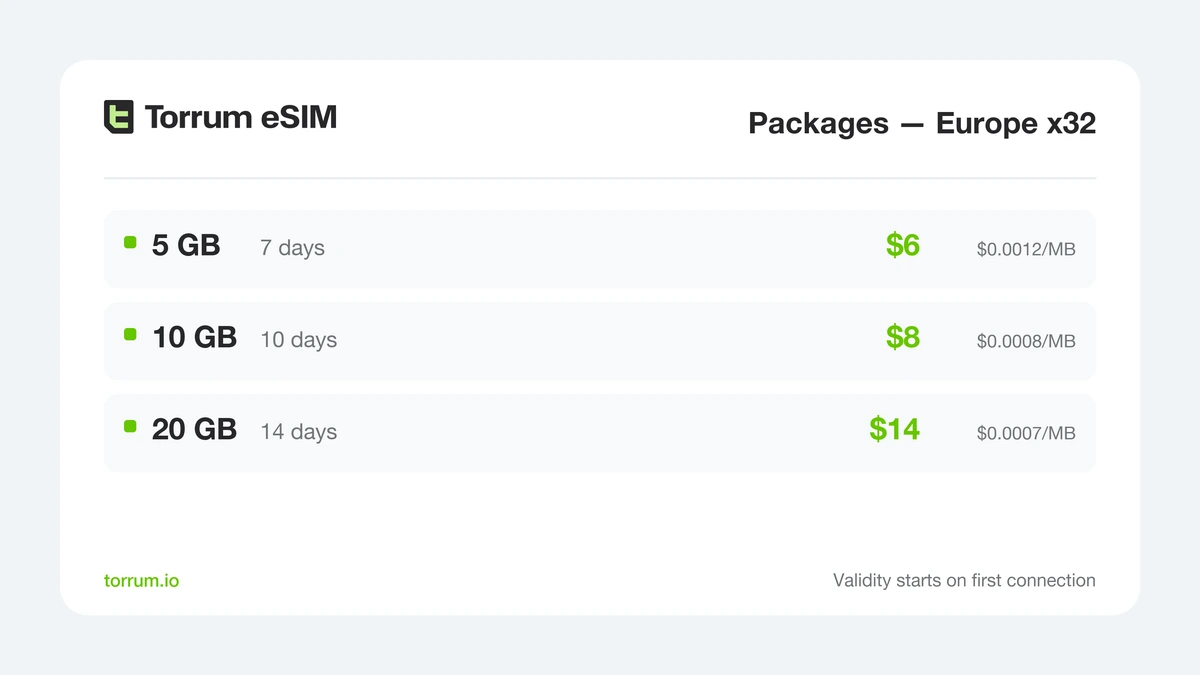
One package across 32 European countries. The clock starts when the eSIM first finds a network, so buying early costs nothing.
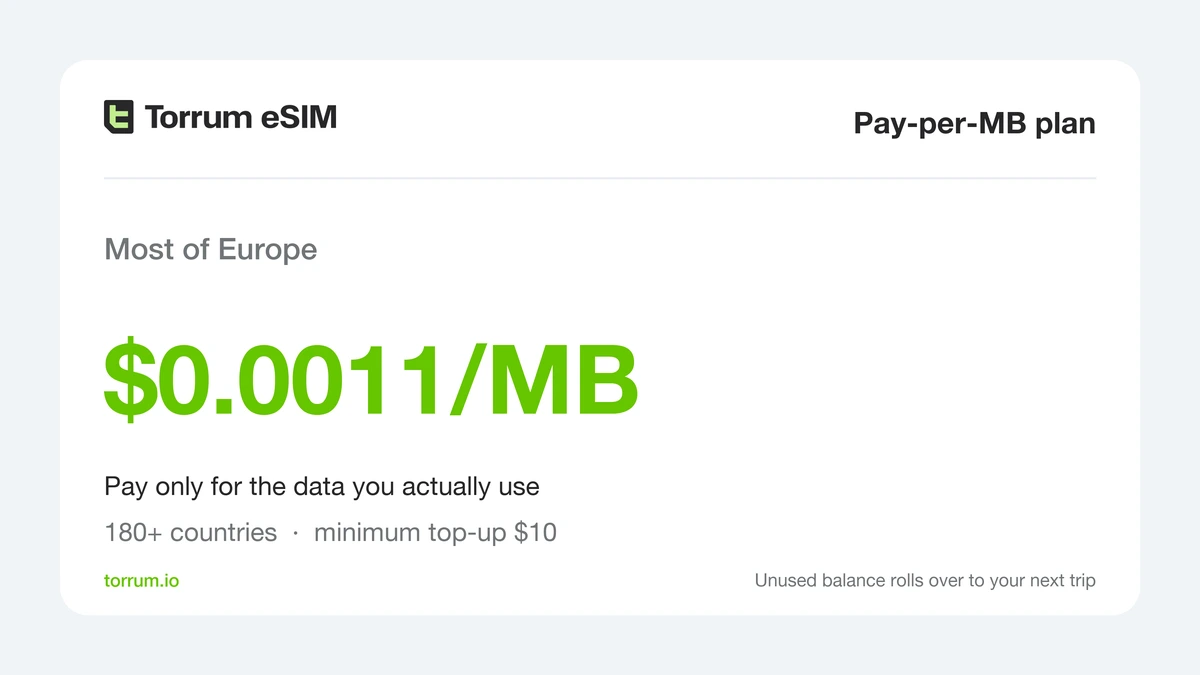
Pay-per-MB runs at $0.0011 per megabyte across most of Europe, with any unused balance carried into your next trip. A few countries sit higher – the plan page lists every rate.
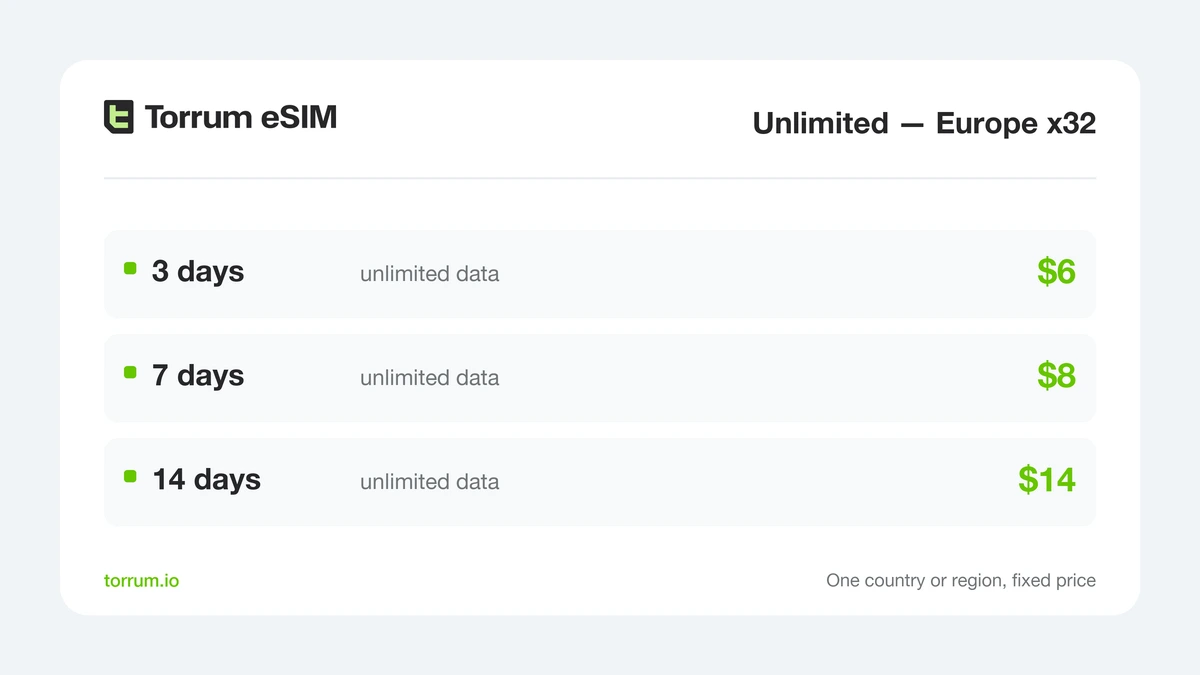
Regional Unlimited – a fixed price for the whole region when you would rather stop counting.
Accidental roaming: borders, boats and the 3G switch-off

Three failure modes catch travellers who did everything else right. All three are documented by Ofcom.
Border regions. Near a frontier your phone can latch onto the stronger signal from the wrong side and start roaming while you stand still. Ofcom names the Northern Ireland–Ireland and Turkey–Greece borders as the classic cases.
Ferries and cruises. Out of range of land networks a phone connects to the ship’s satellite system, billed well above normal roaming. Turn data off before the boat leaves the dock.
The 2G and 3G switch-off. Older networks are retiring country by country on different timetables, and an older handset may then manage neither calls nor data without Wi-Fi. The UK has already switched off 3G; your destination may be ahead or behind it.
A route that crosses borders or water is the strongest argument for Pay-per-MB: one balance, no daily fee running between countries.
Roaming vs local SIM vs eSIM
| What matters | UK roaming | Local European SIM | Torrum eSIM |
|---|---|---|---|
| Set-up effort | None | Shop visit and ID registration | Installed before you fly |
| Cost, one-week trip | Daily fee on most plans; free on a minority | Lowest per GB | Fixed and known in advance |
| Cost if you overrun | £2–£154 per GB, depending on provider | Buy another bundle | Top up, or switch to Pay-per-MB |
| Keeps your UK number | Yes | No | Yes – UK SIM stays active |
| Switzerland | Usually a costlier zone | Not covered | Inside the Europe region plan |
| Turkey | Usually a costlier zone | Not covered | Own plan, or Pay-per-MB |
| Multi-country route | Same zone rules throughout | A new SIM per country | One plan, one balance |
Which option fits your trip
A week in one country. A single-country package is the simplest thing that works – our Spain guide walks through that case.
Two or more countries. This is where the Europe region plan earns its keep: no new plan at each border.
Arriving after midnight. Operator desks are shut and airport Wi-Fi is a coin toss – the one case where installing before you fly is not just cheaper, but the only thing that works.
👉 One destination in mind? Our Italy guide covers a single country in the same detail.
FAQ
Do all UK networks charge for roaming in the EU now?
No. Most majors reintroduced a daily fee after Brexit; one large network and several smaller providers still include it.
Why do EU residents still roam for free when I do not?
In 2022 the EU extended surcharge-free roaming for its own residents to 2032. That came after the transition period, so it never entered UK law.
Is there still a legal cap on my data roaming bill?
Not a statutory one – the retained cap and the 80%/100% alerts expired on 30 June 2022. Many providers keep a default spend cap voluntarily, but amounts vary and some have none.
Will I get a warning text when I start roaming?
Yes – since 1 October 2024 providers must notify you when roaming begins, unless you opted out.
Does a roaming add-on affect my spending cap?
It can – an add-on may opt you out of the default cap or the one you set. Confirm rather than assume.
Are Switzerland and Turkey in my Europe roaming bundle?
Usually not – neither is in the EU or EEA. Switzerland is inside Torrum’s Europe region plan; Turkey needs its own single-country plan or Pay-per-MB.
What is inadvertent roaming?
Your phone connecting across a border without you leaving the country. Ofcom requires providers to explain how to avoid it.
Does the Europe region plan cover Ireland?
No – Ireland is not on the 32-country list and needs a plan of its own.
Do I have to buy before I fly?
Easier, but not required – a profile can be installed abroad if you have Wi-Fi to download it.
Can I use a Torrum eSIM back home in the UK?
No – it is a travel service, not intended for use in your country of habitual residence.
Final thoughts
Whether Europe costs a British traveller nothing or a small fortune now rests on three things the provider chose: the daily fee, the fair-use cap, and the price per gigabyte beyond it. None is set by law any more.
Fifteen minutes settles it: look up your cap and your out-of-bundle rate, check whether your destination sits inside your provider’s Europe zone, and set a spend limit. If the answers are uncomfortable, a plan bought in advance fixes the number before you leave.
👉 Flying soon? Pick a Europe plan and land with the price already settled.


 Continue with Google
  Continue with Telegram

