
Thailand in 2026: file the arrival card, watch the thirty-day clock, and choose between roaming, a Thai SIM and a travel eSIM
Contents:
On 15 September 2026 the visa-free stay in Thailand falls from sixty days to thirty. A few days before that, the paper slip cabin crew used to hand out over the Andaman Sea has already gone, replaced by a web form and a QR code.
Neither change is about telephones. Both decide what your telephone has to do on arrival day – and whether the connection gets sorted at your own kitchen table or in a queue at the terminal.
👉 Skip ahead to the plans: data packages for Thailand.
Before you land, there is a web form
Since 1 May 2025 every non-Thai national arriving by air, land or sea must file a Thailand Digital Arrival Card. It replaced the paper TM6, it is free, it lives at tdac.immigration.go.th, and it wants passport details, flight, the address of your first night and recent countries visited.
Three details catch people out. The window opens only 72 hours before arrival, so it cannot be ticked off a month ahead. One submission covers one entry – fly to Phnom Penh for the weekend and you file again before flying back. And immigration wants the QR code that arrives afterwards.
None of that is hard with a connection, and genuinely awkward without one. Kiosks at five airports catch anyone who missed the window – a queue, not a disaster.
Thirty days, not sixty: the clock changes on 15 September 2026
Thailand is halving its visa-free allowance. Under rules published in the Royal Thai Government Gazette on 31 August 2026 and taking effect on 15 September 2026, nationals of 60 countries and territories – the United Kingdom, the United States, Australia and Canada among them – will get 30 days visa-free instead of 60, for tourism only. Until that date the sixty-day rule still stands, so a trip booked this week can straddle both.

It matters here for one unglamorous reason: trip length drives plan length. A month was the natural unit of a Thai winter, and much connectivity advice is still written for it. The new unit is shorter, which pushes the sensible choice down a tier.
The year is quieter too: 21.28 million foreign visitors between 1 January and 5 September 2026, 3.12% fewer than the same stretch of 2025 (Ministry of Tourism and Sports, reported 8 September 2026). Fewer arrivals, shorter stays, the same scramble on landing day.
Airport Wi-Fi in Thailand: sixty minutes and an email address
Thai airports are, refreshingly, easy. The network is “AOT Airport Free Wi-Fi by NT”, the login asks for an email address and a ticked box, and you are online (Airports of Thailand guidance, checked September 2026). No local number, no code by SMS – the trap that catches travellers elsewhere is simply not set here.
What is set is a clock. Access runs 60 minutes – enough for the arrival card and a taxi, not enough for the evening.
Past the terminal it is everywhere and uneven – quick in a Bangkok café, absent on the boat and the sleeper train. A bonus, never the plan.
Roaming into Thailand: no passport gets a free ride here
European readers are used to a comfortable answer: inside the EU, your allowance travels with you. That protection stops at the edge of the roaming area, and Thailand is far outside it. Here every billing country pays.
A UK line. Rest-of-world travel passes run roughly £2–8 for each day the handset is used, and without one the standard out-of-bundle rate can be £3–6 per megabyte. An automatic worldwide spend cap, typically £40–49, limits the damage without preventing it (Uswitch roaming guidance, updated May 2025).
A North American line. Published day passes sit around $10–12 per line per day (international roaming price lists compared, September 2026). Two handsets across a fortnight is $280–340 before anyone has watched anything.
An EU or Australian line. Same shape, different currency.
Roaming’s one virtue is needing no decision at all. Defensible on a two-day stopover; on a fortnight, the most expensive way to do an ordinary thing.
Thai prepaid: cheap, uncapped, and a passport check on day sixty
Thailand effectively has two national networks. True Corporation, formed by the True–dtac merger, holds a little over half the market and AIS most of the rest – between them, more than nine subscribers in ten. State-owned NT is a distant third. Both sell tourist SIMs at airport counters, in their own shops and in convenience stores.
Prices, checked on the operators’ own pages on 9 September 2026 and converted at 32.87 baht to the dollar (7 September 2026): tourist plans run from 349 baht for 10 days, roughly $11, through 699 for 15 days and 1,199 for 30, up to 1,599 baht for 60 days, near $49. Most are sold as unlimited data at full speed, with local calls thrown in.
Pros: the cheapest gigabytes in the country, a Thai number for delivery drivers, and native rather than borrowed coverage.
Cons: your passport is copied at the counter; the phone stays offline from the gate until you reach that counter; and your own number sleeps in a drawer unless you have two slots. There is also a rule with a sting in it – under NBTC regulations a tourist SIM used beyond 60 days from activation requires the holder to reconfirm identity by passport.
Where the Thai signal actually stops

The headline coverage numbers are good and slightly misleading. One operator reported 93% 5G coverage in February 2025, with 98% targeted by the end of 2026; the other puts its own 5G past 95% of the population. Both are reach figures, and reach follows people. Thailand’s people are not where its holidays are.
Independent measurement puts the honest number lower. In Opensignal’s Thailand report of June 2025, on data collected that February to May, the best network’s users held an active 5G connection 38.8% of the time. So 5G exists, and you spend most of the day on 4G – ample for maps, messages and boat times.
Where it thins out is predictable. Open water between islands drops to nothing mid-crossing. Limestone bays shadow their own signal, so a beach twenty minutes from a busy pier can be dead. National park roads are patchy, and a sleeper train spends hours between towns.
One habit covers most of it: download the offline map and screenshot the boat booking before leaving the city.
A travel eSIM in Thailand, and where it stops
A travel eSIM is a data profile downloaded to the phone instead of a card pushed into it. It rides the Thai networks in roaming at a price your plan fixes, not your home operator, while your usual SIM stays put and keeps taking calls and bank codes.
It is live at the aircraft door, bought weeks ahead from your sofa, with no counter and no passport photocopy – and and since the plan starts counting on first connection, not at checkout, buying early costs nothing.
The honest limits, four of them:
Your device must support it. Broadly iPhone XS and newer, recent Pixels and Samsung flagships – but mainland-China iPhone variants have no eSIM at all, and some regional Android models are locked out. Check yours against the supported devices list.
There is no Thai number. Fine for maps, messaging and calls over the internet; not fine if a local delivery app insists on texting you.
It loses on price over a long stay. A month or more in one place, and a local prepaid plan is cheaper.
It is a travel product. The terms cover trips abroad, not the country you actually live in.
👉 The three options side by side, without a country attached: eSIM vs local SIM vs roaming.
Torrum plans for Thailand: what data actually costs
Which of the three fits comes down to one question: how much of the trip can you predict? A package needs a rough gigabyte figure. A meter needs nothing. Unlimited needs only the dates.
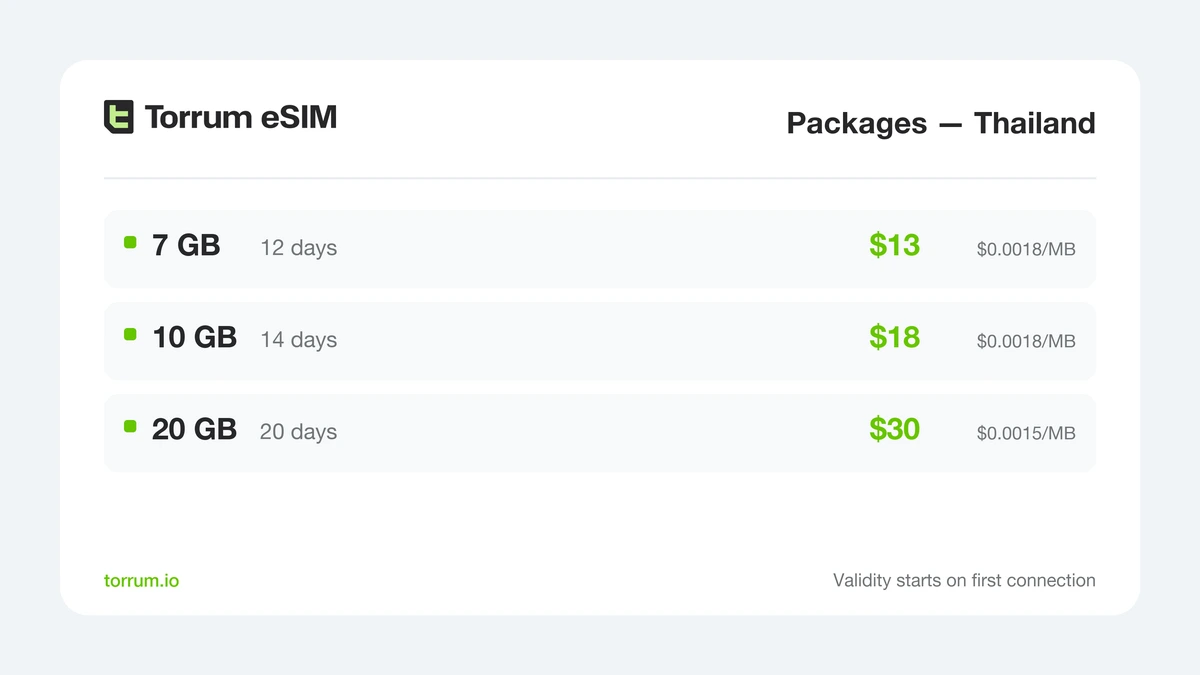
Thailand by the block. Once a visa-free stay tops out at thirty days, the longest package covers a whole trip instead of half of one – so the validity column decides more than the price column does.
Most people need far less than they fear; our guide to working out your own figure reads it off your phone’s own counter.
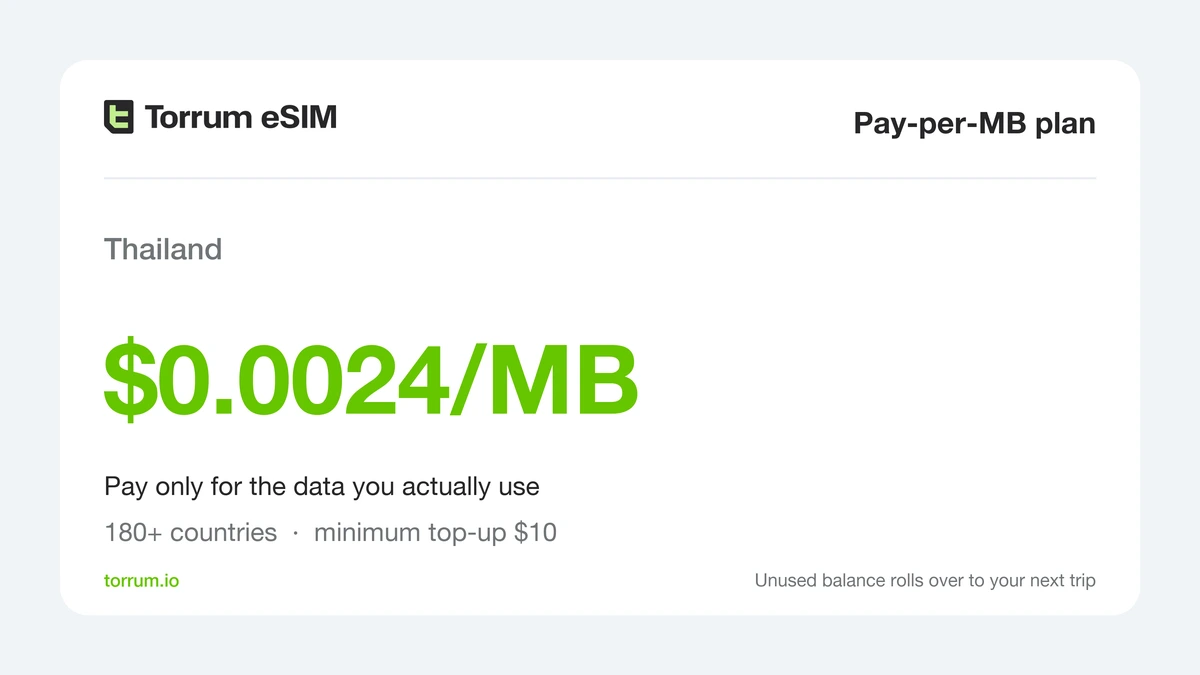
Pay-per-MB is a meter rather than a plan. Thailand bills at $0.0024 a megabyte, a day spent on a dive boat costs nothing at all, and whatever is left on the account waits for the next country.
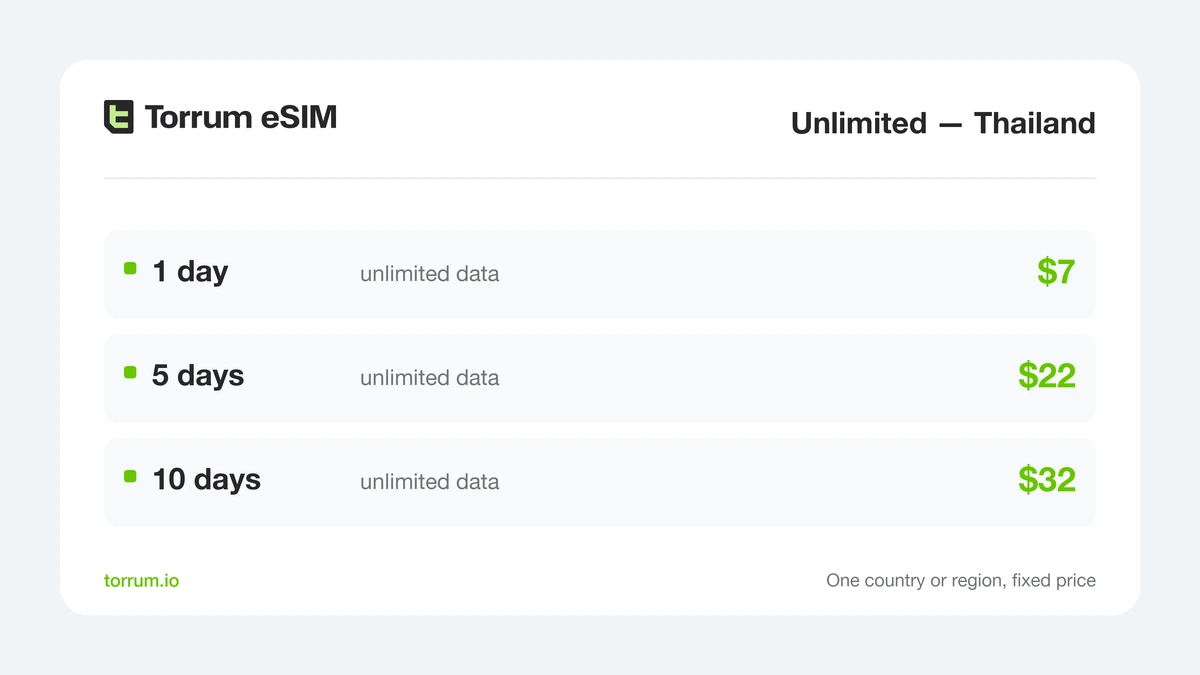
Unlimited ignores the counter and charges the calendar instead. It earns its place on the days a laptop is tethered to the phone and nobody wants to think in gigabytes.
One profile across the border: Cambodia, Laos, Malaysia

Very few people fly all this way for Thailand alone. Angkor for four days, a slow week through Laos, the night train to Penang – each hop puts the phone on another country’s networks, where a Thailand-only plan stops working.
There are two clean answers. A regional Asia package covers twenty destinations, Cambodia, Laos, Malaysia, Vietnam and Singapore among them, on one profile with no reinstalling at each border. Or a metered balance, which bills each country at its own rate and carries what is left into the next trip. A fixed itinerary suits the package; a route that keeps changing suits the meter.
👉 Heading further east afterwards? What data costs in Japan works through a very different market.
Setting up a Thai profile before you fly
Do this at home, in about five minutes.
- Check the handset against the supported devices list.
- Sign in with Google, Apple or Telegram – no forms to fill in.
- Pick the plan: a Thailand package for a single-country trip, the regional Asia package for a route, Pay-per-MB if the plan is to have no plan.
- Pay by card, scan the QR code that appears, and let the profile install.
- Turn on Data Roaming for that profile only – this is the step people skip, and the only reason an eSIM ever seems dead on arrival.
No clock starts until the phone first connects in Thailand. The app walkthrough has the screens; the support bot answers if a step goes sideways.
Thailand compared: roaming vs a Thai SIM vs a travel eSIM
| On a Thai trip | Your own operator, roaming | A Thai tourist SIM | A Torrum eSIM |
|---|---|---|---|
| Filing the arrival card before immigration | Works, at roaming rates | Not bought yet | Already connected |
| When the free airport hour runs out | Still charging by the day | Queue at the counter first | Nothing changes |
| What the point of sale asks for | Nothing | Passport, copied and filed | Nothing |
| Thirty days, two handsets | Two daily charges, every day | Two SIMs, cheapest overall | Two profiles, priced up front |
| Four days in Siem Reap mid-trip | Billed at Cambodian roaming rates | Stops at the border | Regional Asia plan, or the meter |
| A day on a dive boat off Koh Tao | No signal, still billed by the day | No signal | No signal, nothing spent |
| Overnight train to Chiang Mai | Charged through hours of no service | Whatever a Thai line gets | Whatever a Thai line gets, price fixed |
| Day sixty of a long stay | Nothing changes | Identity reconfirmed, or it stops | Nothing changes |
Four Thai trips, and what each should buy
A week in Bangkok and Krabi. A mid-size Thailand package; the figure you need is smaller than you fear.
A month of remote work from Chiang Mai. Unlimited days if you are tethering a laptop; otherwise the largest package. Check the new 30-day limit before planning five weeks.
Thailand plus two neighbours. Regional package for a fixed itinerary, a metered balance for a loose one. Do not buy three separate country plans.
Diving out of Koh Tao. Assume the boat has nothing and download everything the night before. A metered balance is kind here: days at sea cost nothing at all.
FAQ
Do I need internet to complete the Thailand Digital Arrival Card?
Yes – it is an online form, filed within 72 hours of arrival, and you show the QR code it returns. Airport kiosks are the fallback.
How long can I stay in Thailand without a visa?
Until 15 September 2026, 60 days; from that date, 30 days for tourism for nationals of the 60 listed countries. Check your own nationality against the official list first.
Is 5G reliable across Thailand?
The 93% and 95% figures the networks publish describe reach, not the road you happen to be standing on. Independent testing found the best network’s users on an active 5G connection 38.8% of the time; the rest is 4G, which is enough for everything a traveller does.
Do I need a passport to buy a Thai SIM card?
Yes – registration is mandatory and the counter copies it. Beyond 60 days from activation, the identity check has to be repeated.
How much does a tourist SIM cost in Thailand?
Roughly 349–1,599 baht depending on validity, about $11–49 at September 2026 exchange rates, with most tourist plans sold as uncapped data.
Is airport Wi-Fi free at Suvarnabhumi and Don Mueang?
Yes, 60 minutes on “AOT Airport Free Wi-Fi by NT”, and the login needs only an email address – no Thai number required.
Will my eSIM keep working in Cambodia or Laos?
A Thailand-only package will not; a regional Asia package or a metered balance will.
Will my phone work on a longtail boat or a dive trip?
At the pier, usually. Past the headland, assume not – and note a metered balance costs nothing on a day with no signal.
What happens to data I do not use?
On a package it expires with the plan’s validity. On a metered balance it stays on the account and travels to the next trip.
Can I buy the plan weeks before flying?
Yes – validity starts at first connection in Thailand, not at checkout.
Final thoughts: what to actually do about data in Thailand
Thailand is one of the easier countries to be online in, and one of the easier ones to overpay in. Fast networks, cheap tourist SIMs, an hour of airport Wi-Fi that never asks for a local number. What changed in 2026 is the paperwork around all that: an arrival card assuming you are connected before immigration, and a visa-free stay about to halve.
So the sensible order is the boring one. Sort the connection at home, file the arrival card inside the 72-hour window, and land able to read the QR code out of your own inbox. A country package is the least fuss for a Thai-only trip; go regional or metered if it wanders into Cambodia or Laos. And for a whole season in one town, buy a Thai SIM once you arrive – that one is genuinely cheaper, and pretending otherwise would not help you.
👉 Pick the plan before the flight: Thailand packages.


 Continue with Google
  Continue with Telegram

