
Staying connected in Malaysia: 2026 SIM rules, tourist SIM prices, Singapore and Borneo
Contents:
Malaysia is in the middle of its Visit Malaysia 2026 campaign, and the numbers are already large: about 42 million arrivals by December 2025, Tourism Minister Tiong King Sing told The Star in January 2026, against a campaign target that started at 35.6 million.
Visitors also find mobile data cheap here. Malaysian tourist SIMs cost a few dollars a week. The catch is on the paperwork side: since February 2026, buying one comes with stricter passport rules and a hard time limit.
This guide is honest about both. For many trips a local tourist SIM is the better buy; for some, a travel eSIM installed at home saves the trouble.
👉 Comparing already? Open the Malaysia packages in a second tab.
The 2026 rules for a tourist SIM
On 26 February 2026, new registration rules from the Malaysian Communications and Multimedia Commission (MCMC) took effect, as reported by Malay Mail the same day. For visitors they mean three things:
- Original documents only. You show your physical passport, plus your visa if you need one; photocopies, photos or scans are not accepted;
- Three months, then it stops. A tourist prepaid SIM can be used for a maximum of three months from registration;
- Two per operator. Non-Malaysians can register at most two prepaid SIMs with each telco.
The details also include your hotel or temporary address in Malaysia. None of it is hard for a holiday; it just means the SIM is bought in person or in an operator’s app with passport verification, and the line is not meant to be a long-term line.
One more form comes before any of this. Foreign visitors generally must complete the Malaysia Digital Arrival Card online, no earlier than three days before arrival; it has been mandatory since 1 January 2024 and is free. The Immigration Department’s portal is the only official route, and the authorities have warned about look-alike sites that charge a fee or harvest data. Filling it in needs a connection, so it is one more reason to have data or Wi-Fi sorted before the flight rather than after it.
What Malaysian tourist SIMs cost
Here are the visitor offers from Maxis and CelcomDigi, as they list them (read on 29 September 2026; conversions use about RM4.08 to the dollar, derived from that day’s ECB reference rates):
- Hotlink (Maxis) Travel SIM: RM25 (about $6) for 7 days, RM35 for 15 days, RM64 for 30 days, with fair-use allowances of 40, 100 and 400 GB. The data also works in Singapore, Thailand and Indonesia. It is sold at Maxis Centres at KLIA and klia2, Penang and Langkawi airports and in cities, and as an eSIM through the Hotlink app;
- CelcomDigi Tourist SIM: RM25 for 7 days, RM35 for 14 days, RM60 for 30 days and RM90 for 90 days. The 7- and 14-day passes are capped at 18 Mbps, with fair-use limits of 100 and 200 GB; the 14-day and longer passes add 3 GB of roaming in ten ASEAN countries.
CelcomDigi says its passes do not renew automatically; you buy a new one in the app. Both offers include domestic calls, which a data-only eSIM does not.
Put simply: for a week or more in Malaysia with a free hour at the airport, nothing we sell undercuts these, and we will not pretend it does.
Your home plan in Malaysia
For British and American visitors, Malaysia is long-haul roaming.
From the UK. Outside Europe, the big UK networks’ worldwide passes cost somewhere between £5 and £8 per day, depending on network and contract (Uswitch roaming guide, checked 29 September 2026). Check which zone your network puts Malaysia in before relying on it.
From the US. A big national US carrier asks $12 for every day its international pass is used, and every other phone on the plan that uses it that day adds $6 (published pass terms, 29 September 2026).
Against a RM25 tourist week, a daily pass only makes sense for a one-night stop – the guide to connections and stopovers treats that case separately.
Crossing to Singapore for the day

From Johor Bahru, Singapore is just across the Causeway, and a rail shuttle between Bukit Chagar and Woodlands North – the RTS Link – is being built for about a five-minute ride, with passenger service reported for around the turn of 2026 and 2027.
For your phone, Singapore is a separate country:
- A Torrum Malaysia package covers Malaysian networks only;
- Torrum’s Asia x20 regional package covers Malaysia, Singapore, Thailand, Indonesia and other Asian destinations on one profile, in smaller allowances of up to 5 GB;
- Singapore packages or a Pay-per-MB balance cover a day across – though Singapore’s metered rate is about twice Malaysia’s;
- Hotlink’s Travel SIM already includes Singapore, which is a real advantage for JB-based trips.
Sabah and Sarawak: where the bars run out

National averages look strong: 4G reached about 97% of populated areas, according to the government’s JENDELA programme figures reported by Malay Mail in March 2023. But the averages hide Malaysian Borneo.
JENDELA data for 30 June 2025 put 4G coverage of populated areas in Julau, a district in Sarawak, at 58.28%, Malaysian Wireless reported. And the word “populated” matters: rainforest lodges, river routes and trails between settlements fall outside that measure.
No SIM or eSIM fixes a missing mast. What helps:
- download maps of Sabah or Sarawak and your bookings in Kota Kinabalu or Kuching;
- ask lodges in advance whether they have Wi-Fi, and how;
- tell someone your route and return time before a jungle trek or river trip.
Torrum plans for Malaysia, and when they make sense
If the local tourist SIMs are so cheap, why buy anything before you fly? Mostly for the first hours and for short trips: no counter or app registration, data as soon as the plane is down, your usual number still on the phone. The day count begins at the first Malaysian connection, and unused gigabytes lapse when the package period ends.
Which network will you actually be on? Malaysia’s big mobile operators are CelcomDigi, Maxis and U Mobile. A Torrum eSIM roams onto local partner networks – in our price list those are the Celcom, Digi and Maxis networks – so you use the same masts as those operators’ own customers.
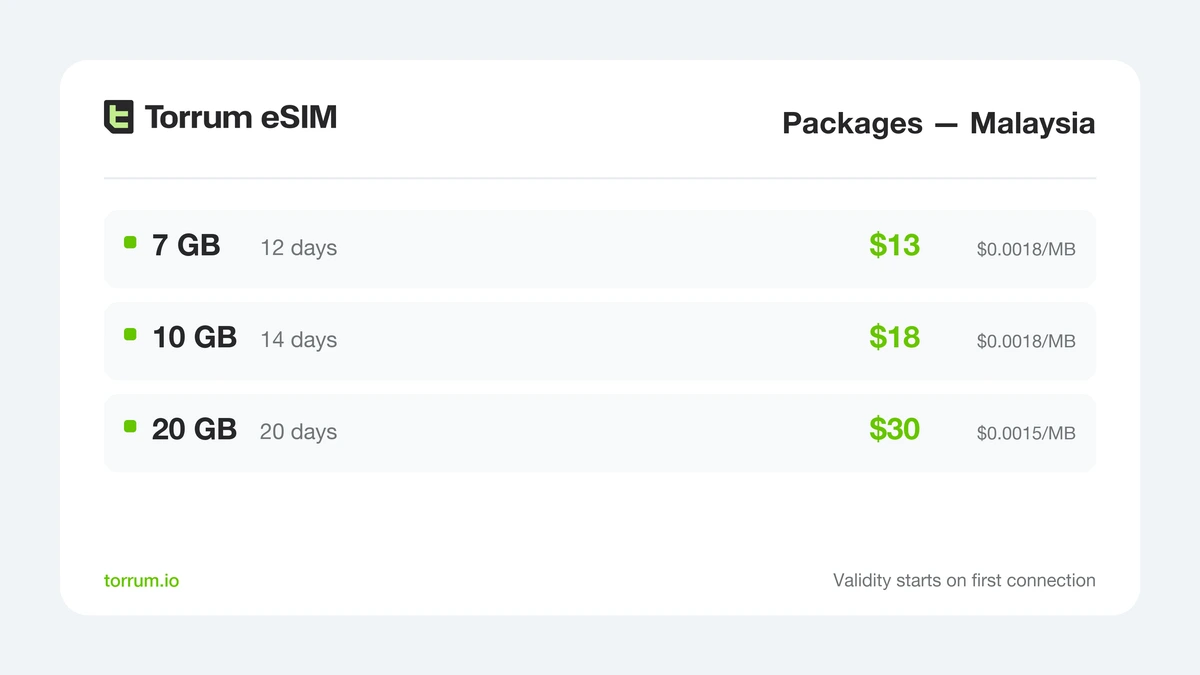
Malaysia Packages: gigabytes and days fixed at purchase, running from the moment the eSIM first reaches a Malaysian network.
For a stopover of a day or two, Pay-per-MB is the simplest fit: Malaysia costs $0.0024 per MB, paid from prepaid credit; unused balance carries over.
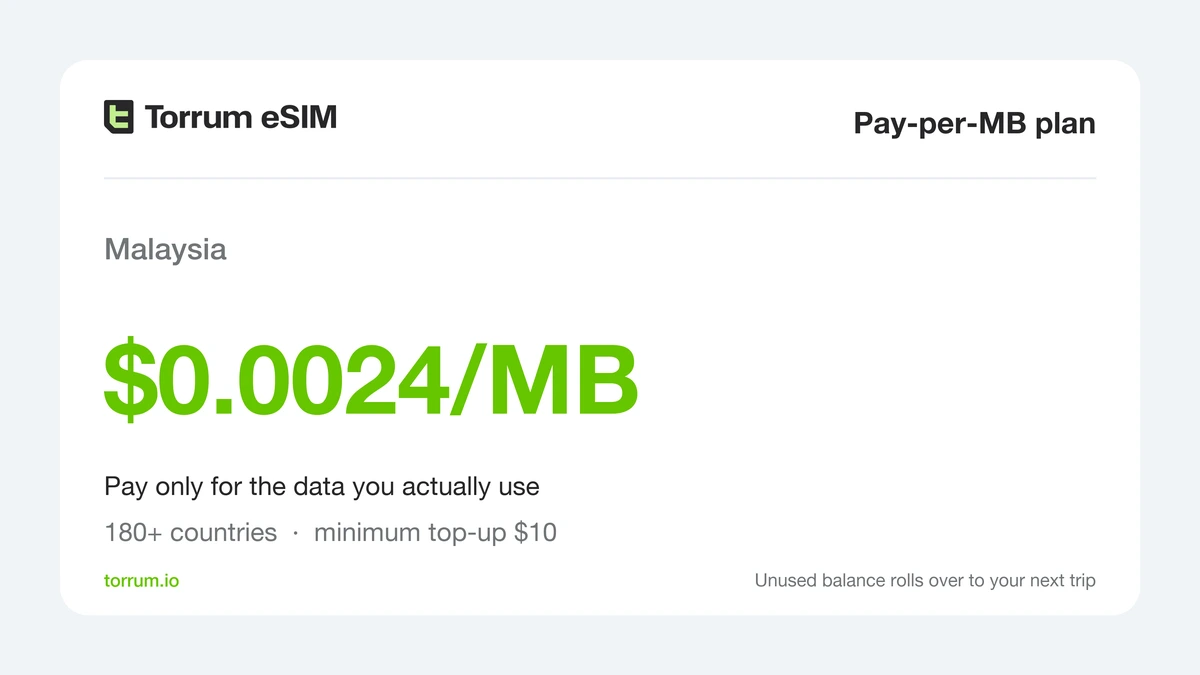
Pay-per-MB in Malaysia: metered use for stopovers and short visits.
For a business trip of a few days with constant calls, Unlimited prices the country by the day.
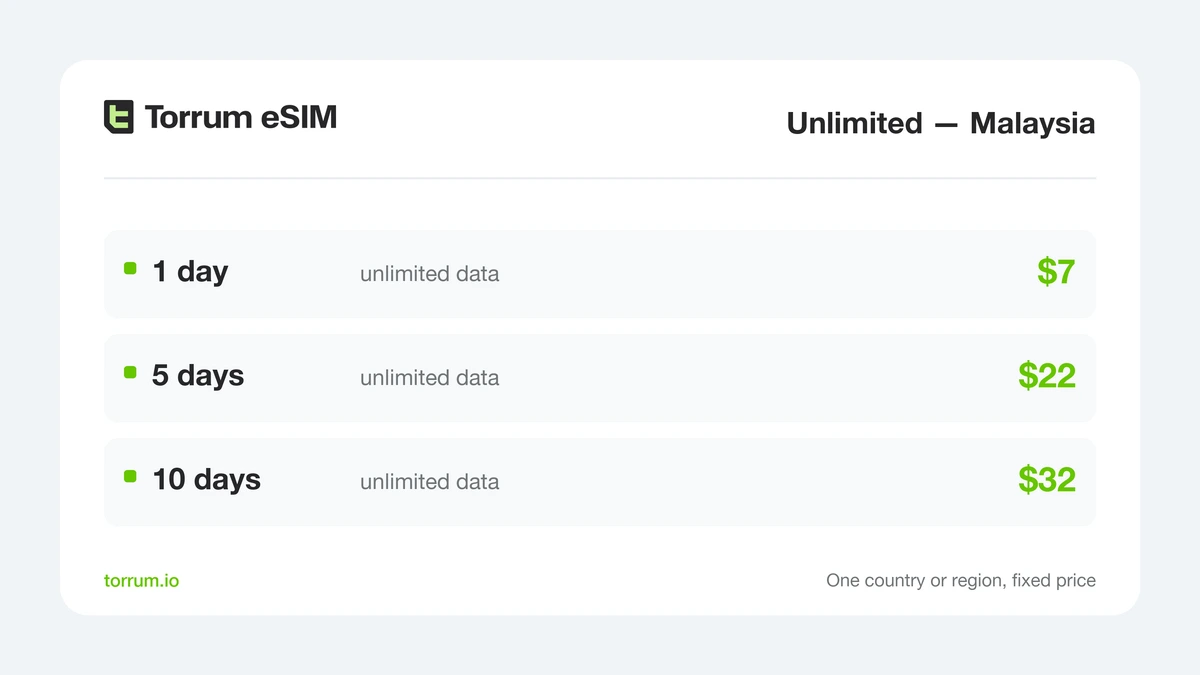
Malaysia Unlimited: day-based pricing for work trips.
How much data do you need at all? The data-use guide reads the answer off your own phone’s usage counters.
Getting the eSIM ready before KLIA
- Look your model up in the device compatibility table; a carrier-locked phone will not take the profile.
- Register with Torrum; Google, Apple and Telegram are all valid logins.
- Pick a Malaysia package, Asia x20 for a multi-country route, or a metered balance, and pay by card.
- Install the profile over home Wi-Fi from the QR code in your order; the installation walkthrough has screenshots for iOS and Android.
- Assign mobile data to the eSIM; your home line stays for SMS and calls, at your home carrier’s roaming rates.
- On arrival at KLIA, klia2 or Penang, enable roaming on the eSIM line only.
If nothing connects, message the Torrum bot on Telegram using any Wi-Fi you can reach.
Malaysia at a glance: roaming, tourist SIM, Torrum
| Question | Home roaming | Malaysian tourist SIM | Torrum Malaysia |
|---|---|---|---|
| Price for a week | Highest | Lowest | In between |
| Passport check | No | Yes, original passport | No |
| Maximum use | Your plan’s terms | Three months | Package period; buy another |
| Local number and calls | No | Yes | No, data only |
| Singapore day trip | Depends on your plan | Included on Hotlink Travel SIM | Separate plan or Asia x20 |
| Online on landing | Yes | After buying at the airport or in the Hotlink app | Yes, installed at home |
| Home number reachable | Yes | With a dual-SIM phone | With a dual-SIM phone |
Which option for which Malaysian trip

A night in KL between flights. A small Pay-per-MB balance; nothing to buy on arrival.
Ten days: KL, the highlands, Penang. A Malaysian tourist SIM from the airport is cheapest. A Torrum Malaysia package if you would rather not queue after a long flight.
Johor Bahru with days in Singapore. Hotlink’s Travel SIM, or Torrum’s Asia x20 if you prefer to sort it before leaving home.
Malaysia, then Thailand or Vietnam. Asia x20 for a light user, or separate country packages for heavier use; and Thailand has its own entry quirks.
👉 Heading on to Bangkok? Read the Thailand guide.
Sabah or Sarawak trekking. Any option works in the towns; offline maps matter more than the plan in the interior.
Several months in Malaysia. A tourist SIM stops after three months under the 2026 rules; plan for what comes next before it does.
FAQ
What documents does a Malaysian tourist SIM require?
Your original passport. Since February 2026, copies or photos are not accepted, and your visa is needed too if you have one.
Do I need the digital arrival card before landing?
Generally yes: submit it on the Immigration Department’s portal within three days before arrival. It is free.
How long does a Malaysian tourist SIM last?
At most three months from registration under the 2026 MCMC rules, whatever pass you buy.
How many tourist SIMs can I register?
Up to two prepaid SIMs per operator for non-Malaysians.
Which is cheaper for a week, a tourist SIM or Torrum?
A Malaysian tourist SIM, at RM25 for seven days. A Torrum package saves the airport purchase and works from landing.
Does a Torrum Malaysia package work in Singapore?
No. Use Asia x20, a Singapore package or Pay-per-MB for days across the border.
Is there signal in Borneo’s rainforest?
Not reliably away from towns: in one Sarawak district, Julau, 4G reached only 58% of populated areas in mid-2025.
Do tourist SIMs renew automatically?
CelcomDigi says its tourist passes do not; you buy a new one in the app when one ends.
Can I use WhatsApp and calls on a Torrum eSIM in Malaysia?
Torrum carries data, so internet apps work over it. For ordinary calls and SMS, keep your home SIM on, at your home carrier’s roaming rates.
Will my data work at Kuala Lumpur airport straight away?
If the eSIM was installed at home and roaming is on for it, it connects on arrival.
I live in Malaysia. Is Torrum for me?
For trips abroad only. Under Torrum’s terms, your country of residence is excluded.
Final thoughts: cheap local SIMs, a few catches
In Malaysia we would tell most visitors plainly that a local tourist SIM wins on price. The trade-offs are practical: an original passport at the counter, a three-month ceiling, and a counter queue after a long flight, unless you set up Hotlink’s app eSIM.
Where Torrum earns its place is the short and the complicated: a KL stopover, a work trip, a route through several Asian countries, or simply leaving the terminal with maps and messages working.
👉 Flying in soon? Compare Malaysia packages, or Asia x20 for a longer route.


 Continue with Google
  Continue with Telegram

