
Costa Rica by phone in 2026: three networks, park signal gaps, what a tourist SIM costs and when an eSIM wins
Contents:
December is when Costa Rica fills up. The tourism board, ICT, counted 347,143 international arrivals in December 2025, almost three times September’s total. The dry season runs from December to March, and the high season usually lasts until April.
Most of those visitors come from North America: 1.63 million of the 2.94 million arrivals in 2025 were from the United States, and another 274,000 from Canada. For most of them, home roaming in Costa Rica costs extra.
Below: what a roaming day pass, a local prepaid SIM and a travel eSIM really cost here, and where the signal gives out, from the cloud forest to the Caribbean canals.
👉 Already know you want data only? See the Costa Rica plans.
Three networks, one small country: Liberty, Kölbi and Claro
Costa Rica has three mobile networks. According to the regulator, SUTEL, Liberty held 40.2% of mobile lines at the end of 2025, Kölbi (owned by the state utility ICE) 38.1% and Claro 21.8%. Liberty is the former Movistar: the brand changed in 2022, so older guides may still use the old name.
5G is new and uneven. Claro launched commercial 5G in September 2025 on more than 350 sites. Liberty announced its first 5G sites in March 2026, but SUTEL’s tests in the first half of 2026 found no Liberty 5G signal in Guanacaste, Puntarenas, Cartago or Limón. Kölbi had no commercial 5G in SUTEL’s report for the first half of 2026. For a trip, plan around 4G.
No network is best everywhere. In SUTEL’s 2025 drive tests on national roads, Claro had the fastest average 4G download (55.1 Mbit/s), ahead of Kölbi (36.1) and Liberty (21.4). The same study checked how much of each operator’s published 4G map was real: 93.8% for Liberty, 84.8% for Claro and only 71.8% for Kölbi. Yet in SUTEL’s 2025 study with Opensignal, based on data from users’ phones, Kölbi scored highest for coverage.
In short: a coverage map is a promise, not a guarantee, and the strongest network changes from valley to valley.
Roaming from the US, Canada, the UK and the EU: what a day pass adds up to
Roaming needs no setup and keeps your number. The catch is the price.
From the US. The North America roaming that many US plans include covers Canada and Mexico, not Costa Rica. Large US carriers charge about $12 a day per line for an international day pass (carriers’ price pages, checked 16 October 2026). Two weeks can cost up to $168 for one phone; one carrier stops charging after 10 day-pass fees per bill. One large carrier includes Costa Rica in free roaming, but at reduced speeds that suit messages better than maps.
From Canada. A major Canadian carrier charges CA$18 a day plus tax outside the US (checked 16 October 2026), or CA$252 for two weeks.
From the UK. Costa Rica is outside every European roaming zone. UK daily add-ons for “rest of the world” destinations typically cost £6–8 a day (checked 16 October 2026); without one, pay-as-you-go rates of several pounds per minute apply.
From the EU. “Roam like at home” ends at the EU border, so it does not cover Costa Rica. Check your operator’s rate for Central America before you fly.
Torrum plans for Costa Rica
Validity counts from the first time the eSIM connects in Costa Rica, not from the purchase date.
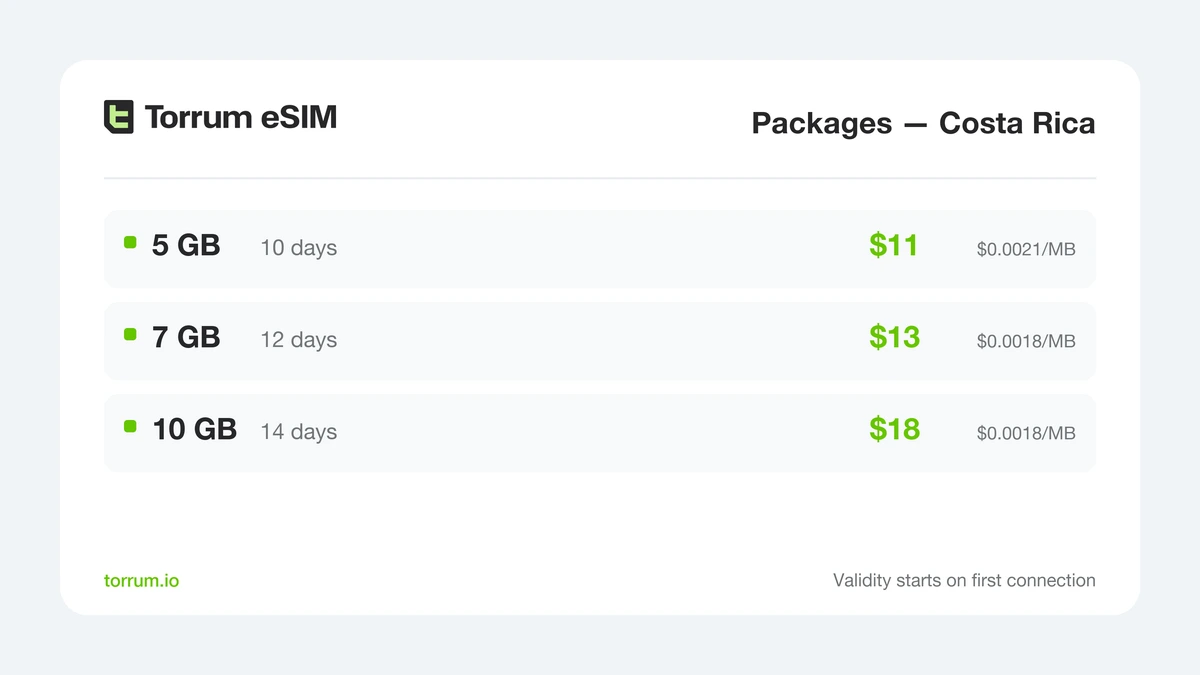
Three sizes for three trip shapes: a Guanacaste beach week, a volcano-and-cloud-forest loop, or two full weeks coast to coast.
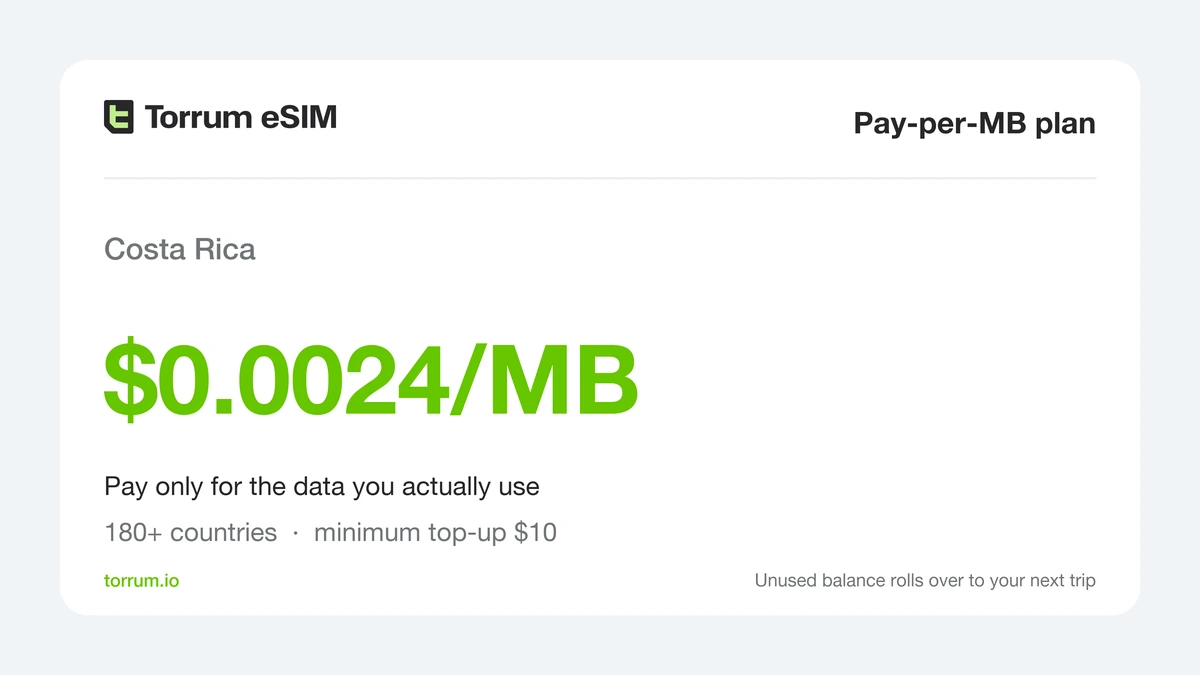
A metered balance for the light user, or for a route that dips into Panama or Nicaragua.
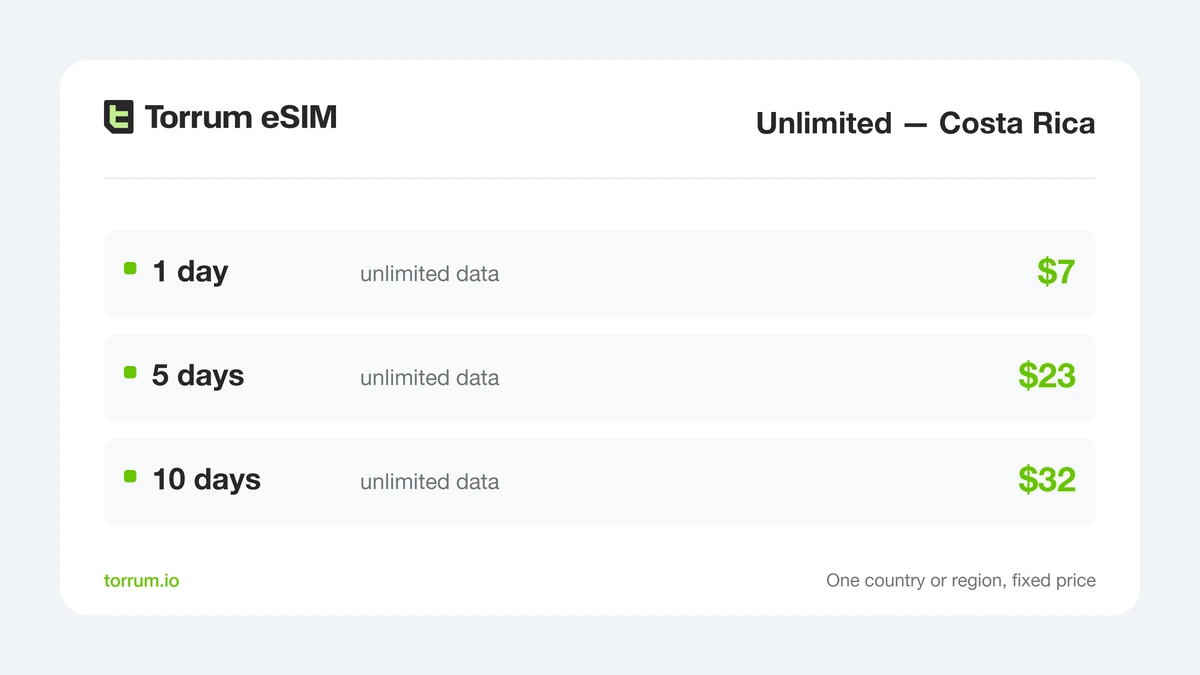
Priced by the day, for heavy days: a work sprint in Santa Teresa or a rainy afternoon of streaming.
Ten days of maps, messaging and some photo sharing usually fit in 5 to 7 GB. If you stream or make daily video calls, take the 10 GB package. Our data-use guide shows what common apps consume.
Pay-per-MB bills Costa Rican data at $0.0024 per MB against a balance you top up from $10; unspent money stays on the account for a later package. Unlimited is a fixed price per period. Packages expire on their end date, whatever is left.
The Torrum Costa Rica profile works with all three networks: Kölbi, Liberty and Claro. It gives you data only, with no Costa Rican number, and it needs an unlocked phone that supports eSIM.
Kölbi SIM Turista or Liberty prepaid: the local options
Costa Rica has required prepaid lines to be registered to their user since 2014, and foreign visitors register with a passport. We converted prices at ₡455.44 to the US dollar (ExchangeRate-API, 16 October 2026).
Kölbi SIM Turista (kolbi.cr, checked 16 October 2026) is the only SIM we found sold as a tourist SIM. The listed price is ₡12,095, about $27, for 30 days. According to Kölbi’s plan list, it includes 5 GB of general data, plus a separate data bonus for WhatsApp, Facebook, Instagram and Waze, plus 100 local minutes and 30 texts. The terms PDF says ₡12,000 plus taxes, so confirm the total at the counter.
Liberty Prepago Ultra (libertycr.com, checked 16 October 2026) costs ₡5,000, about $11, for 30 days on a Liberty prepaid SIM. It includes 5 GB of data, unlimited use of social and mobility apps, and 70 minutes to all Costa Rican networks.
Claro sells prepaid data packs through the *555# menu; its website did not show current prices when we checked.
Do not count on buying a SIM at the airport: a 2025 traveller report found Kölbi’s desk at SJO closed and Claro’s unstaffed after 5 pm. Plan on a Kölbi or Liberty store in town.
Pros of a local SIM:
- a Costa Rican number for tour operators and restaurants;
- Liberty’s plan lasts 30 days, while our packages run 10–14 days, so a month-long stay costs less on Liberty;
- bonus data for WhatsApp and Waze.
Cons:
- a store visit with your passport after the flight;
- offline on the drive from the airport;
- a single network, which matters in the parks and on the Caribbean side.
Landing at SJO or Liberia
Two airports take almost all flights. In 2025, Juan Santamaría near San José (SJO) handled 1.78 million international arrivals, and Guanacaste Airport in Liberia (LIR), the gateway to the Pacific beaches, 905,000.
Guanacaste Airport offers free, unlimited Wi-Fi in the whole terminal: choose the “VINCI Airports Wifi” network and follow the steps. SJO also lists free Wi-Fi among its services; check the time limit when you connect.
Airport Wi-Fi covers the wait for bags; the drive to Tamarindo, La Fortuna or Jacó needs mobile data.
National parks: signal in Monteverde, none in Corcovado

The parks are where signal varies most. The tourism board’s visitor answers show the range:
- Monteverde Cloud Forest: mobile service is available, and so is free Wi-Fi;
- Corcovado National Park on the Osa Peninsula: no mobile service and no Wi-Fi.
Most other parks fall somewhere between. Ask the lodge or the ranger station about signal before a long hike.
Three habits help:
- download offline maps of the park and the drive before you leave the lodge Wi-Fi;
- share your route and expected return time with someone while you still have a signal;
- keep the ranger station and lodge numbers written down, not only in a chat app.
Costa Rica’s single emergency number is 911 for police, ambulance and fire.
Tortuguero and the Caribbean coast

Tortuguero, famous for its nesting turtles, has no road. The tourism board says you reach the park only by small boat: roads end at La Pavona or Caño Blanco, and boat taxis leave from La Pavona at 7:30, 12:30 and 16:30. Domestic flights from San José take about 30 minutes.
The whole Caribbean province of Limón, which also holds Cahuita and Puerto Viejo, is where SUTEL’s 2025 drive tests confirmed the least of the operators’ published coverage: the lowest 3G figures for all three operators.
Here a profile that can use more than one network helps. If your phone stays on a weak network, choose another one by hand in the network settings; our eSIM troubleshooting guide shows how.
Waze, landmarks and gravel roads
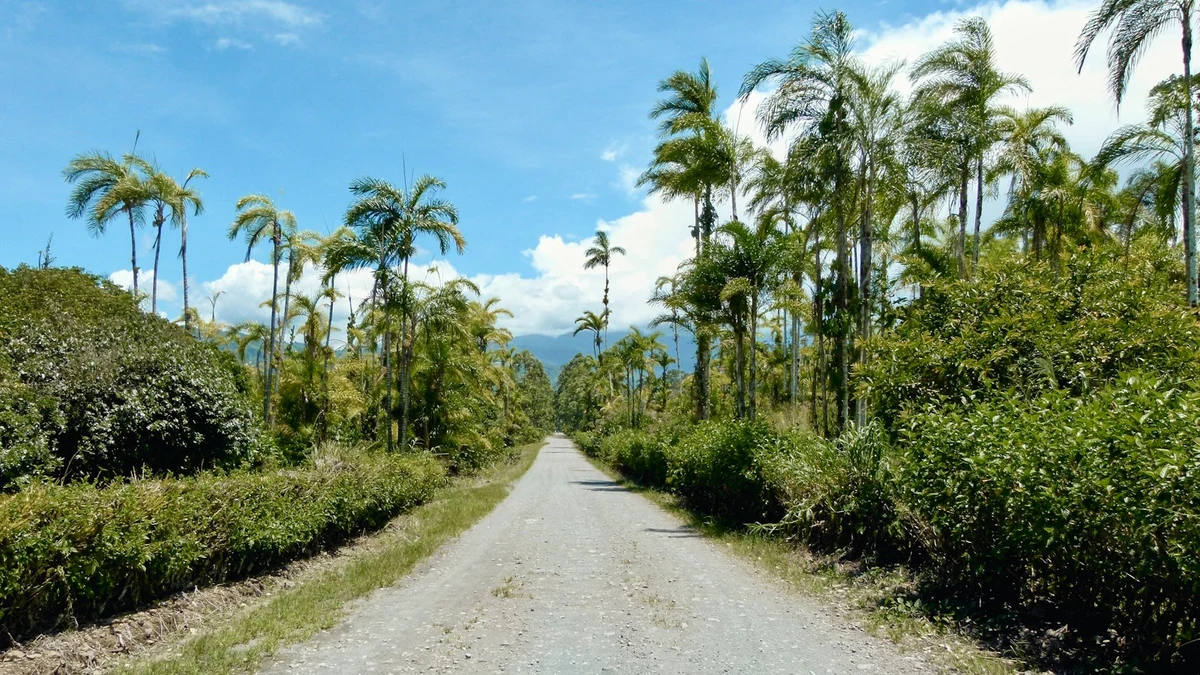
Costa Rica has no standard street addresses in most places: directions refer to landmarks, often “so many metres from” a church or a shop. Navigation apps fill the gap, and Waze is so common that Kölbi’s tourist SIM includes bonus data for it.
Navigation apps do not know which dirt road flooded overnight, and rural signal can drop. Before a drive to the Nicoya beaches or the Osa Peninsula, download an offline map, and ask your lodge about river crossings in the rainy season.
Two more phone habits work differently here:
- SINPE Móvil, the central bank’s system for instant transfers to a phone number, needs a colón account at a Costa Rican bank and a local line. Visitors pay by card or cash;
- Bank codes still go to your home number. Keep that line on for texts; this guide explains the dual-SIM setup.
Day trips to Panama or Nicaragua
Costa Rica borders Nicaragua to the north and Panama to the south, and some itineraries cross by land. A Costa Rica package covers Costa Rica only.
For a short hop, Pay-per-MB is the simplest choice: one balance works in all three countries, so the phone keeps working at the border. Panama’s rate per megabyte is about three times Costa Rica’s. For several days there, buy a Panama package or a Nicaragua package instead.
Before the flight: five steps
- Check the device list: the phone needs eSIM support and no carrier lock;
- Log in through Google, Apple or Telegram, pick a Costa Rica package, Unlimited or a Pay-per-MB top-up, and pay by card;
- Install the profile from the QR code while you are still on home Wi-Fi. The installation guide covers iPhone and Android;
- Enable data roaming on the Torrum eSIM, not on your home SIM, which can stay active for calls and texts;
- On arrival, pick Torrum for mobile data; validity starts then.
Stuck? The Torrum support bot on Telegram answers setup questions.
Roaming, a local SIM or Torrum: Costa Rica compared
| Question | Home roaming | Local prepaid SIM | Torrum Costa Rica |
|---|---|---|---|
| Two weeks of data | Up to $168 on a $12 day pass (US); CA$252 (Canada); £6–8 a day (UK) | One 30-day plan | The 10 GB / 14-day package (price on the card) |
| About 5 GB for a month | Depends on your plan | ₡5,000 (about $11) at Liberty; ₡12,095 (about $27) for Kölbi SIM Turista | Packages run 10–14 days, so a month needs two or three |
| Passport and store visit | No | Yes | No |
| Costa Rican number | No | Yes | No |
| Networks | Your carrier’s partners | One | Kölbi, Liberty and Claro |
| Online on the airport road | Yes | Only after you find a store | Yes |
| Panama or Nicaragua side trip | Depends on your plan | Not on SIM Turista: roaming is excluded | Pay-per-MB covers both |
| Corcovado backcountry | No service | No service | No service |
Beach week, volcano loop or surf month: which plan
Seven days in Guanacaste. Fly into Liberia and take the 5 GB Costa Rica package; hotel Wi-Fi covers the rest.
Ten to fourteen days on the Arenal–Monteverde–Pacific loop. The 7 or 10 GB package, plus offline maps for the mountain roads.
Work calls on some days. Add Unlimited days for the days with long calls.
Four weeks or more of surfing in Nosara or Santa Teresa. A Liberty prepaid SIM costs less per month. For the first days, before you find a store, a Pay-per-MB top-up keeps you online, and what you do not use stays on the balance.
Costa Rica plus Panama or Nicaragua. Pay-per-MB on one balance, or one package per country.
FAQ
Which mobile network is best in Costa Rica?
It depends on the area. In SUTEL’s 2025 tests Claro was fastest on 4G, Liberty’s coverage map was the most accurate, and Kölbi scored highest for coverage in data from users’ phones.
Does Costa Rica have 5G?
Yes: Claro since September 2025, and Liberty on its first sites since March 2026. Kölbi had no commercial 5G in the first half of 2026.
Is there a SIM desk at San José airport?
Do not count on it. A 2025 traveller report found Kölbi’s desk closed and Claro’s unstaffed after 5 pm; plan on a store in town.
What ID does a Costa Rican prepaid SIM need?
A passport. Prepaid lines are registered to the person who uses them.
Is there phone signal in Corcovado National Park?
No. The tourism board says Corcovado has no mobile service and no Wi-Fi.
Is there signal in Tortuguero?
Coverage there is less reliable: SUTEL’s 2025 drive tests found the lowest confirmed 3G coverage in Limón province, where Tortuguero is.
Can Torrum switch between Costa Rican networks?
Yes. The profile works on Kölbi, Liberty and Claro, and you can pick one by hand in the network settings.
Does Costa Rica block foreign phones?
We found no rule that asks visitors to register a foreign phone. SUTEL’s validation platform blocks phones with tampered IMEI numbers and phones reported stolen; you can check an IMEI at pvc.sutel.go.cr.
Can I use SINPE Móvil as a tourist?
Usually not: it needs a colón account at a Costa Rican bank and a local phone line.
Does a Costa Rica package work in Panama?
No. Use Pay-per-MB for a border trip, or buy a Panama package.
Can I reinstall the eSIM if I delete it by mistake?
Yes: a Torrum QR code installs up to three times. If reinstalling fails, message support.
I live in Costa Rica. Is Torrum for me?
No. It is built for travel abroad; at home you need a Costa Rican plan.
Final thoughts: plan for the parks, not the towns
In San José, La Fortuna and the beach towns, coverage is rarely the problem. The real differences show up in the cloud forest, on the Caribbean coast and on the Osa Peninsula. That is why it helps to have a profile that can switch networks, offline maps, and a written list of numbers.
For a trip of up to two weeks, a travel eSIM installed at home saves the store visit and the day-pass bill. Staying four weeks or more? A Liberty prepaid SIM costs less.
👉 Flying in for the dry season? Pick your Costa Rica eSIM.


 Continue with Google
 Continue with Telegram

