
Tunnels, fjord ferries and Svalbard: how to stay online in Norway without paying Norwegian prices for data
Contents:
Visitors from the United States spent 1.64 million nights in Norwegian hotels, cabins and campsites in 2025, 23% more than a year earlier; only visitors from Germany spent more. Nights by British visitors rose 26%, to almost a million. In total, Statistics Norway counted 14.2 million guest nights by foreign visitors in 2025, a record year.
The networks are modern: 3G is gone, and 5G coverage reached 99.7% of households at the end of 2024, according to the regulator. The hard parts are local prices, an ID check for prepaid SIMs, and a long country of fjords, plateaus and an Arctic archipelago with its own rules.
You can roam on your home plan, buy a Norwegian prepaid SIM or install a travel eSIM before you fly. This guide puts the three side by side, then follows the signal into tunnels, onto coastal ships and up to Svalbard.
👉 Short on time? Go straight to the Norway plans.
Who roams free in Norway, and who pays by the day
Norway stayed out of the EU but joined the European Economic Area (EEA), and EU roaming law applies across the whole EEA.
From the EU. Your home plan works on the Norwegian mainland as it does at home, under your operator’s fair-use rules. Most EU residents do not need anything extra. The exception is Svalbard, which we cover below.
From the UK. After Brexit, British networks set their own European roaming terms. According to Which? (10 April 2026), the daily add-ons on the big networks cost about £2 to £2.60, while some plans include Europe at no extra cost. Some networks put Norway in a different zone from EU countries, sometimes with no daily fee, so check where your plan puts it. At £2.59 a day, a two-week trip costs about £36. More in our guide to UK roaming after Brexit.
From the US. Many American plans sell a daily international pass. One large carrier charges $12 per line per day (checked 13 October 2026), so 14 days cost $168 for one phone.
Roaming keeps your number and works from the moment you land, but a daily fee adds up fast.
Arriving at Oslo or Bergen: border checks and airport Wi-Fi
If you are not an EU, EEA or Swiss citizen, expect the EU’s Entry/Exit System (EES) at passport control: Visit Norway says it is fully operational in Norway. ETIAS, the planned travel authorisation, is not running yet.
Avinor, which runs Norway’s state airports, offers free Wi-Fi for four hours. Join the “AIRPORT” network, choose “Free” on the start page and log in; after four hours you log in again (Avinor, checked 13 October 2026). Bergen Airport links to the same service. Use it while you wait for your bags; maps for the drive or train into town from Gardermoen (Oslo) or Flesland (Bergen) need mobile data.
Torrum plans for Norway
A package starts on its first Norwegian connection, not on the day you buy it.
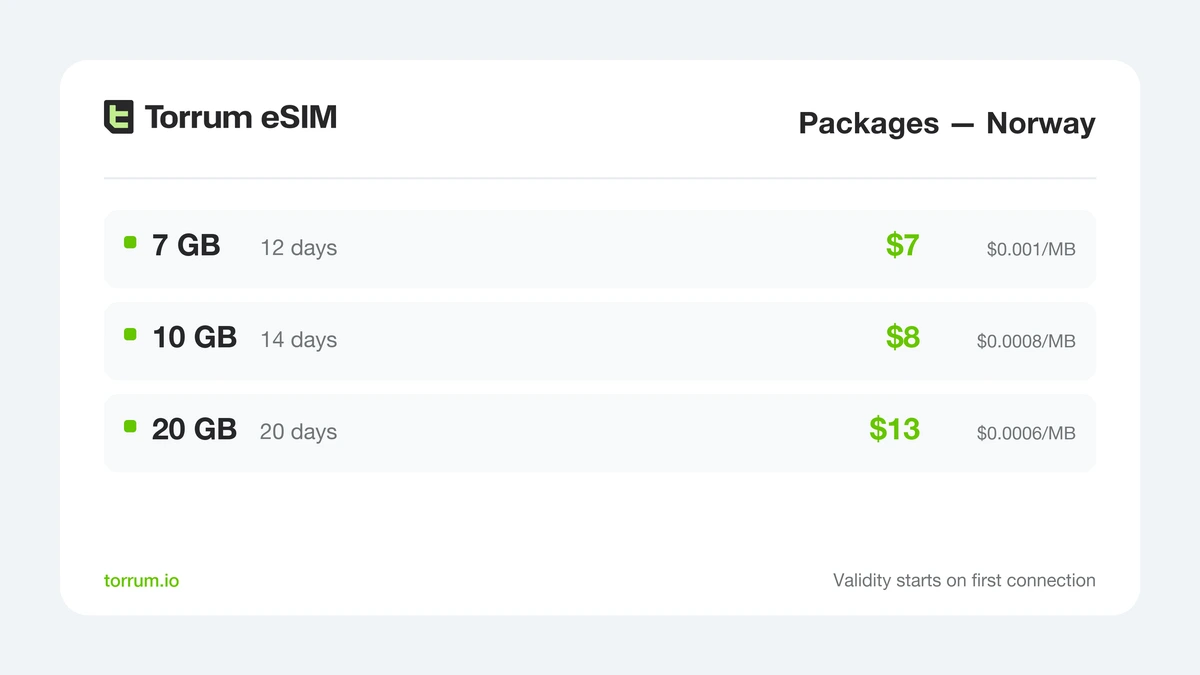
Small, medium or large: a city break, a fjord loop, or nearly three weeks with the northern lights.
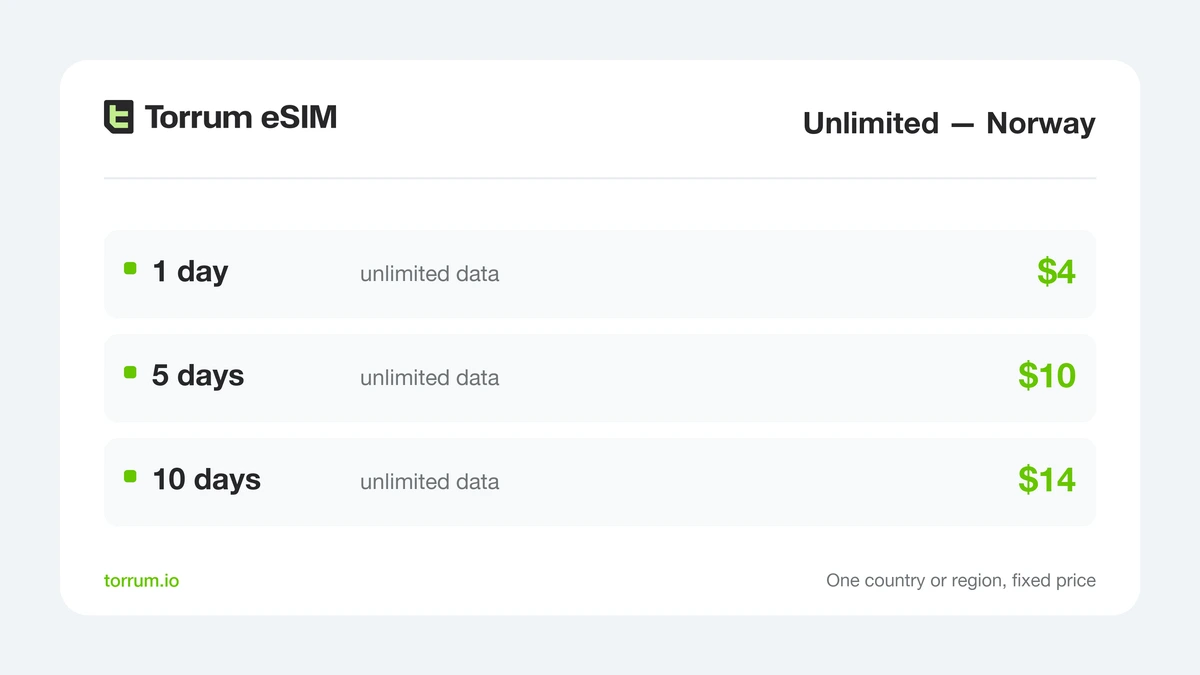
A day without counting: long video calls from a Lofoten cabin or a full day of uploads.
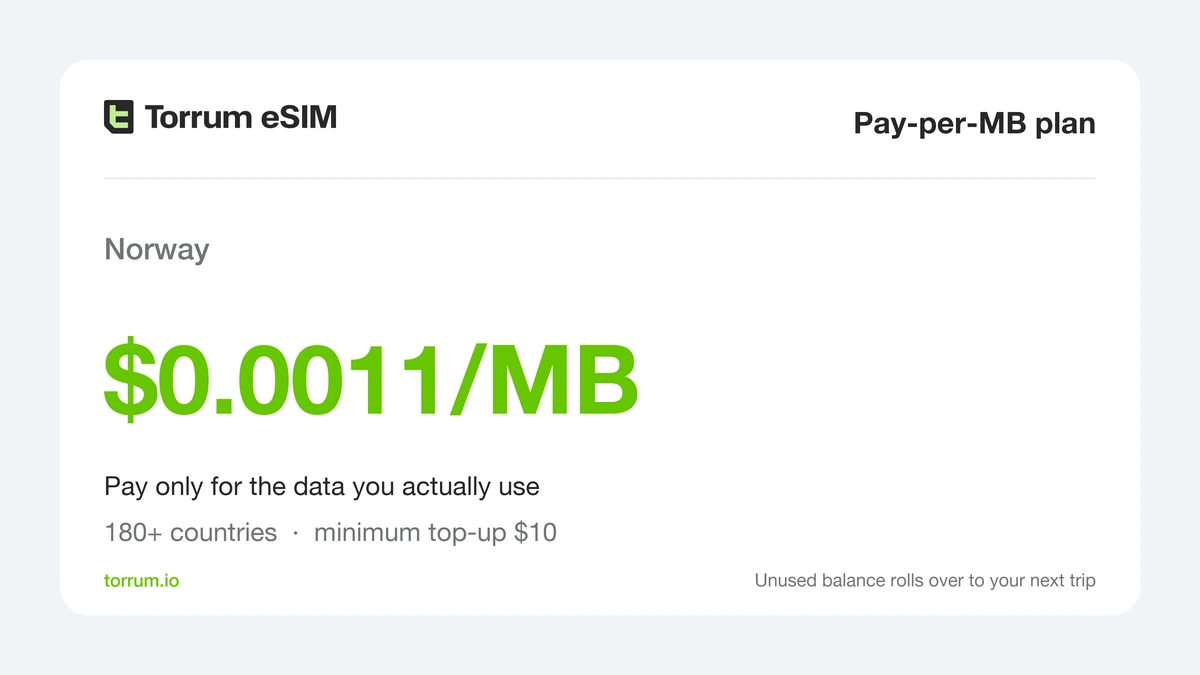
One balance, billed by the megabyte: handy if the drive crosses into Sweden or Finland.
For ten days of navigation, chat apps and photos, the 10 GB package is usually enough; if you stream video every day, take the 20 GB package. See how much data common apps use.
On Pay-per-MB, Norwegian data is charged at $0.0011 per MB against a top-up of $10 or more, so unused megabytes cost nothing. Unlimited has a fixed price per day. A package ends on its last day, and any data you have not used ends with it.
The Torrum Norway profile connects to the Telenor and Telia networks. It has no Norwegian number and needs an unlocked, eSIM-capable phone.
A Norwegian prepaid SIM: an ID check and prices in kroner
Every new Norwegian prepaid SIM needs an identity check. Under the rules of the regulator, Nkom, a foreign passport is accepted if it shows your date and place of birth, a photo and your citizenship. We converted prices using the ECB euro reference rates for 12 October 2026: NOK 1 ≈ $0.1045.
Telia Kontant (telia.no, checked 13 October 2026). A NOK 99 (about $10) starter pack includes 250 MB for 14 days and is sold in Telia stores, Power and Elkjøp. Registering online needs BankID, the Norwegian digital ID that visitors usually do not have, so visitors register in a Telia store. Most data packs run for 31 days. Telia’s FAQ gives examples such as 10 GB for NOK 399 (about $42), but its current list shows 3, 7, 12, 20 and 50 GB packs, so check the price in store.
Mycall (mycall.no, checked 13 October 2026) runs on Telia’s network and says you can register without a Norwegian ID. Starter packs are sold at Narvesen and 7-Eleven, and you activate the SIM online with your ID. The monthly prepaid plans cost NOK 199 (about $21) for 2 GB, NOK 299 (about $31) for 10 GB and NOK 399 (about $42) for 30 GB.
Telenor sells prepaid SIMs only through its customer pages and app, which need a Telenor login. Ice has no prepaid offer, and its plans need a Norwegian national ID number.
The honest summary: a local SIM gives you a Norwegian number, which matters on a long stay. For data alone, our Norway packages cost a fraction of these prices, and there is no store visit or ID step.
1,290 road tunnels and the gaps between towns

The national road database lists 1,290 road tunnels in Norway. The best known, the Lærdal Tunnel on the E16 between Oslo and Bergen, is 24.5 km long and has an emergency phone cabinet every 250 m. From autumn 2026 to 2030/31 it closes at night for upgrade work, so check the opening times before a late drive.
Do not count on mobile data in every tunnel. Download offline maps before a fjord route, where tunnels often follow one another.
Outside the tunnels, coverage is wide but not complete. Nkom puts basic 4G or 5G coverage at about 84.5% of Norway’s area at the end of 2024. Only 44.8% of the area gets 30 Mbit/s or more. In the mountains, Visit Norway warns, some places have little or no reception.
Before you travel, check your phone. Norway’s 3G is gone, Telia closed its 2G network in December 2025, and Telenor will close its 2G network at the end of 2027. Nkom says that once 2G is gone, phones need 4G calling (VoLTE) for voice calls, and Norwegian operators cannot warn you directly if you use a foreign SIM. Ask your home carrier whether your phone supports 4G calling while roaming in Norway. The emergency numbers are 112 for police, 113 for medical emergencies, 110 for fire and 120 for emergencies at sea.
Fjord ferries and coastal ships

On most fjord car ferries, drivers can pay with an AutoPASS tag; a few ferries are exceptions. Hurtigruten and Havila ships sail along the coast for days, so on-board Wi-Fi matters more.
Hurtigruten offers free Wi-Fi on all its ships but says the signal varies, speeds drop in remote areas, and the connection is less suitable for streaming. Guests on its Basic fare must join its loyalty programme to use the Wi-Fi. Havila includes basic Wi-Fi for browsing and messaging, and warns that video calls may not work.
In port and within reach of coastal masts, your phone can use Norwegian land networks. If it joins a ship’s own satellite network instead, EU price caps do not apply and Torrum plans do not work. Our cruise phone guide explains the settings that stop costly ship charges.
Svalbard: still Norway, but outside the EEA roaming rules

Svalbard, Norway’s Arctic archipelago, recorded almost 189,000 guest nights in 2025. Visitors from the UK were the largest foreign group. The archipelago belongs to Norway, but it is outside the EEA agreement, and that changes your phone bill.
Visit Svalbard, the official tourist board, says standard EU roaming rules do not apply there, and your operator may treat the connection as international roaming. EU residents should check their plan’s price for Svalbard before the flight, even if mainland Norway is free.
In Longyearbyen, Telenor Svalbard provides good mobile and data coverage. Outside the settlements, it is limited or absent; for longer trips, the tourist board recommends satellite equipment. The Governor of Svalbard advises keeping your phone switched on during trips, because the rescue helicopter can detect phones with or without network coverage.
Visit Svalbard says eSIMs there usually connect to Telenor or Telia. Before a Svalbard trip, message our support bot to check whether your Torrum plan works in Longyearbyen.
Svalbard is also outside Schengen. Flights from the mainland include passport or ID checks, and travellers who need a visa should get a double-entry Schengen visa.
A country that pays by app: Vipps, tolls and parking
In Norway, several everyday payments run through phone apps or your number plate. Not all of them are open to visitors.
- Vipps, the payment app Norwegians use to pay each other, needs BankID plus a Norwegian or Swedish phone number, bank card and account. Visitors pay by card instead;
- Road tolls are collected by AutoPASS. Drivers of foreign-registered cars can register with Epass24 and drive without a tag, or order a tag by post. Without registration, the toll invoice can include an owner-lookup fee, for example €5.10 for German cars. With a rental car, ask the company how tolls are billed;
- Parking apps may ask for a phone number and send codes by SMS. Check that the app accepts your home number before you depend on it.
With your usual SIM left on for texts, codes keep arriving. This guide explains how to set it up for WhatsApp, iMessage and bank SMS.
Getting the eSIM ready at home
- Confirm on our device list that your phone takes an eSIM and is not locked to a carrier;
- Create a Torrum account; a Google, Apple or Telegram login is enough;
- Pick a Norway package, Unlimited days or a Pay-per-MB top-up, and pay by bank card;
- Before departure, scan the QR code shown on a second screen. The setup guide shows each step for iPhone and Android;
- Switch data roaming on for the Torrum line only. Your usual line can stay active for calls and texts, provided it supports VoLTE abroad;
- On arrival, make Torrum the line your phone uses for data. The package clock starts with that first Norwegian connection.
Stuck at any step? Write to our support bot on Telegram.
Roaming, Norwegian prepaid or Torrum: the comparison
| Question | Roaming on your home plan | Norwegian prepaid SIM | Torrum Norway |
|---|---|---|---|
| EU resident, mainland Norway | Included under EU rules | Not needed | Not needed |
| Two weeks from the UK or US | Up to about £36 (£2.59 a day), some UK plans include Norway; $168 on a $12 day pass | Starter pack plus a 31-day data pack | One fixed price per package (see the cards) |
| 10 GB of data | Depends on the plan | From NOK 299 (about $31) at Mycall | One of the three packages |
| ID check | No | Yes: passport, in a store or online | No |
| Norwegian number | No | Yes | No |
| Svalbard | EU rules do not apply; check your plan | Check coverage with the operator | Ask support before the trip |
| Out of range of land masts at sea | Ship network if any, no EU price caps | Same | No service; use ship Wi-Fi |
| Set up at home | Yes | No, bought and registered in Norway | Yes |
City weekend, fjord drive or Arctic week: which plan
An Oslo or Bergen weekend. The 7 GB Norway package is plenty. Pay-per-MB bills only the megabytes you use, and the rest of the balance stays on your account.
A ten-to-fourteen-day fjord drive. 10 or 20 GB, downloaded maps for the tunnel stretches, and a check of tolls and ferry payments before you collect the car.
A week in Tromsø or Lofoten in winter. Visit Norway says many people come to Tromsø from September to March to see the northern lights. Night photo uploads and calls home suit the largest package or a few Unlimited days.
Norway plus Sweden, Denmark or Finland. The regional Europe x32 plan covers all four on one eSIM. Our multi-country Europe guide explains how borders work.
EU resident. On the mainland, use your home plan. Check Svalbard prices separately.
FAQ
Is roaming free in Norway for EU residents?
Yes, on the mainland. Norway is in the EEA, so “roam like at home” applies. Svalbard is an exception.
Does EU roaming work in Svalbard?
Not automatically. Visit Svalbard says standard EU roaming rules do not apply there, so check your plan before the trip.
Can a tourist buy a SIM card in Norway?
Yes, with an ID check. Telia registers visitors in its stores, and Mycall lets you register online with a foreign ID.
Which networks does the Torrum Norway profile use?
Telenor and Telia.
Is there mobile coverage in Norwegian tunnels?
Not in every tunnel. Download offline maps before a tunnel-heavy route; long tunnels such as Lærdal have emergency phones every 250 m.
Will my phone make calls in Norway now that 2G is closing?
Telia has closed 2G and Telenor closes it at the end of 2027. For reliable calls, your phone needs 4G calling (VoLTE) while roaming; ask your home carrier.
Can I use Vipps as a visitor?
Usually not. It needs BankID and a Norwegian or Swedish number, bank card and account.
Does Oslo Airport have free Wi-Fi?
Yes, for four hours on the “AIRPORT” network, after which you log in again.
Does Torrum work on the Hurtigruten or Havila ships?
In port and within reach of coastal masts, usually yes. On a ship’s own network Torrum does not work; use the ship’s Wi-Fi.
Can I use Torrum if I live in Norway?
No. Torrum is built for trips abroad, so residents of Norway need a Norwegian plan.
Final thoughts: modern networks, high local prices
Norway is an easy country for a modern phone: 5G reaches 99.7% of households, and EU residents roam for free. For everyone else, the problem is price: daily passes add up, and local prepaid data is expensive. Plan for the gaps too: tunnels, mountains, the open sea, and Svalbard with its own roaming rules.
For a trip from the UK, the US or anywhere outside the EEA, a travel eSIM installed before departure is the simplest choice for data, unless your plan already includes Norway. A local SIM is still the right choice if you stay longer or need a Norwegian number.
👉 Packing for Norway? Choose your Norway eSIM, or see our Iceland guide if Iceland is next on your route.


 Continue with Google
 Continue with Telegram

