
Your phone on a cruise: why the ship’s own network costs so much, what onboard Wi-Fi gets you, and how to stay online cheaply on port days
Contents:
Ocean cruising carried 37.2 million passengers in 2025, up 7.5% on the year before, according to the cruise industry body CLIA. More than four in ten sailed the Caribbean; the Mediterranean and the rest of Europe added more than nine million between them.
Each of those trips puts a phone through something a hotel holiday never does: several network changes a day, one of them to a network owned by the ship – and that one plays by different rules from everything on land.
Here is which network you are on and when, what each costs, what ship Wi-Fi buys, and where a travel eSIM helps – and where it does not.
👉 Sailing around Europe? See the Europe x32 regional plan, which covers ports in 32 countries, from Spain and Greece to Norway.
Three networks in one day: port, coast, open sea
In port, your phone behaves as in any foreign city. It roams on a local land network at whatever your plan charges for that country.
Along the coast, land masts keep reaching the ship for a while after departure. How far depends on terrain and the nearest tower.
At sea, the ship’s own system takes over. Lines and carriers give different switch-on distances: one line says about six nautical miles from shore, another says only in international waters, 12 nautical miles out. Under an EU decision on ship base stations, the system must be off within two nautical miles of the coast, for example when arriving in port.
In between lies a band of water where the phone may see both a fading coastal mast and the ship, and pick the stronger.
The ship’s own mobile network, and why the price caps stop there
The onboard network is a small mobile base station linked to land by satellite, and your phone roams on it like any foreign network. The cruise line does not set the price – one line’s FAQ says these rates are determined by your cellular provider.
That is why rules you rely on at home stop where the ship’s network starts. The European Union’s Your Europe site (last checked 7 January 2026) says that when mobile services on a ship or plane run via satellite, EU rules no longer apply and there are no price caps. EU residents keep one safety net: their operator sends a warning and stops mobile data once extra charges reach €50 or another agreed limit, the European Commission explains (July 2026) – under the EU roaming regulation, where the ship’s network allows real-time tracking.
The prices themselves, by home market:
- US carriers: two of the three largest sell cruise day passes at roughly $15–20 per day for about 500 MB, according to their published terms in 2025–2026. Without a pass, calls run from about $2 to $6 a minute, and one large carrier offers no pay-as-you-go data on ships at all.
- UK networks are outside EU rules altogether. One UK network’s help page (October 2026) lists ship data at £5 per MB, with calls at £1 a minute both ways.
- EU travellers face similar sums: the European Consumer Centre in the Netherlands put satellite data at sea at €7–10 per MB (2022).
At £5 per MB, ten megabytes of background syncing is £50. The other trap is quieter: an incoming call answered on a ship network can be billed too.
A travel eSIM is no way around it either: ship networks appear on none of Torrum’s plans, so the eSIM is a tool for port days, not for the open sea.
Settings before sail-away
No line in your phone should reach the ship’s network unless you decide it should. Before the first sail-away:
- Switch data roaming off for the home line. On iPhone: Settings > Mobile Data (Cellular) > your home line > Data Roaming. On Android, the switch sits under your SIM’s settings.
- Decide about calls and texts. Data roaming off does not stop the home line from registering on the ship network for calls and SMS. To be certain, switch the home line off entirely while at sea, or use airplane mode with Wi-Fi on.
- Make the travel eSIM your data line and turn Data Roaming on for it – without that it will not connect in port. How the two lines share the work is covered in our home-number article.
- Pause auto-backups and app updates over mobile data.
For sea days, airplane mode with Wi-Fi switched back on is the bluntest and safest setting: useful on ship Wi-Fi, invisible to the ship’s mobile network.
Onboard Wi-Fi in the Starlink era
Onboard internet changed when the big fleets moved to low-orbit satellite internet: Carnival Corporation finished its Starlink rollout across its brands in May 2024, MSC Cruises planned its whole fleet by the same month, and several other large lines now say their onboard internet is powered by Starlink.
The speed improved; the pricing model did not. Packages are sold per device per day, and what we found on the lines’ own pages and recent reviews in 2026 lands at roughly $20–40:
- basic “social” or browsing tiers at the bottom of that range;
- streaming tiers near the top;
- on some lines, lower prices when bought before sailing.
Read the fine print: one major line states that only one device can use a plan at a time, and another notes that prices vary by ship and sailing length.
The arithmetic adds up fast: four phones for seven nights at $20 each is $560 before any upgrade. A cheaper split is one package passed between phones on sea days, and mobile data in port, where land networks cost far less.
Port days: where a travel eSIM earns its place

For EU residents, ports in the EU, Norway and Iceland are covered by Roam Like at Home, so their home plan already works there – no need to pay twice. Travellers from the US and the UK are in a different position: every port day can trigger a daily roaming charge, and a seven-port sailing can mean seven of them. UK residents, of course, need nothing extra for ports back in Britain.
A regional eSIM handles the whole itinerary as one plan. Europe x32 covers ports in Spain, France, Italy, Greece, Croatia, Malta, Portugal, Norway, Iceland, Denmark, Sweden, Finland, Estonia, Germany, the Netherlands and the UK, among others.
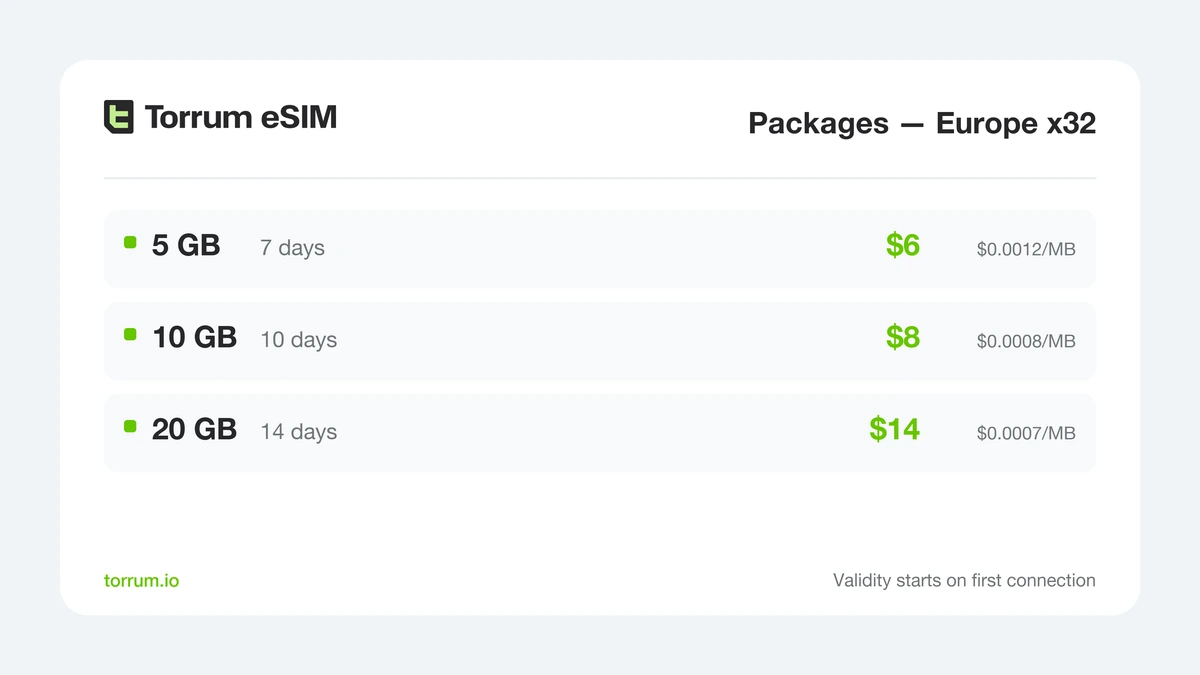
Europe x32 Packages: 5 GB for a one-week sailing, 20 GB for two weeks with plenty of photo uploads.
The clock starts on first connection, not at installation. Two hotel nights in Barcelona before boarding count too – choose the length with them in mind.
For a sailing where you will not want to watch the counter, the regional Unlimited plan is the simpler choice:
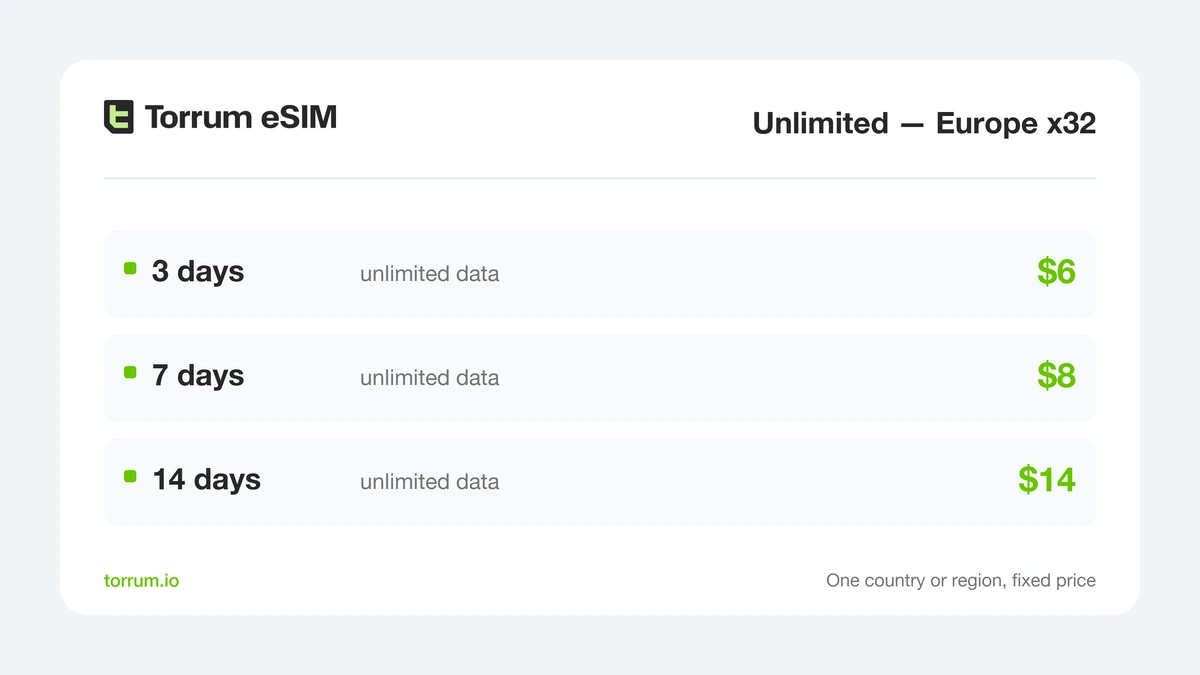
Europe x32 Unlimited: a seven-day pass matches a classic one-week Mediterranean loop.
Not sure how much a port day uses? Our data-per-day guide gives typical figures for maps, messaging and photo uploads.
Ports outside the regional plan
On European routes, watch for:
- Turkey – Kusadasi and Istanbul appear on eastern Mediterranean routes. Turkey has its own packages.
- Montenegro – Kotor, a regular Adriatic call, is outside both the EU and Europe x32; it has separate packages.
- Gibraltar and Monaco – separate entries with their own rates; Monaco is among the priciest on the list, so use Wi-Fi there.
- Ireland and the Faroe Islands – on British Isles and North Atlantic cruises, Dublin, Cobh and Tórshavn are not part of Europe x32.
For one or two calls in Turkey, Montenegro, Gibraltar, Ireland or the Faroes, Pay-per-MB is the tidy answer: you top up once, at least $10, and pay only for what you use in each country. In Turkey the rate is $0.0018 per MB.
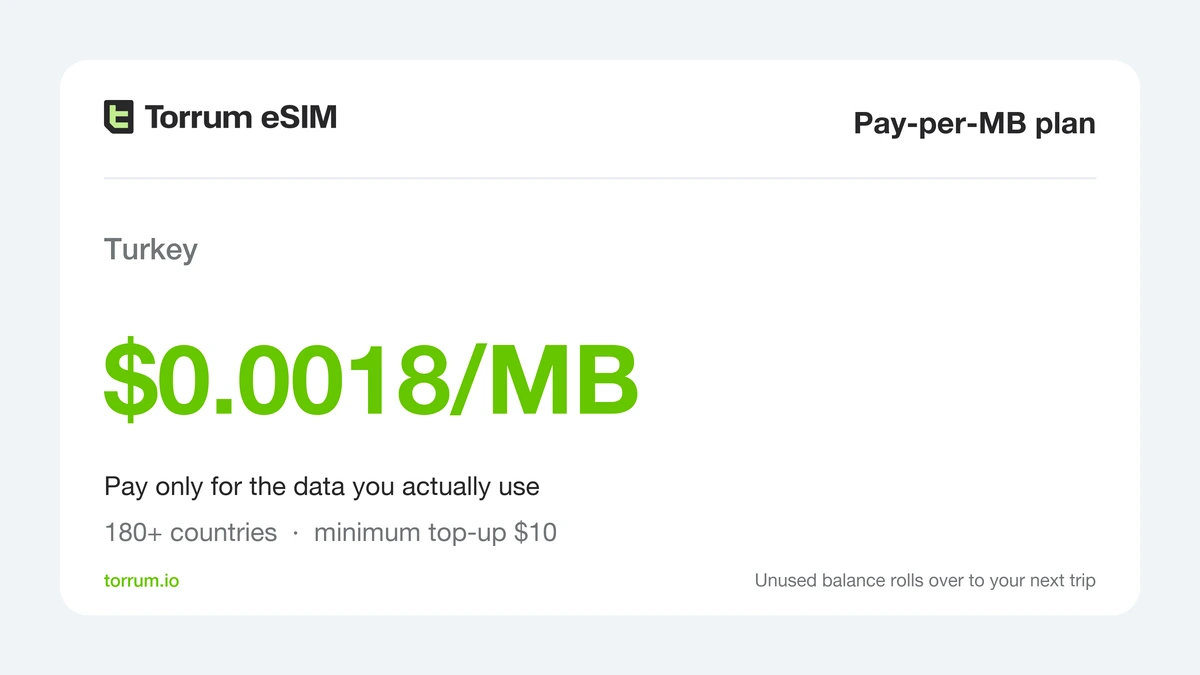
Pay-per-MB in Turkey: metered data for a single day ashore in Kusadasi or Istanbul.
The Caribbean is a different story. Island networks are expensive to roam on: Pay-per-MB rates there run from about double the European rate to more than ten times it, depending on the island. Mexico and Jamaica have their own country packages (Mexico, Jamaica), but neither is a low-cost destination. Some popular ports – Aruba, Sint Maarten and the US Virgin Islands – were not on Torrum’s country list when we checked on 8 October 2026.
Two more boundaries. US residents on Alaska, Hawaii or Puerto Rico sailings are in their own country, where a travel eSIM is not meant to be used – the home plan covers those ports. And no Torrum plan works on the ship itself: sea days mean ship Wi-Fi or your carrier’s cruise rates.
Ship time, phone time and the all-aboard trap
Phones take their clock from the network, the network keeps changing country, and the ship may keep a different time from the port it is in.
One major line’s official tips warn not to rely on your phone, because it may switch to local time in port, and recommend a wristwatch. Another states that shore excursion times are based on ship’s time.
All-aboard is set by ship’s time, so:
- check the ship’s time in the daily programme or app each evening;
- on port days where ship and shore time differ, set the clock manually or add a second clock for ship time;
- set your return alarm by ship’s time, with a margin.
Private islands, tender ports and satellite texting
Cruise-line private islands in the Bahamas are not “ship territory” for your phone. Land signal there, where there is any, comes from Bahamian networks, and US carriers treat Bahamas roaming as international. One line confirms that its onboard Wi-Fi package also works on its private island, a simple way to stay in touch on the beach.
Tender ports, where small boats ferry passengers from an anchored ship, keep the ship near the coast, so land masts may reach you on board – another reason to keep home roaming off.
Satellite texting on recent phones is not a cruise internet substitute. Apple says Messages via satellite is available only in the United States, Canada, Mexico and Japan, needs a clear view of the sky and horizon outdoors, and may not work above 62° latitude, such as northern Alaska. Treat it as an emergency backup ashore, not a plan for sea days.
Ship network, ship Wi-Fi, travel eSIM: side by side
| Feature | Home SIM on the ship network | Ship Wi-Fi package | Torrum eSIM |
|---|---|---|---|
| Where it works | At sea, from a few miles out | On board; some private islands | In port and near the coast, on listed land networks |
| Who sets the price | Your home carrier | The cruise line | Fixed plan price |
| Typical cost | US passes $15–20 a day; one UK network £5 per MB | Roughly $20–40 per device a day | Regional plan for the whole trip |
| EU price caps | Do not apply | Not roaming | Not needed: fixed price |
| Several devices | Each phone on its own bill | Usually one device per plan at a time | Each phone with its own eSIM |
| Home number calls and SMS | Yes, can be billed both ways | Via Wi-Fi calling, if your carrier allows it | Data only; the home line is separate |
| Best use | Emergencies, or a carrier cruise pass | Sea days | Port days and arrival |
A cruise-week phone plan
Before you leave home: confirm eSIM support and no carrier lock (the device list and our phone readiness guide help), then buy and add the plan over home Wi-Fi using the illustrated install guide.
Embarkation day: travel eSIM as the data line with Data Roaming on, home line’s roaming off, ship’s time noted.
Sea days: airplane mode with Wi-Fi on; one ship package if the cabin needs it.
Port days: airplane mode off once alongside, home line still off – a call or text on it may trigger your carrier’s daily charge. Upload photos and sync messages here, not at sea.
Sail-away: back to airplane mode with Wi-Fi as the ship leaves the berth.
Stuck on installation? Message Torrum’s Telegram support bot.
👉 Flying in for a multi-country sailing? Our guide to one eSIM across Europe covers borders, trains and the gaps in a regional plan.
FAQ
Does a travel eSIM work at sea on a cruise ship?
No. At sea the phone can only reach the ship’s own network, and Torrum’s plans do not cover ship networks. Use the ship’s Wi-Fi for sea days.
Why is roaming on a cruise ship so expensive?
The ship’s network reaches land by satellite and is billed as unregulated roaming. In the EU, Your Europe confirms that no price caps apply to satellite services on ships.
Is turning off data roaming enough?
It stops data, not calls and texts. To keep the home line off the ship network completely, switch that line off or use airplane mode with Wi-Fi.
Will I be charged for incoming calls at sea?
You can be. One UK network lists £1 a minute to make or receive calls on ship networks; check your own carrier’s cruise rates.
How much does cruise ship Wi-Fi cost in 2026?
Roughly $20–40 per device per day on the major lines, depending on the tier, the ship and whether you buy before sailing.
Can two phones share one ship Wi-Fi package?
Usually not at the same time. One major line states that only one device can use a plan at a time; multi-device bundles cost more.
Which Torrum plan suits a Mediterranean cruise?
Europe x32 – a package or a seven-day Unlimited for a one-week loop. Add Pay-per-MB if the route calls in Turkey or Montenegro.
Does Europe x32 cover a Norwegian fjords cruise?
Yes, Norway is part of Europe x32, as are Iceland, Denmark and the UK. The Faroe Islands are not – use Pay-per-MB there.
Is a travel eSIM worth it on a Caribbean cruise?
Less than in Europe. Island rates are high and some ports are not on the list, so for many Caribbean sailings ship Wi-Fi plus port café Wi-Fi is the cheaper mix.
Why did my phone show the wrong time in port?
Phones take the time from the network, and port time may differ from ship’s time. Excursions and all-aboard follow ship’s time.
Can I set up the eSIM after boarding?
Only with internet to download it – ship Wi-Fi or a café in port. Adding it at home, where the clock does not start until first connection, is simpler.
Final thoughts: pay for the sea only when you choose to
On a cruise, the expensive network is the one you never chose: the ship’s satellite system, billed at rates that EU caps do not touch and UK networks quote per megabyte. Home roaming off and airplane mode at sea keep it out of your bill, and one Wi-Fi package covers the sea days if you need them.
Ports are where the money is saved. On European itineraries one regional plan covers most ports of call; in Turkey or Kotor, metered data fills the gaps; in the Caribbean, honest arithmetic often favours Wi-Fi.
👉 Planning a European sailing? Choose a Europe x32 plan or compare Unlimited passes for the whole voyage.


 Continue with Google
 Continue with Telegram

