
Iceland after the 3G switch-off: calls, coverage gaps and the right data plan for a stopover, a Ring Road loop or an aurora trip
Contents:
The last Icelandic 3G masts went dark this spring: around Reykjavík on 8 April 2026, and across the rest of the country in May, on the schedule the regional paper Skessuhorn published. 2G had already gone. Every call and every megabyte now travels over 4G and 5G.
For most visitors that is good news – faster data and one modern network standard everywhere. For some it means a phone that can’t make calls the moment it lands. And there are a lot of visitors: about 2.27 million foreign passengers left through Keflavík in 2025, and three in ten were American, according to the Icelandic Tourist Board.
Below: what has changed in the networks, what roaming and a local SIM cost, and how to stay online on a stopover, on the Ring Road and on a long night chasing the northern lights.
👉 Already booked? See the Iceland packages and pick one for your dates.
Iceland after 3G: check your phone first
With 2G and 3G gone, voice calls in Iceland run over 4G. Síminn, the largest operator, puts it plainly: a device has to support 4G, 5G and/or VoLTE, or it will not be able to make calls.
Data is the easy part: the eSIM uses 4G and 5G directly. Calls on your home SIM are different: in roaming they now depend on 4G calling working between your home network and the Icelandic one, and that is down to your home network, not the phone’s alone.
Three checks before you fly:
- make sure VoLTE (often labelled 4G calling or HD Voice) is switched on in your phone’s mobile settings;
- ask your home network whether it supports 4G calling in roaming in Iceland;
- save the backup emergency number 599 0112 (+354 599 0112). Safetravel, Iceland’s travel-safety service, advises calling it if 112 does not connect or the call drops.
A data line also opens a second route: WhatsApp, FaceTime and other app calls work over the eSIM even if your home SIM can’t place a 4G call. Our guide to keeping your number abroad shows how to run both lines side by side.
Coverage itself is still settling. In August 2026, the news site Vísir reported on a review by the national telecoms regulator: the new networks are more sensitive to coverage gaps, some places improved after the switch-off while others got worse, and the operators spent the summer moving transmitters. A nationwide measurement was scheduled for September 2026.
Roaming in Iceland: free for some, a daily fee for others
EU and EEA residents. Iceland is not in the EU, but it is in the European Economic Area. The EU’s Your Europe portal lists Iceland, Norway and Liechtenstein inside roam-like-at-home, so a German or Spanish plan works there at home prices.
From the UK. After Brexit, most big British networks charge a daily fee in their European zone, typically about £2 to £2.47, while one large network still includes EU use (Uswitch, November 2025). Zone lists differ, so look up which one Iceland sits in on your plan. Our UK roaming guide covers the fair-use limits.
From the US. One major US network charges $12 for each day you use its international pass, plus $6 for every extra phone on the account (its pass terms as of 29 September 2026). For two phones over seven days, that is $126.
Síminn, Nova and Sýn: the local SIM route
Iceland has three mobile networks: Síminn, Nova and Sýn, which trades under the Vodafone brand.
Síminn publishes its prepaid prices openly. On its price list updated 25 September 2026 (dollar figures at the European Central Bank’s 30 September rate, €1 = 137 ISK = $1.1355):
- Starter pack: 3,000 ISK (about $25) for 10 GB, plus 50 minutes and 50 texts to 55 countries;
- Data top-up: 50 GB for 31 days at 5,800 ISK (about $48).
A local card gives you an Icelandic number, useful for booking a table or calling a guesthouse. The trade-offs:
- you buy it once you are in Iceland, so the first hour runs without data;
- the physical card replaces your home SIM unless your phone takes two;
- it covers Iceland only, so a stopover that continues to London or Paris needs something else for the second leg.
If you are staying for a month and need an Icelandic number, the local card makes sense. For data alone, an eSIM bought at home costs less per gigabyte and is already running when the plane taxis in.
Torrum plans for Iceland
Two limits first: a Torrum eSIM comes without an Icelandic phone number, and it needs an eSIM-capable phone that is not locked to one carrier. Iceland packages are priced the same as Spain or Croatia. The clock on a package starts when it first connects in Iceland, not when you pay, and unused data expires with the package’s last day.
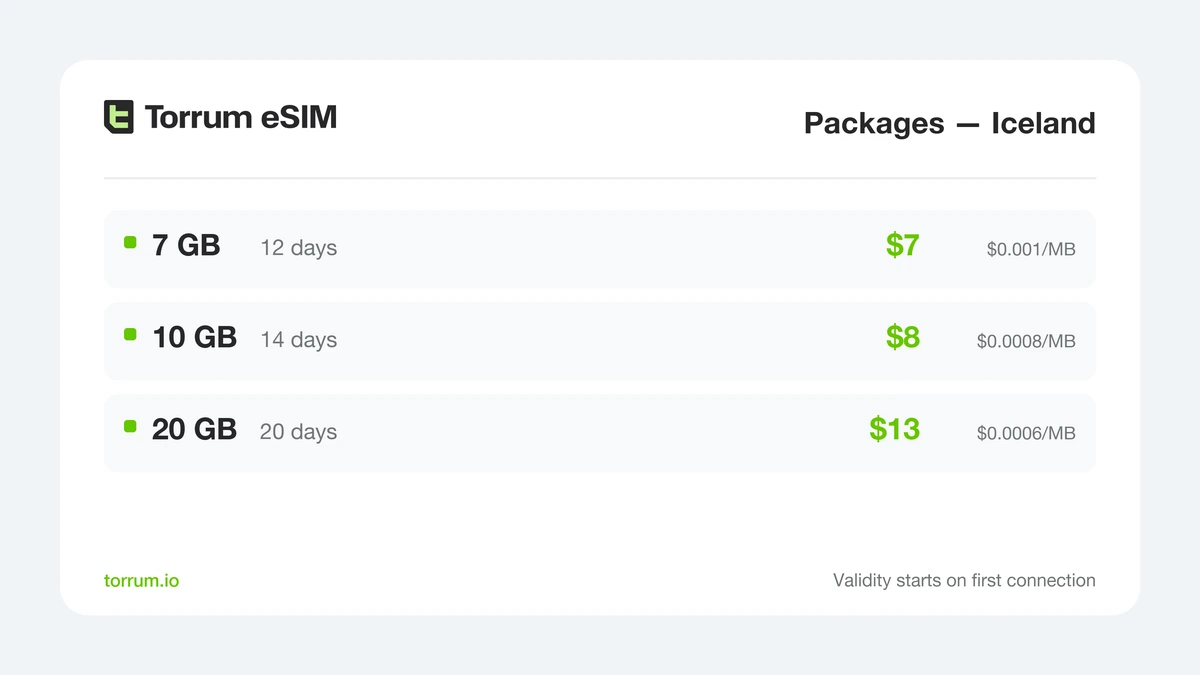
Iceland Packages: 7, 10 or 20 GB, with the clock starting on your first connection in Iceland.
On a road trip with streaming and uploads, you might use a lot of data in a day. Unlimited sells Iceland by the day, so a short, data-heavy stay has a fixed price.
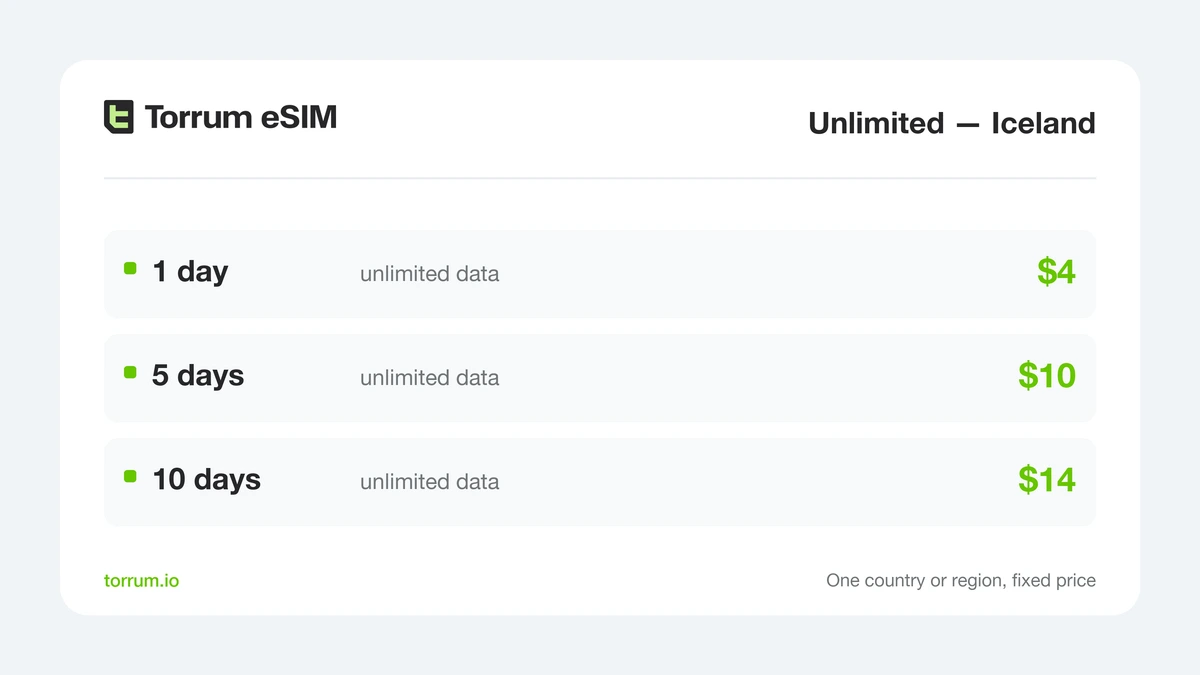
Iceland Unlimited: one day for a stopover, five or ten for a full road trip.
If you only need maps and messages, Pay-per-MB meters every megabyte instead: $0.0011 per MB in Iceland, charged to a balance you top up from $10. The same balance works in 180+ countries.
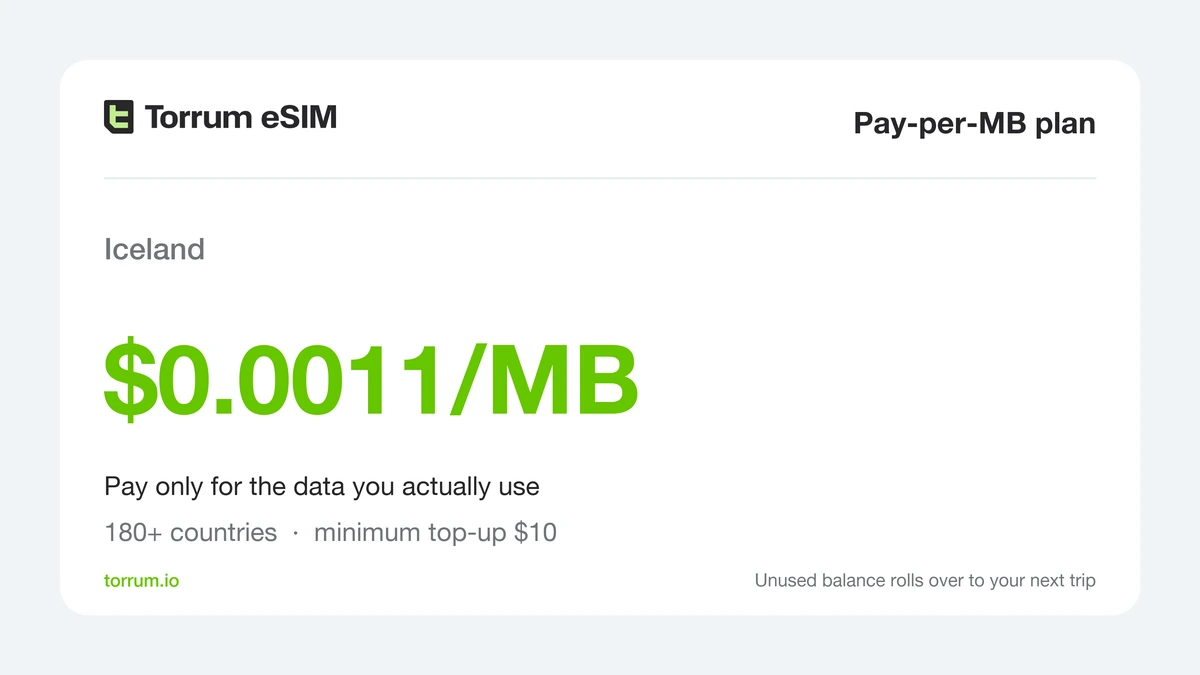
Pay-per-MB in Iceland: pay for what the trip actually uses.
A stopover on the way to Europe
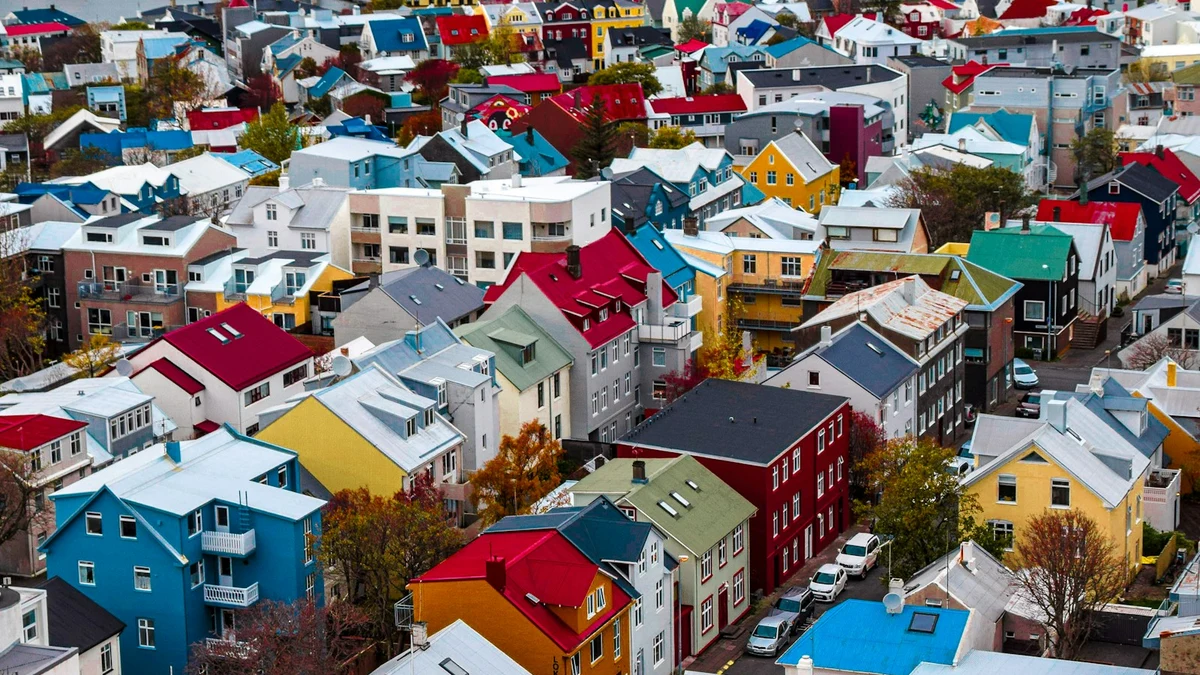
For many North American travellers, Iceland sits halfway to somewhere else. Icelandair lets transatlantic passengers add a stopover in Iceland at no additional airfare, for one night or up to a week.
That turns one trip into two countries, and the plan should cover both. Three ways to handle it:
- One profile for the whole trip. The Europe x32 package includes Iceland, the UK and most of continental Europe, so the same eSIM runs in Reykjavík and then in London, Paris or Copenhagen;
- Short stopover, long main trip. A day of Unlimited for Iceland, then a country package for the main destination;
- Several stops. Pay-per-MB works across 180+ countries without choosing a package for each.
Our multi-country Europe guide lists where the 32-country bundle stops. Note that the Faroe Islands and Greenland are not in it: both have their own packages.
Ring Road, side roads and the highlands

The Ring Road links most of Iceland’s towns, but signal between towns is not guaranteed, and after this year’s switch-off local reception can be better or worse than older coverage maps suggest.
The interior is another matter. Safetravel says the F-roads into the highlands are usually closed from mid-September until June or July. From now until early summer they are usually shut; in summer, plan as if you will be offline for hours.
Before leaving a town with signal:
- download offline maps for the whole day’s route, not just the destination;
- check road status on umferdin.is and weather alerts on Safetravel;
- register a travel plan with Safetravel for remote hikes or long drives;
- install the 112 Iceland app: it lets you text the emergency centre, and sends your location automatically when you contact them.
Aurora nights: cold batteries and dark roads

From autumn to spring, many visitors spend nights outside the towns waiting for the aurora. The phone does a lot of work: aurora forecasts, maps in the dark, long-exposure photos, and messages home at 1 a.m.
Cold is the hidden problem. Apple designs iPhones for ambient temperatures between 0 and 35 °C, and warns that in very cold conditions battery life can drop for a while, the phone can turn off, and it may not charge until it warms up.
A few habits help:
- keep the phone in an inside pocket between photos;
- carry a power bank, and charge the phone in the car on the drive out;
- download the forecast and your route back before you leave the last lit village;
- share your live location with someone at the hotel before you drive off.
Mobile data is light on these nights; the battery runs out first. The pages you need are small, so even a modest package lasts for a week of chasing.
Installing the eSIM before Keflavík
- Check your model on the device list.
- Create a Torrum account – a Google, Apple or Telegram login is enough.
- Pick the Iceland package – or Europe x32 for a stopover – and pay by card.
- At home, on Wi-Fi, scan the QR code in your Torrum account; the illustrated setup guide covers iPhone and Android.
- Set the eSIM as your mobile data line and keep the home SIM for calls and texts.
- Once the plane lands, enable roaming on the eSIM line only.
If the line doesn’t connect, write to the Torrum support bot in Telegram over airport Wi-Fi.
Wi-Fi at Keflavík and on the road
Keflavík Airport offers free Wi-Fi in the terminal, which is enough to message your driver or fix an eSIM that doesn’t start. Hotels, guesthouses and cafés in Reykjavík usually have it too.
Outside the towns, Wi-Fi is limited to where you sleep and eat. It won’t help you on the road between them – which is exactly where you need maps, weather and road updates.
Iceland compared: roaming, Síminn starter pack, Torrum
| Question | Home roaming | Síminn starter pack | Torrum Iceland |
|---|---|---|---|
| EU or EEA resident | Included at home prices | Optional | Optional |
| UK or US visitor | Often a daily charge | About $25 for 10 GB | Fixed package price |
| Ready on landing | Yes | After buying a card | Yes |
| Calls on the home number | Need 4G calling in roaming | Icelandic number | Home SIM stays in; calls still need 4G calling |
| Continues to London or Paris | Depends on your plan | No | Yes, with Europe x32 |
| Month-long heavy use | Expensive | 50 GB top-up, about $48 | Packages back to back, lower per GB |
Which plan for which Iceland trip
A 24- or 48-hour stopover. One day of Unlimited for a single night, the smallest package for two, or Europe x32 if the flight goes on to Europe.
A week on the south coast. The smallest Iceland package covers maps, photos and calls in apps.
Two weeks around the Ring Road. The largest package, plus offline maps for the east and the Westfjords.
An aurora trip in winter. A small package is enough; spend the effort on batteries and route planning.
Four weeks or longer. Torrum packages bought back to back still cost less per gigabyte; choose a Síminn card if you need an Icelandic number for day-to-day life.
FAQ
Is roaming free in Iceland for EU residents?
Yes, within your plan’s fair-use limits. Iceland is in the European Economic Area, so EU roam-like-at-home rules apply there.
Will my phone work in Iceland after the 3G shutdown?
Data will, on any eSIM-capable phone. Voice calls need 4G calling (VoLTE) on the phone and in your home network’s roaming.
What do I dial if 112 doesn’t connect?
Safetravel gives 599 0112 as the backup number. The 112 Iceland app can also send a text with your location.
Who are the mobile operators in Iceland?
Síminn, Nova and Sýn (Vodafone). Torrum’s eSIM roams onto these same Icelandic networks.
How much is a Síminn tourist SIM?
The starter pack costs 3,000 ISK, about $25, for 10 GB plus some calls and texts (price list of 25 September 2026).
Is there signal in the highlands?
Plan for long stretches without it. F-roads usually close from mid-September to June or July anyway.
Does the Iceland package work on an Icelandair stopover to Europe?
Only in Iceland. Use Europe x32 to cover Iceland plus the UK or continental Europe on one profile.
Are the Faroe Islands or Greenland included?
No. Both have separate packages, and neither is part of Europe x32.
When does my Iceland package start?
When the eSIM first connects in Iceland. Leftover data does not carry past its final day.
Does cold weather affect my phone?
Yes. Below 0 °C, Apple says battery life can drop for a while and the phone may switch off, so keep it warm and carry a power bank.
Can I keep receiving calls on my usual number?
Yes, if the phone takes two lines and your home network supports 4G calling in roaming. App calls work over the eSIM regardless.
I live in Iceland. Can I use Torrum there?
Only when you travel abroad. Torrum’s terms rule out use in the country where you normally live.
Final thoughts: a small country with modern networks and empty miles
Iceland now runs entirely on 4G and 5G, and getting data there is cheap for almost everyone. What needs attention is calling over 4G, the empty country between towns, and phone batteries on cold aurora nights.
For most trips, an eSIM set up at home is the simplest answer: online as soon as you land, with the home number still in the phone. For a stopover, Europe x32 carries the same line on to the rest of Europe.
👉 Ready for the Ring Road? Pick an Iceland package, or take Europe x32 if Iceland is your stopover.


 Continue with Google
  Continue with Telegram

