
Several countries, one phone: how to keep mobile data running on a multi-country Europe trip, from Monaco's single network to ferries and the Channel Tunnel
Contents:
A Global rail pass opens 33 European countries, from Great Britain to Turkey (Euronews, 20 July 2026). The list printed on your data plan will not match it line for line – and the lines that differ are where a phone bill jumps.
For a trip through several countries you have three ways to stay online: roam on your home plan, pick up a local card at the first stop and carry it onwards, or load a regional travel eSIM at home.
Below: which countries a regional plan actually reaches, the pockets it skips, and the three places a moving phone behaves oddly – Monaco, the train and the sea.
👉 Route already sketched? Open the Europe x32 country list and tick your stops against it.
Start from the route, then pick the plan
A country package works inside one set of borders. Step over the line and it stops, even if the next town is twenty minutes away. For a trip through four countries, that means four plans.
A regional package works the other way round. One profile, one allowance, one validity window across the whole list. When the train leaves Belgium, the phone drops the Belgian mast, picks up a Dutch one and carries on.
So the first question is not “which country is cheapest?” but “are all my stops on one list?” The Torrum Europe x32 list covers 26 of the 27 EU members, plus Norway, Iceland, Liechtenstein, Switzerland, the United Kingdom and the French island of Réunion in the Indian Ocean.
Where the 32-country list stops
The 27th EU member is the easy one to overlook: Ireland is not in the region. A London–Dublin–Paris loop needs a second plan for the Irish days, and Ireland has its own packages as well as a Pay-per-MB rate of $0.0011 per MB.
Turkey is outside too, with separate country packages – worth knowing if an Istanbul stop closes a Balkan or Greek route. The western Balkans outside the EU are out too, at several times the usual EU rate.
Then come the small places a road trip passes through without noticing. Andorra on the drive from Barcelona into the Pyrenees, Gibraltar beside Andalusia and Monaco on the Riviera each appear as separate lines in our price list, outside the regional package. Monaco needs its own section.
Monaco: a single network wall to wall

Monaco is not an EU member, and since 5 March 2024 it runs a unified mobile network. The principality’s public service portal explains that customers of French operators now connect to Monaco’s network by roaming throughout the principality, just as they would abroad (page updated 11 October 2024).
For a visitor that has two consequences. Inside Monaco, even a French SIM is sent to the Monegasque network rather than kept on a French one – the home market next door gets no exception. And the portal notes that phones in automatic network selection mode choose that network by themselves.
On a Torrum plan, Monaco has its own packages, and its per-megabyte rate is many times the usual EU rate. A day trip from Nice is cheap to plan around:
- save offline maps and any tickets while still in France;
- switch mobile data off for the hours inside the principality, or buy a small Monaco package if you need to stay reachable;
- on the French side of the border, check which network the phone has picked before you start streaming.
Five countries on a daily roaming pass
Roaming is the zero-effort option, and on a multi-country trip its cost scales with days, not with countries.
From the US. One of the largest American carriers charges $12 a day for its international day pass on land, plus $6 for each additional line used on the same day; the 24 hours start the first time you use data, text or call (carrier’s day-pass page, checked 25 September 2026). Fourteen days across five countries comes to $168 for one phone.
From the UK. Most big British networks charge again for EU roaming, around £2 to £2.47 a day, while one major network still includes it (per Uswitch’s EU roaming guide, November 2025). Whether Switzerland counts as “Europe” depends on your network’s zone list – our guide to UK roaming after Brexit walks through the zones and fair-use caps.
From the EU. You may not need anything. The EU’s no-surcharge roaming reaches every member state plus Norway, Iceland and Liechtenstein – and now Moldova and Ukraine as well, according to the EU’s Your Europe portal (January 2026). Outside it: Switzerland, the UK, Turkey, the western Balkans and the small territories above.
The local SIM that follows you across the EU
Here is a point worth making even on an eSIM blog: a prepaid SIM bought in the first EU country of your trip falls under that same EU no-surcharge rule. A card from Lisbon keeps working in Seville, Bordeaux and Milan.
Three limits apply:
- The roaming allowance can be smaller than the local one. Operators may cap roaming data, and for prepaid cards the EU minimum depends on the credit you hold (Your Europe).
- The rule stops at the EU/EEA edge. Switzerland and the UK are not on it. Some tourist SIMs sold for Europe add them by their own terms, so read the coverage list, not the name on the pack.
- You still need a shop. Buying means finding a counter on the first day, and what you get is a new number, not your own.
For a month-long, EU-only trip a local card can be the cheapest route. For a week that also takes in Zurich or London, a regional plan installed at home skips the shop and the gaps.
Trains, tunnels and on-board Wi-Fi

Trains carry much of a multi-country trip, and on-board Wi-Fi is less independent than it looks.
Deutsche Bahn explains that Wi-Fi on its long-distance trains runs on “all the mobile networks available on the railway lines in parallel”, so speed depends on which networks the system can reach. Free Wi-Fi also runs on connections into Austria, Switzerland, France, Belgium and the Netherlands. When the phone loses signal in a valley, the train’s Wi-Fi can struggle on the same stretch.
Eurostar offers free Wi-Fi on all its routes, with faster connections in its upper classes on the continental services. Under the Channel itself, coverage was installed by specific mobile networks: Eurotunnel (now Getlink) announced in May 2014 that both tunnels were equipped for calls and mobile internet, for the 20 million people who crossed each year. Whether your phone keeps data 100 metres below sea level depends on whether the network it is roaming on is one of them.
Practical rule for rail days: save tickets and the next city’s map at the station, and count on-board Wi-Fi as a nice extra rather than a safety net.
On the water, land networks fall behind

Ferries between Italy and Greece, overnight crossings to Scandinavia and cruise itineraries all leave coastal masts behind at some point. In ports, normal roaming applies. Further out, a phone may attach to a satellite service run on board, and the EU’s price caps no longer apply there (Your Europe).
Home carriers price that separately: the same American carrier sells a cruise pass at $20 a day. A travel eSIM does not solve it either – no Torrum plan lists ship or in-flight networks.
So on the water:
- switch data roaming off on your home line before the ferry leaves, or use flight mode with Wi-Fi on;
- pay for the ship’s Wi-Fi only if you really need to be online at sea;
- let the eSIM pick up land networks again as you approach the next port.
One profile for the whole route: setup
Do the install at home, over the household router, and the profile is waiting at the first border.
- Confirm your phone takes an eSIM and is not carrier-locked, using the list of supported devices.
- Sign up at Torrum with your Google, Apple or Telegram login.
- Choose the Europe x32 package for the core of the route and add a country plan for any stop outside it.
- Check out with a bank card, then point the camera at the QR code Torrum shows you; the step-by-step screens show each tap.
- Label the new line “Travel” and make it the data line; leave your home SIM on for calls and texts.
- Once abroad, enable roaming on the Travel line and leave it off on the home one.
Stuck at a border with no signal? Message the Torrum support bot on Telegram from any Wi-Fi.
Torrum plans for a trip through several countries
For a route inside the 32 countries, start with the regional package. It starts counting days on its first connection, not on the day you buy it, and expires on its end date even if gigabytes are left over.
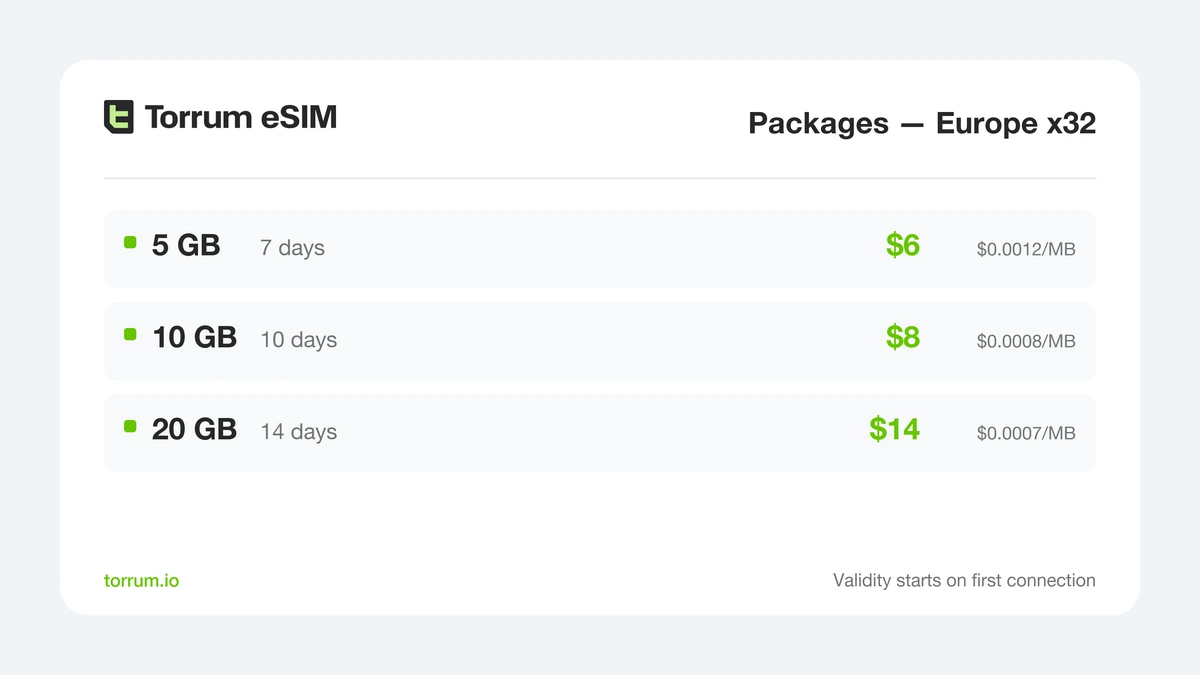
Europe x32 Packages: one allowance from Lisbon to Tromsø, sized by gigabytes and days.
How much to buy depends on what you do online more than on how many countries you visit; our data-use guide works it out from your own phone’s settings. If almost every night is in one country, that country’s own package usually gives more days for similar money.
Heavy users – video calls from the train, say – should look at Unlimited, sold for the same 32 countries by the period rather than by the gigabyte.
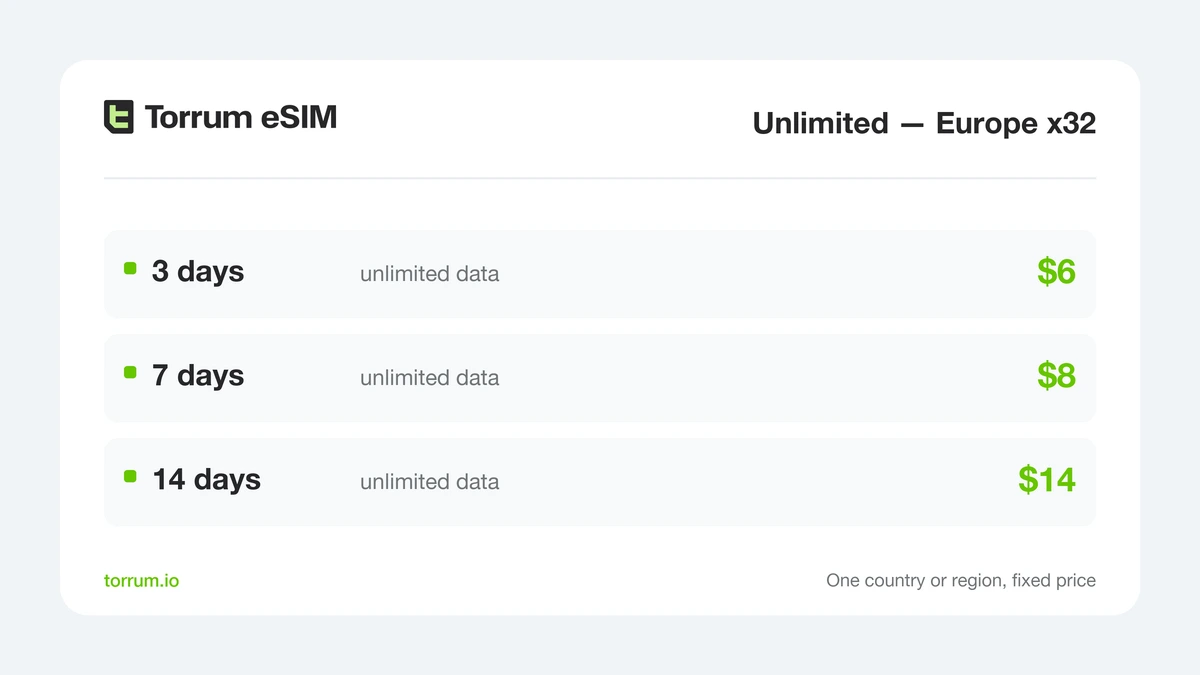
Europe x32 Unlimited: the same list, sold by the period.
For the stops outside the region – Ireland, say – Pay-per-MB bills only the megabytes you use from a prepaid balance, so a two-day Dublin detour needs no package of its own.
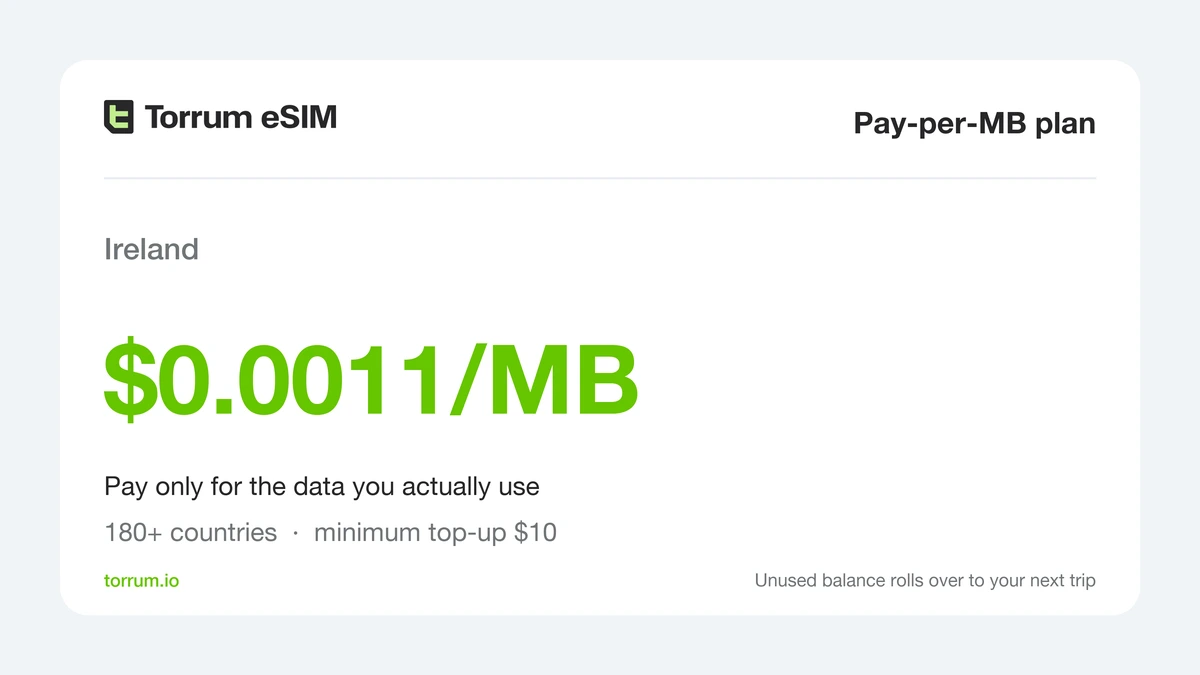
Pay-per-MB in Ireland: a balance for the day or two your route leaves the region.
Multi-country Europe: roaming, a local EU card and a regional eSIM compared
| Question | Home roaming | Local EU SIM | Torrum Europe x32 |
|---|---|---|---|
| Works on landing | Yes | After a shop visit | Yes, installed at home |
| Cost grows with | Days abroad | Top-ups | Package size or days |
| Across EU borders | Yes, at pass prices | Yes, under EU rules | Yes, one profile |
| Switzerland and the UK | Depends on the plan’s zones | Only if the card’s terms add them | Included |
| Ireland | Depends on plan | Yes, it is in the EU | Separate plan |
| Monaco | Roams on Monaco’s network | Outside EU rules | Separate plan |
| Ferries and cruises at sea | Ship network, billed separately | Ship network, no EU caps | No ship networks |
| Your usual number | Yes | No, new local number | Home SIM stays active |
Six itineraries, six answers
London, Paris, Amsterdam by train. All three cities are on the list. One regional package; plan the Channel minutes offline.
Milan, the lakes and a Swiss mountain pass. Italy and Switzerland share the list, a pairing EU roaming rules do not guarantee. Regional package; our Switzerland guide covers the valleys where signal thins.
The Riviera with a day in Monaco. Regional package for France and Italy; data off in Monaco, or a small Monaco package for the day.
Britain and Ireland. Regional package for Great Britain, Pay-per-MB for the Irish days. From the UK? Skip the regional package; Torrum is for travel away from home.
Greek islands by ferry. Regional package on land; home-line data off for the open-water legs.
A month in one EU city, weekends across borders. A local card can be the better buy here – it covers EU weekends too. Add a regional plan only if Switzerland or the UK is on the route.
FAQ
Does one Torrum plan work in every country of a Europe trip?
The Europe x32 packages cover 32 countries on one profile. Check each stop against the list; Ireland, Turkey, Monaco, Andorra and Gibraltar are outside it.
Do I need to do anything when the train crosses a border?
No. The phone hands over to the next country’s network by itself, and the regional plan carries on as long as both countries are on the list.
Why is Ireland not in the Europe region?
The regional list is set by the plan, not by EU membership. Ireland has separate packages, plus metered Pay-per-MB pricing.
Can I stay on a French network inside Monaco?
No. Since March 2024, French customers inside the principality connect to Monaco’s network by roaming, as they would abroad.
Is there signal on a ferry between Greek islands?
Near the coast and in port, yes, on land networks. Mid-crossing the phone may join an on-board satellite service, and no Torrum plan includes those.
Does the eSIM work in the Channel Tunnel?
Only if the network your phone roams on is one of those equipped inside the tunnel. Save anything you need at the station.
Is a local EU SIM a good alternative for a trip through several countries?
Inside the EU, it can be: EU roaming rules let it keep working across member states. It does not reliably cover Switzerland or the UK, and it gives you a new number.
I live in the UK. Can I use the regional plan at home before I leave?
No. Torrum’s terms rule out use in the country where you normally live – UK coverage is for visitors.
Can I use the same eSIM for my next trip?
Each package ends on its end date; buy a fresh one next time. Unused Pay-per-MB credit stays on your balance.
Will my home number still receive calls and texts?
Yes, if the home SIM stays switched on. Watch its roaming charges for calls and SMS, and keep its data roaming off.
Does the eSIM work on a short flight between two stops?
In the air, in-flight systems replace land networks, and no Torrum plan covers them. The eSIM reconnects after landing.
Final thoughts: one plan, drawn around your route
On a single-country holiday the choice is about price. On a trip through several countries it is about coverage: a plan that stops at a border costs more than a slightly dearer one that doesn’t. Draw the route, then check it against the list.
For EU residents staying inside the EU, home roaming may already be enough. For travellers from the US and UK, and for anyone whose route touches Switzerland or Britain, a regional eSIM installed before departure removes the gaps – except Monaco, the open sea and Ireland, which you now know how to handle.
👉 Ready to cover the route? Choose a Europe x32 package, and if Ireland is on the way, see the Irish packages too.


 Continue with Google
  Continue with Telegram

