
Mobile internet in Italy: coverage, local SIM cards, roaming costs and the eSIM alternative
Contents:
Italy closed 2025 with roughly 185 million tourist arrivals, and foreign arrivals alone climbed 8.7% to more than 104 million.
Every one of those foreign arrivals faces the same decision between the gate and baggage claim: roam on the plan you have, queue for an Italian SIM, or install an eSIM before leaving home. The three differ more than the marketing suggests – in price, in paperwork, and in what happens when you board a ferry or drive towards the Alps.
👉 Straight to the numbers? See Torrum data packages for Italy.
Italian networks in 2026: who runs them and where the signal stops

Four operators carry Italian mobile traffic: TIM, WindTre, Iliad and Fastweb+Vodafone – the last formed on 1 January 2026 when Fastweb and Vodafone Italia merged, bringing some 20 million mobile lines and 5G reaching about 87% of the population.
Between them they claim 5G population coverage of 90–95%. That is accurate, and slightly misleading: population coverage is not territory coverage. Estimates for 2026 put 5G across roughly 60–70% of Italian land area. Iliad and WindTre also run a joint venture, Zefiro Net, to share the cost of covering rural areas home to about 26.8% of Italians.
In practice, Rome, Milan, Florence, Naples and Venice are excellent. The gaps show up where holidays happen – deep valleys, slopes above the tree line, coastal trails and thinly populated interiors. Two habits solve most of it: download offline maps before you go, and pick a plan that is not tied to a single operator’s footprint.
Free Wi-Fi in Italy: generous at the airport, patchy after that
Italy’s two main gateways are unusually generous. Rome Fiumicino offers free, unlimited Wi-Fi across check-in, gates and arrivals – connect to AIRPORT FREE WIFI and access runs automatically. Milan Malpensa runs MALPENSA FREE WI-FI with no account and no time limit. After that:
- Some cafés and hotels gate access behind an SMS code, and a foreign number does not always work.
Speeds also collapse in high season. Treat Wi-Fi as a bonus, not a plan.
Roaming in Italy: what it actually costs
Roaming takes zero effort: the phone connects on landing. The cost depends entirely on where you fly from.
From the EU: nothing extra. Under Roam Like at Home an EU resident uses their domestic allowance in Italy at no additional charge – no problem to solve here.
From the United States: daily international passes typically run about $10–15 per device per day (published carrier tariffs, checked August 2026), and usually activate the moment the phone touches a foreign network. Without a pass, billing is per megabyte – that is where the horror stories live.
From the UK: the awkward one. Post-Brexit, roughly half the UK market reintroduced daily EU fees of around £2–£2.59; the rest still includes EU roaming under fair-use caps of about 5–30 GB (published UK carrier terms, checked August 2026). Check your own plan before you fly.
Local SIM cards in Italy: bring your passport
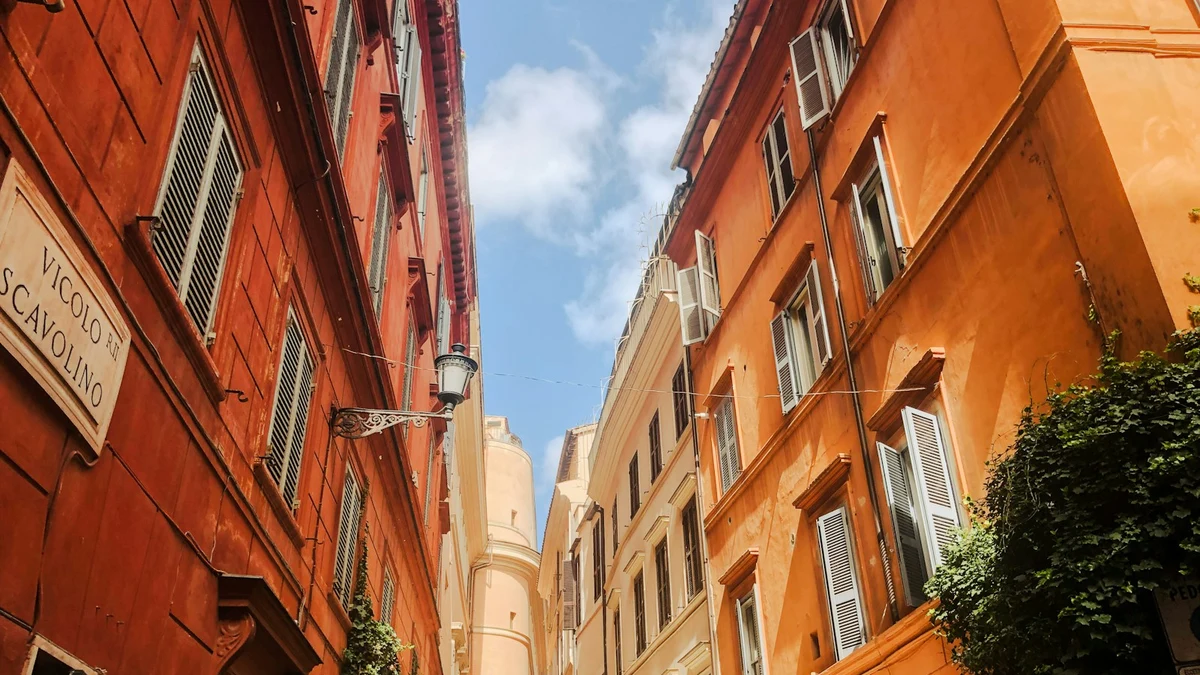
Italy is genuinely cheap for prepaid data, and strict about who may buy a SIM. Since Decree 144/2005, every prepaid SIM must be registered against an identity document, in person, at a shop or airport desk. Non-EU visitors are asked for a passport – no document, no SIM.
Tourist offers broadly land between about €8 and €25 for 20–150 GB over 30 days – roughly $9–29 at 1 EUR = 1.16 USD on 19 August 2026.
Pros
- The lowest cost per gigabyte by a wide margin.
- An Italian number, which unlocks SMS-gated Wi-Fi.
- Allowances big enough for a long stay.
Cons
- The document has to come out, and August queues are long.
- You lose your usual number, or juggle two.
- Anything left over vanishes on departure.
For three weeks, a local SIM is hard to beat. For a five-day break, the lost hour outweighs the saving.
How an eSIM works in Italy
An eSIM is a mobile profile downloaded onto your phone instead of a plastic card. It activates on landing, while your physical SIM stays put and keeps taking calls on your usual number. One setting matters: Data Roaming must be switched on for the eSIM profile.
Upside: no queue, no passport at a counter, a price known before departure. The honest downside: your device must support eSIM, and a data-only eSIM gives you no Italian number – check yours on the supported devices list.
Setting up a Torrum eSIM for Italy
- Confirm your phone supports eSIM and is unlocked – see the compatibility guide.
- Register at torrum.io using Google, Apple or Telegram, and pick a plan: a data package for Italy, the global Pay-per-MB plan, or an Unlimited plan.
- Pay by bank card – minimum top-up $10, with $10–100 per transaction.
- Install the profile by scanning the QR code – the app walkthrough shows every screen.
- Switch on Data Roaming for the Torrum profile, leaving your home SIM as the voice line.
- Land and connect – the support bot answers questions in Telegram.
Torrum plans for Italy: how much data costs
Three plans, three kinds of trip. Current Italy pricing:
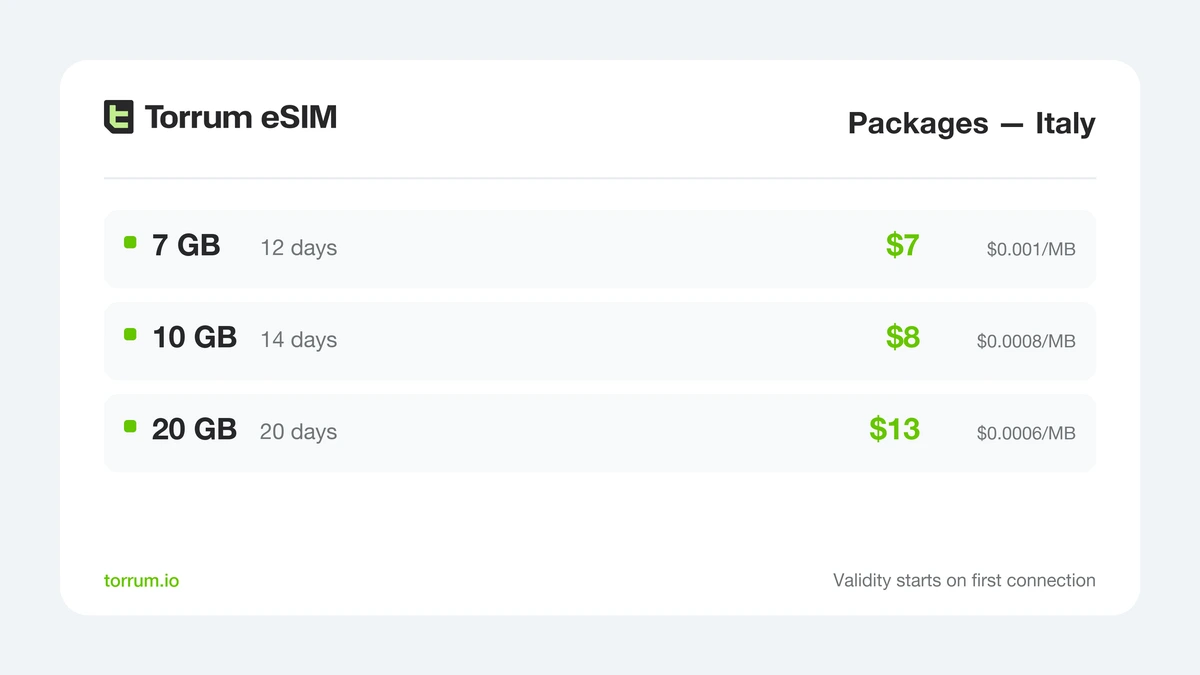
Italy data packages – validity begins the first time the eSIM connects, not when you buy it.
For most travellers the middle option is the sweet spot: maps, messaging, bookings and plenty of photos sit inside 10 GB over a fortnight.
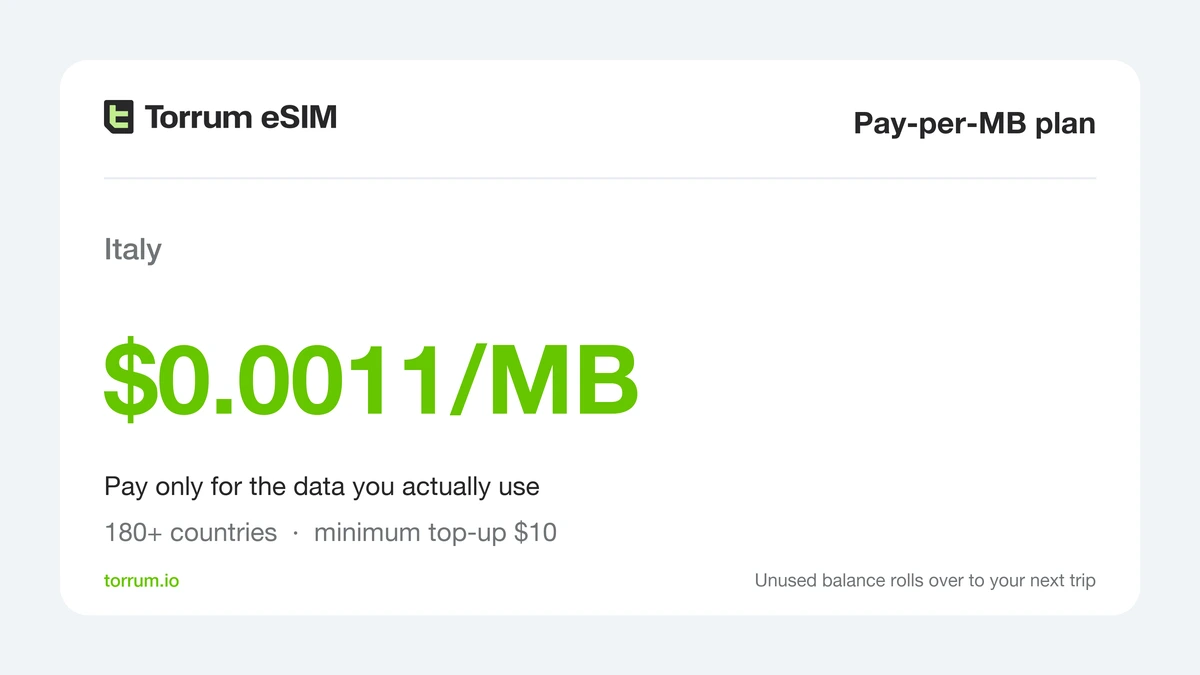
Italy on Pay-per-MB – $0.0011 per megabyte, billed only on what you use, and an unused balance carries over to your next trip.
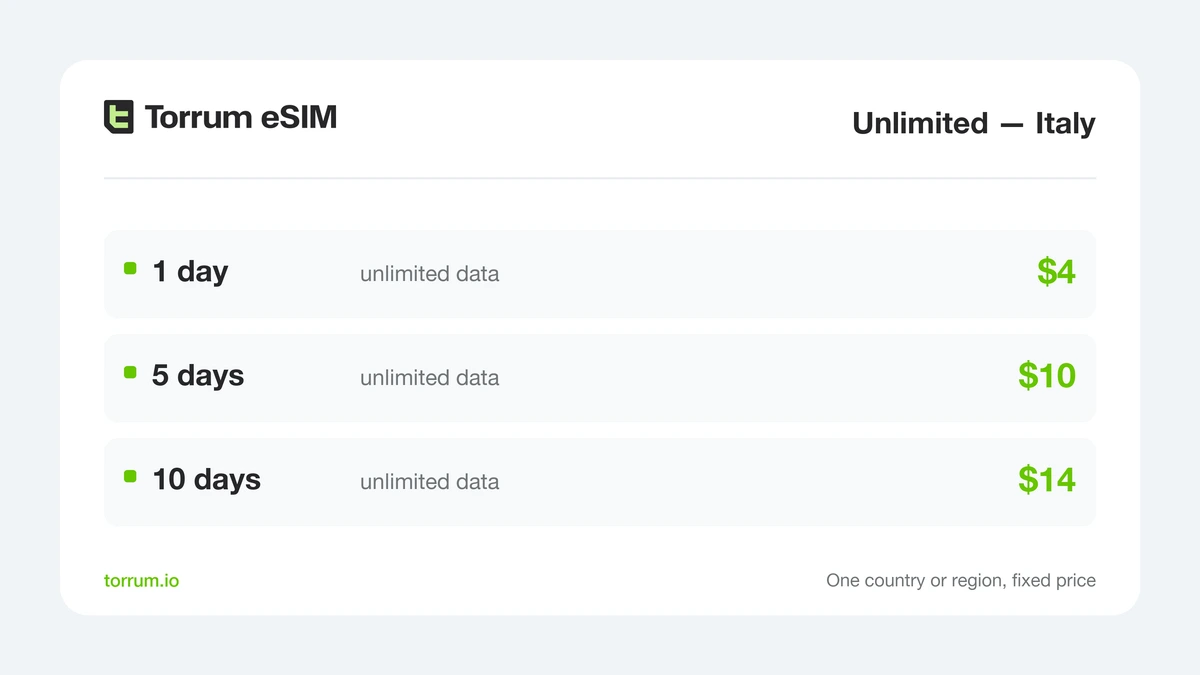
Unlimited for Italy – a fixed price per day when you would rather not think about megabytes at all.
Where EU roaming quietly stops: Swiss day trips and the ferry trap

Switzerland is not in the EU roaming zone. Some of the best day trips from Italy cross that border – Como or Milan up to Lugano, Aosta towards the Swiss Alps. The moment your phone registers on a Swiss network, EU roaming rules stop applying, leaving daily add-ons commonly in the €5–15 range, or per-megabyte rates that climb fast (roaming guides, checked August 2026). EU residents who roam freely across Italy are just as exposed here.
Ferries are their own billing universe. Crossings to Sardinia and Sicily leave land coverage behind, and some vessels run offshore maritime or satellite networks. Your phone connects automatically if roaming is on – and those networks sit outside normal roaming bundles and outside EU roaming protection. Rates reported in 2026 run from a few dollars to $30 per megabyte, so a scroll while waiting to dock can cost more than the ticket.
Three defences, in order of effort:
- Turn mobile data off before the ferry leaves the dock.
- For a border day trip, buy a plan for the country you are actually visiting.
- Or run Pay-per-MB across the route – you pay only for the megabytes you actually spend, with no daily fee ticking while you are between ports.
Italy compared: roaming vs local SIM vs eSIM
| What matters | Roaming | Local Italian SIM | Torrum eSIM |
|---|---|---|---|
| Set-up effort | None | Shop visit on arrival | Installed before you fly |
| ID required | No | Yes – ID document, by law | No |
| Cost, one-week trip | Highest for US and some UK plans; free inside the EU | Low | Low and fixed in advance |
| Keeps your own number | Yes | No | Yes – home SIM stays active |
| Coverage in thinly covered areas | Host network only | Chosen operator only | Roams on Torrum’s Italian partner networks |
| Swiss day trip | Usually billed separately | Usually billed separately | Add a Swiss plan, or use Pay-per-MB |
Choosing by trip type
A long weekend in Rome, Florence or Venice. On foot with maps open all day – the smallest Italy package is plenty. For two weeks touring, take a larger one and stop counting.
Italy as one stop on a European route. One balance across borders beats a plan per country – that is what Pay-per-MB is for.
👉 Our guide to connectivity in Spain covers the next leg.
One day in Milan for meetings. A single day of Unlimited is the least stressful option.
Arriving late at night. Operator desks close; a profile installed at home has you in a taxi while everyone else hunts for a shop.
FAQ
Do I really need my passport to buy a SIM card in Italy?
Yes. Identity registration has been required for every prepaid SIM since Decree 144/2005, and shops enforce it. Bring your passport.
Will my phone work in the Dolomites?
In towns and ski resorts, generally yes. Above the tree line and in deep valleys, expect short dead zones.
Does my Italian plan cover a day trip into Switzerland?
Almost never – Switzerland sits outside the EU roaming zone, so an Italy plan stops at the border.
What happens to my data on the ferry to Sardinia or Capri?
Some ships run maritime or satellite networks that fall outside normal roaming deals and bill per megabyte at high rates. Switch data off for the crossing.
Is airport Wi-Fi at Fiumicino and Malpensa genuinely free?
Yes – Fiumicino with automatic access, Malpensa with no registration and no time limit.
Do UK travellers still pay to roam in Italy?
It depends on the network: around half the UK market charges roughly £2–2.59 a day, the rest still includes EU roaming under a fair-use cap.
Which Italian network will a Torrum eSIM use?
It roams on Torrum’s Italian partner networks – the phone registers on an available one automatically.
When does my Italy package start counting down?
On first connection to a network, not at purchase – so buying a week before you fly costs you nothing.
Can I use one plan for Italy and a side trip to Greece or Spain?
Not on a single-country package – use Pay-per-MB, one balance across 180+ countries.
Which devices support eSIM?
iPhone XS and later, recent Pixel and Samsung flagships and most mid-range Androids – but not iPhones sold in mainland China. The device list is the reliable check.
Final thoughts: the best connection option for Italy
Italy is an easy country to stay connected in and a surprisingly easy one to overpay in. Networks are strong where the people are, local SIMs are cheap if you will hand over a document, and roaming is either free or painful depending on where your plan was bought.
For a week or two, an eSIM installed before departure has the fewest moving parts: a known price, your own number intact, no counter to find. Keep the two Italian traps in mind – the Swiss border and open water – and nothing on the bill will surprise you.
👉 Ready to sort it before you fly? Choose your Italy data package – or see how the same choice plays out at the 2026 World Cup across the USA, Canada and Mexico.


 Continue with Google
  Continue with Telegram

