
A layover is where the phone does the most work and your plan covers the least: what airport Wi-Fi asks for, and which plan fits three hours in a country you are not visiting
Contents:
Europe ran 35,959 flights a day this summer and landed 72.6% of them on time (EUROCONTROL, 11 September 2026). Turn that around and it reads less comfortably: more than one arrival in four was late, and a late arrival is where a connection breaks.
A layover is an odd piece of a journey. You are in a country you did not choose, for hours you did not choose either, and it is the part of the trip where the handset does the most work – the gate that moved, the reissued pass, the message home, the rebooking.
It is also the part nobody buys data for. Whatever plan you bought covers where you are going.
👉 Straight to the shape that fits a gap: Pay-per-MB, priced by the megabyte rather than by the week.
What the phone is actually doing between two flights
A layover rarely asks you to read something you already hold. It asks you to receive something new.
The gate that changed while you were in the air. The seat reassigned after a swap of aircraft. The transfer desk queue you would rather not join if the airline’s app can do the same job. The hotel at the far end, wanting a confirmation before midnight.
None of it is heavy. All of it is time-critical, and all of it arrives over the network rather than out of your pocket – which is the argument for treating the connection as its own leg rather than as dead time bolted to the leg before it.
Airport Wi-Fi is free almost everywhere. The sign-in is the hard part

Big hubs solved the price question years ago. What they did not agree on is how you prove who you are.
Singapore Changi states plainly that you need not register, pay or provide personal information – you pick the network and you are on. Amsterdam Schiphol gives four hours per session on Schiphol_Free_Wi-Fi and tells you to log in again, free, when it runs out. Doha’s Hamad International offers complimentary wireless across the terminal on #HIAQatar, with a sign-in page in the way.
Istanbul is the instructive one. Its Wi-Fi is unlimited and free, with two doors into it: a phone number and the code that arrives by SMS, or a terminal kiosk that reads your passport and issues an access code. Only the second of those works without a line that can receive a text.
The pattern is not about money. It is about identity, and about proving it while a gate waits.
Two caveats: the airport network stops at the airport, and it is an open one shared with a few thousand strangers.
The hub is a country, and your plan may not contain it
This is the mistake that costs money, and it is invisible at the moment of purchase. A country package covers a country; a regional package covers a named list. Your connection happens in neither, unless the hub is on the list.
Take the European case. The Europe x32 regional package reaches Amsterdam, Frankfurt and Madrid, and it reaches the United Kingdom too. It does not reach Istanbul. Turkey is absent from that list of thirty-two and sits on its own country plan instead. Ireland is not on that list either, which surprises people routing through Dublin.
The Asian picture works the same way. Asia x20 takes in Singapore and Hong Kong alongside the bigger destinations, so a route stitched through either can sit on one profile – but a Gulf connection sits outside that list, and the Emirates carry a country plan of their own.
The fix is thirty seconds of reading: open the regional block, look for the hub by name, and if it is absent, choose between a second country plan and a meter that does not care where you land.
When the connection slips, what the rules give you

Passenger rules are more generous than travellers expect, and older than their phones.
The EU regulation covers departures from a Member State, and arrivals into one on an EU carrier. Within that scope, a long delay at departure triggers a duty of care at two hours for short flights, three for most medium ones and four for the longest. Article 9 spells out what care means: meals and refreshments, a hotel where a night becomes necessary – and, in its own paragraph, “two telephone calls, telex or fax messages, or e-mails”, free of charge.
That sentence was written in 2004, and it shows. The right is real; it is not a data plan, and nobody at the desk will hand you one.
On the American side, the Department of Transportation lists what counts as a significant change entitling you to a refund: three hours domestic, six hours international, a different airport – and, notably for anyone reading this page, an itinerary rebuilt with more connection points than the one you bought.
Both matter precisely because you exercise them from a phone, in a queue, at an hour when the transfer desk is the slowest way to reach the airline.
Roaming on a connection: a day rate for three hours
Roaming asks less of you in advance than anything else here. On a connection, what goes wrong with it is the shape rather than the price.
British travellers pay roughly £2.00 to £2.75 a day for a European pass and £5 to £8 a day once the destination sits outside that zone (Uswitch, updated 2 June 2026). US day passes run in the region of $12 to $15 a day per line (operator price lists, September 2026). Residents of the EU, travelling inside it, still roam at home rates and can skip this section entirely – there is no problem to solve there.
For everyone else, two things go wrong. The first is the zone: a pass bought for the destination is priced for the destination, and the hub can sit in a dearer band than the place you are going – a Gulf or Asian connection en route to a European holiday is the classic case.
The second is the day. A day pass bills a day, whatever share of it you actually spend in the terminal, so two hours of gate-checking are charged like a full day at the beach.
The honest exception: if a pass is already running for the destination and the hub sits in the same zone, the layover costs nothing extra. That is genuinely the cheapest answer, and worth checking first.
The one option a transit passenger usually cannot buy
A local SIM card is the cheapest way to hold data in a country over weeks. Over four hours in a terminal, it is usually not an option at all.
Where the SIM counters sit in the arrivals hall, they are on the far side of passport control from someone who never intended to clear it. If the connection keeps you airside, the arrivals hall might as well be in another city.
Where a counter is reachable, the paperwork is the obstacle instead. Turkey is the example we have written up: the line is registered against your passport, and the handset has a clock running on it too. A fine trade for a fortnight, a poor one for an afternoon.
👉 A worked example of what registration looks like in practice: Turkey without a roaming bill.
Install it before you fly, because of the chicken and the egg

Nothing physical reaches you here: what you buy is downloaded, and a download needs a connection. Apple’s own setup instruction opens by telling you to connect to Wi-Fi or a hotspot, with a narrow exception for eSIM-only models in some countries.
You cannot use the data plan to fetch the data plan. If the profile is not on the handset when you leave home, you are back in the kiosk queue hoping the SMS arrives.
The sequence that avoids all of it is short, and it belongs to the evening before you fly:
- Hardware first: the device list says whether your handset can hold a second profile at all. No setting fixes a no.
- Sign in – Google, Apple or Telegram, whichever you already have.
- Choose against the route, not the ticket’s final line. The hub counts.
- Pay by card and let the profile install over the Wi-Fi at home.
- Switch Data Roaming on inside that profile. This is the step that gets missed, and the walkthrough shows exactly where it sits.
- Keep your own line for calls and texts. Data rides on the travel profile.
If anything refuses to install, the support bot answers before you reach the airport – the useful time to ask.
What a connection costs on each plan
A layover moves very little data – a gate check, a few messages, a map, a booking confirmation. The question is not how many gigabytes. It is which shape charges you fairly for a few hours.
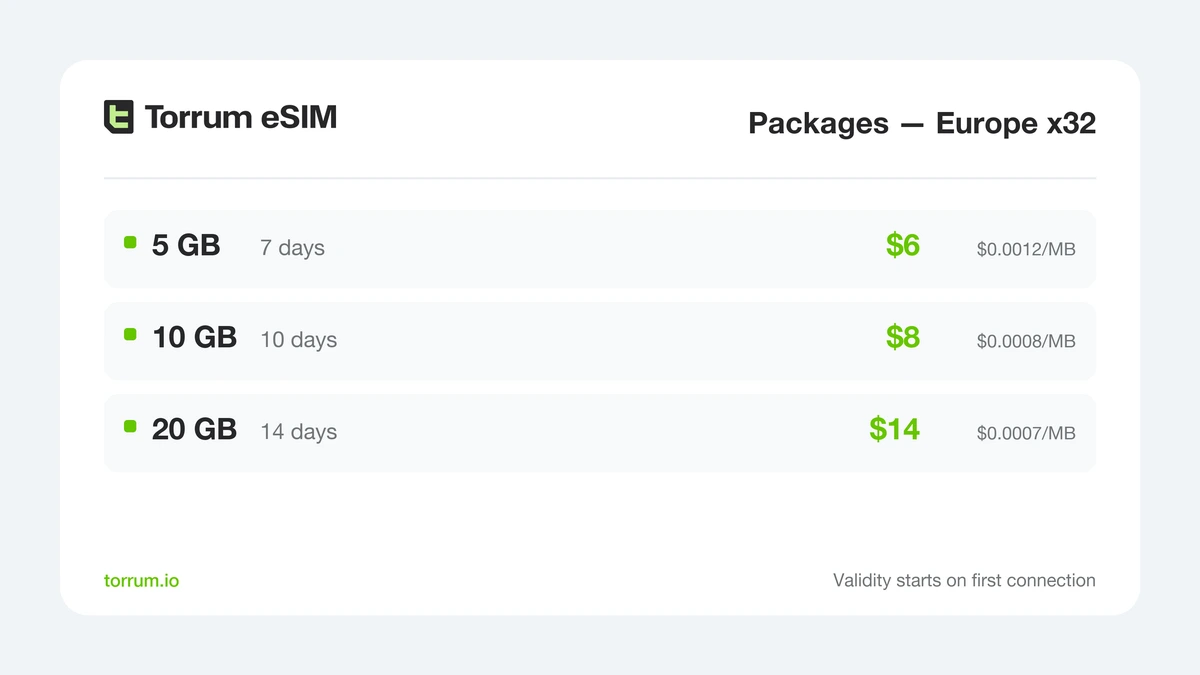
The regional block is the answer when hub and destination sit on the same list: one profile, one purchase, validity counting from the first connection.
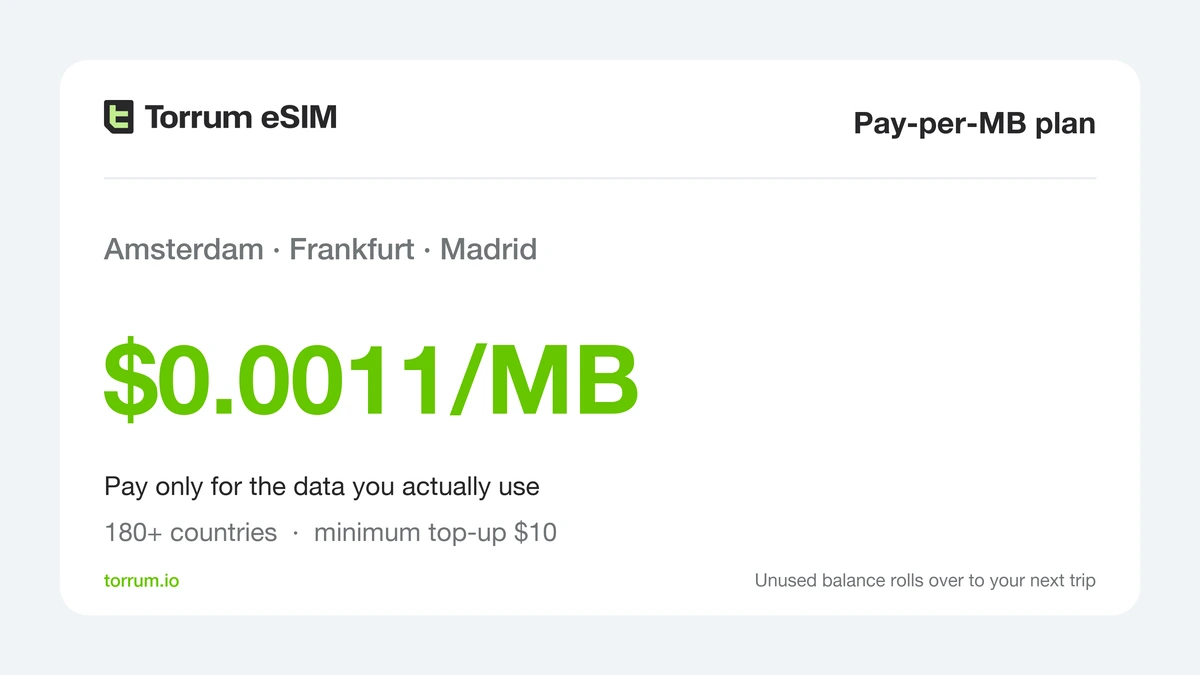
The meter is the answer when they are not. Amsterdam, Frankfurt and Madrid read $0.0011 a megabyte on Pay-per-MB, every other country carries its own rate, and what a connection does not spend waits for the next one.
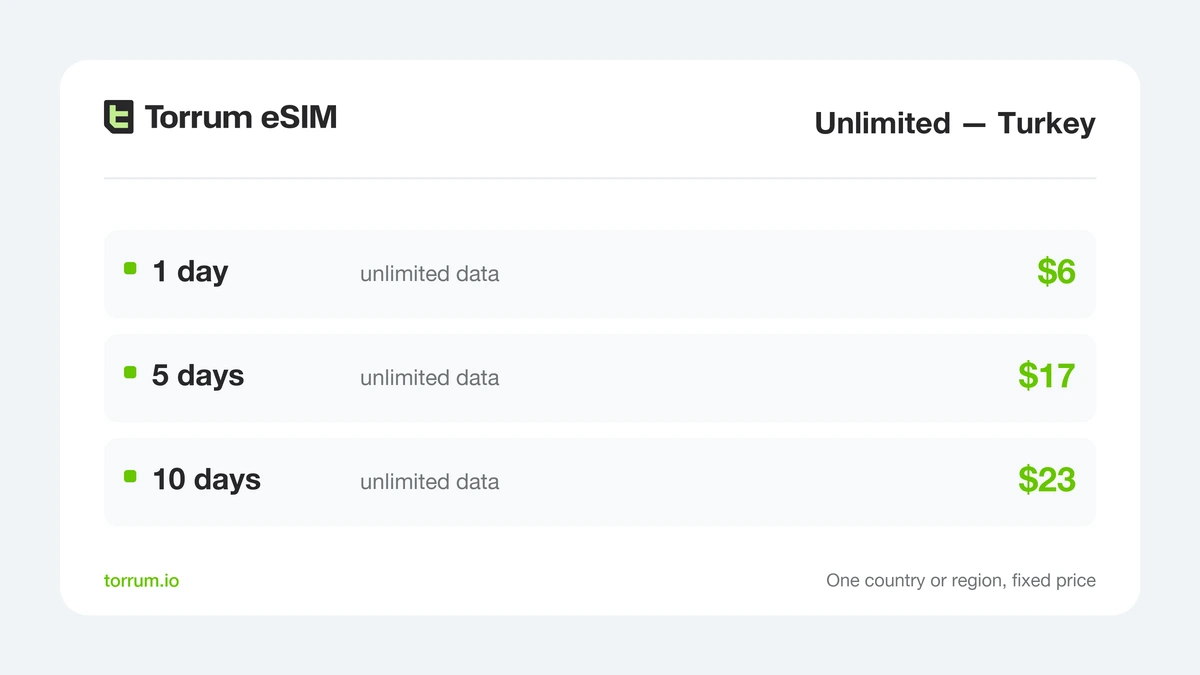
The third shape sells time, not volume: Unlimited is an odd fit for two hours in a terminal and an obvious one for the connection that turns into a working day in the city.
When a layover is really a stopover
Some connections are long enough to stop being connections. Eight hours in Istanbul is an afternoon in the city; a night in a hub means a hotel, a taxi and a return in the dark.
Several countries build for that deliberately. China’s National Immigration Administration runs a visa-free transit scheme of up to 240 hours for eligible nationalities, on condition that you hold a valid travel document and an onward ticket to a third country with a confirmed date and seat.
Once the hub becomes a place you are actually in, the arithmetic flips: a country package stops looking like overkill, and where two such stops sit on the same itinerary, the regional block holds both on one profile.
The line is simple. If you will leave the terminal, buy a day in a country. If not, buy the hours.
Three options against one connection
| Between the two flights | Roaming on your own number | A prepaid card from the hub | A Torrum eSIM |
|---|---|---|---|
| Landing online at a gate you have never seen | Yes, billed by your own operator | No, not if the counter is landside | Yes, before you leave the aircraft door |
| Paying for hours rather than a day | No, the day pass bills a day | Not applicable | Yes on the meter, by the megabyte |
| A hub priced in a dearer zone than the destination | Charged at the higher zone | Not applicable | Priced per country, whatever the ticket says |
| Two different hub countries on one ticket | Two days billed, or two zones | Two cards, two queues | One profile, both countries |
| Paying for two hours of a day pass | The day is billed either way | Not applicable | Only the megabytes are billed |
| Staying airside the whole time | Works | Out of reach behind passport control | Works |
| Rebooking from the app while the desk queue grows | Works | Not until the card is bought and live | Works |
| Staying on for a month afterwards | Rarely the sensible choice | Wins on price per gigabyte | Good, though not the cheapest |
What each kind of connection needs
Ninety minutes, airside, everything on time. The meter, and nothing else: a handful of megabytes you will not notice.
Five or six hours in a hub on the regional list. Buy the regional block once; it covers the connection and the fortnight that follows.
Five or six hours in a hub that is not on the list. Keep the meter for the hub and the package for the destination; two shapes on one account are normal, and cheaper than forcing one to do both jobs.
An overnight connection with a hotel. This is a day in a country, not a gap between flights. A day of Unlimited in the hub is bought once and stops the counting.
Two connections on one ticket, in two countries. The meter, every time. Multi-country is exactly the case a global rate is built for.
FAQ
Does the plan I bought for my destination work during the layover?
Only if the hub country is inside it. Check the hub by name on the plans page before you fly.
Airport Wi-Fi wants a phone number and my line is switched off. Now what?
Look for a kiosk. Istanbul, for one, offers an access code from a terminal kiosk that reads your passport – a route that does not depend on a text arriving.
Can I install an eSIM on airport Wi-Fi once I land?
Usually yes, and it is a poor plan. Apple’s setup instructions start with connecting to Wi-Fi, so the install depends on the one thing you may be queueing for. Do it at home.
When does a package start counting down?
From the first time the profile connects to a network. If the hub is inside the package, the clock starts there rather than at the destination.
Is a package or the meter cheaper for three hours?
The meter, comfortably: a package buys days and gigabytes a terminal cannot use, while Pay-per-MB bills what the phone moves.
Does unused Pay-per-MB balance expire?
It carries over to the next trip rather than being spent or lost, which is why a small standing balance kept purely for connections makes sense.
My connection is domestic, at home, before an international flight. Do I need this?
No. This is a roaming product, and the Terms rule out using it where you habitually live – on home ground your own tariff is the answer.
Will it work on the plane?
No. In the air the phone is in flight mode, and onboard internet is the airline’s own service.
Do I need a transit visa?
That is a border question rather than a connectivity one, and it belongs to the country you land in. Check it before you fly – the answer often decides whether an arrivals hall, and its SIM counter, exists for you at all.
How much data should I actually budget for a connection?
Very little – messages, a map and a boarding pass are small. The arithmetic for a whole trip is a separate piece: how much data you really need.
In closing: the gap deserves its own decision
Most connection problems are not connectivity problems. They are timing problems that arrive as messages, and the phone either receives them promptly or it does not.
The decision is small, and it is made at home: look up the hub, see whether anything you own already covers it, and if not, put a meter on the account.
👉 If you are still weighing the three shapes against each other, the long version is here: eSIM vs local SIM vs roaming. If you already know, the plans are here.


 Continue with Google
  Continue with Telegram

