
Why a German SIM needs your passport first: roaming costs, ICE Wi-Fi and staying online at the Oktoberfest and the Christmas markets
Contents:
Buy a SIM card at a German supermarket, slide it into your phone, and nothing happens. In Germany a prepaid card stays switched off until you have proved who you are – by video call, at a post office counter or in a shop.
That small step catches a lot of people. Foreign guests spent 83.8 million nights in German accommodation in 2025, according to the Federal Statistical Office – and anyone planning to pick up a card on arrival meets the rule on day one.
There are three ways to get online: your home plan in roaming, a German prepaid card, or a travel eSIM installed before the flight. Below: what each costs, how the ID check works, and how to stay connected on the ICE, at the Oktoberfest and in a crowded Christmas market.
👉 Know your dates already? See the Germany packages and pick one.
A German SIM starts with an ID check
Since July 2017, German law has required prepaid providers to check every customer’s identity before a card goes live. The rule now sits in §172 of the Telecommunications Act: name and date of birth have to be verified against an ID document, and a passport counts.
In practice, you choose one of three routes after buying the card:
- Video check. You show your passport to the camera in an app or browser. The supermarket brand ALDI TALK lists what it needs: a phone, tablet or computer with a good front camera, a microphone and a stable internet connection;
- PostIdent. You show your passport at a Deutsche Post branch;
- A shop. Network stores can check your passport on the spot.
Two catches for visitors. First, the video route needs internet – exactly what you are trying to buy – so it usually means doing it on hotel Wi-Fi. Second, not every online check works for every passport. Telekom’s support team has said that online sign-up can be limited for non-EU nationalities, while in a Telekom shop or by phone there is no such restriction.
None of this is hard, but it costs time on day one. Your first name, last name and date of birth must match the passport exactly, and the line goes live only after the provider has processed the check.
A travel eSIM skips this step: Torrum does not need a German ID check, and the line works as soon as the plane lands.
What German prepaid cards cost
Once you are through the ID check, German prepaid is good value. Prices below are from the providers’ own pages; dollar figures use the European Central Bank rate of 1 October 2026 (€1 = $1.1298).
- Vodafone CallYa Allnet Flat S: €9.99 (about $11) for 25 GB and four weeks (price list of 17 September 2026);
- Vodafone CallYa Allnet Flat M: €14.99 (about $17) for 50 GB and four weeks;
- ALDI TALK Kombi-Paket M: €13.99 (about $16) for 50 GB and four weeks, on top of a starter set that normally costs €9.99 and includes €10 of credit.
The Vodafone packs include calls within Germany, EU roaming and 5G. The ALDI TALK pack also runs on 5G and renews every four weeks while there is credit, so top up only what the trip needs.
What you gain is a German number, generous data and a low monthly price. What you give up is the first afternoon, spent on the ID step, and the slot for your home SIM if the phone can only hold one card.
The honest summary: for a month or longer with heavy use, a German card costs less per gigabyte than a travel eSIM. For a week or two, the difference is a few dollars, and the eSIM saves you the paperwork.
Roaming in Germany: who pays and who doesn’t
EU and EEA residents. A French, Dutch or Polish plan works in Germany as it does at home: same allowance, no surcharge, subject only to your operator’s fair-use policy.
From the UK. Brexit ended the guarantee of free EU roaming. In its November 2025 guide, Uswitch found the big British networks charging £2 to £2.47 a day in the EU – with one large network that still includes it. Our guide to UK roaming in Europe explains the fair-use caps.
From the US. Day passes are the usual answer, and they add up: a large American carrier bills $12 per day abroad for its pass, and a second phone on the account costs another $6 a day (terms checked on 29 September 2026). Ten days in Germany on one phone means $120 for that pass alone.
Telekom, Vodafone, O2 and 1&1: how good the networks are

Germany has four network operators. Telekom, Vodafone and O2 (Telefónica) run national networks. 1&1 is building the fourth: in March 2026 its own masts reached about 27% of households, and Vodafone carries its customers everywhere else. Torrum’s eSIM roams onto Telekom, Vodafone and O2.
The Federal Network Agency counted 5G on about 95% of the country’s area in October 2025, and 4G or 5G on about 98%. During its nationwide measurement week from 24 June to 1 July 2026, fewer than 1% of almost 20 million readings showed no signal.
The gaps that remain tend to be in remote countryside rather than in cities. Download offline maps before a hike in the Black Forest or the Harz, and do not count on signal along every forest road.
Near the Swiss border. On the German shore of Lake Constance and along the High Rhine towards Basel, phones can latch onto Swiss masts. Switzerland is outside the EU’s roaming rules, and a consumer advice centre in Lower Saxony (July 2026) recommends switching to manual network selection in border areas. A Germany package is built for German networks, so pick a German one by hand. If you are actually crossing to Basel or Zurich, Europe x32 covers both countries.
👉 Going on to Switzerland? Read our Switzerland data guide.
Torrum plans for Germany
What the eSIM won’t do: give you a German number, or work on a phone that lacks eSIM support or is carrier-locked. What it will do: connect on landing, with Germany priced in the same group as Austria and Switzerland. Validity is counted from the first German connection rather than the purchase date; whatever data is left on the final day lapses.
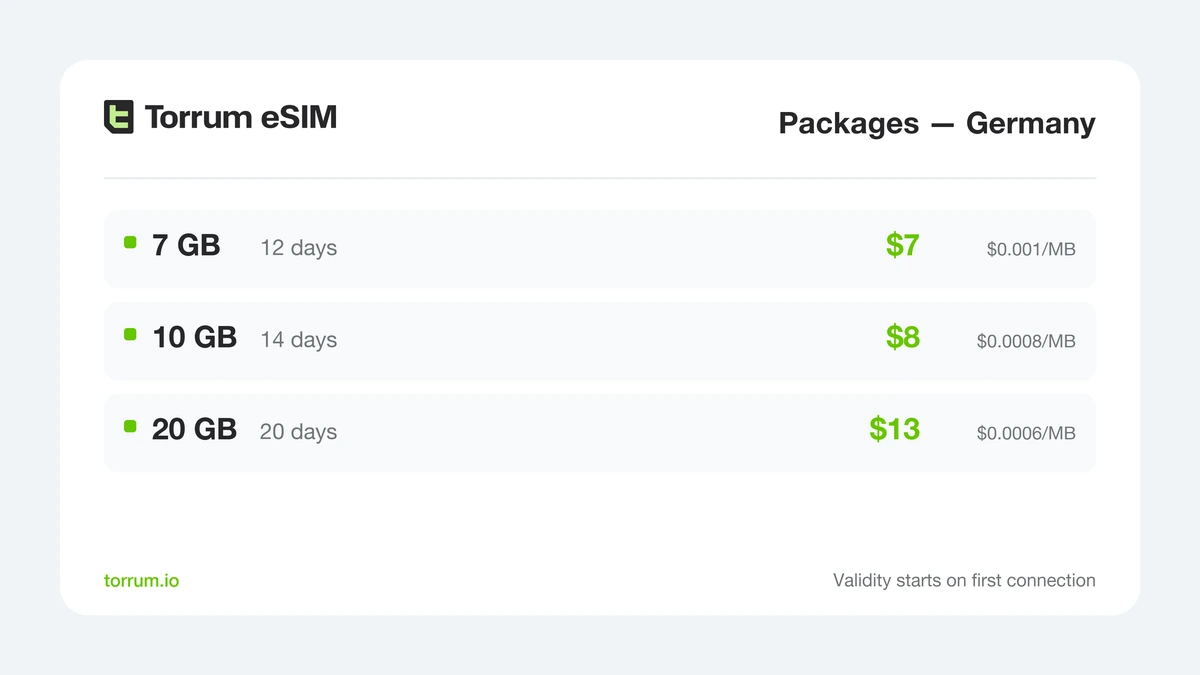
Three sizes for Germany, and no post office visit for any of them.
Trade fairs, back-to-back video calls and hotspotting a laptop eat data fast. Unlimited is priced per day for Germany, which caps the cost of an intense, short work trip.
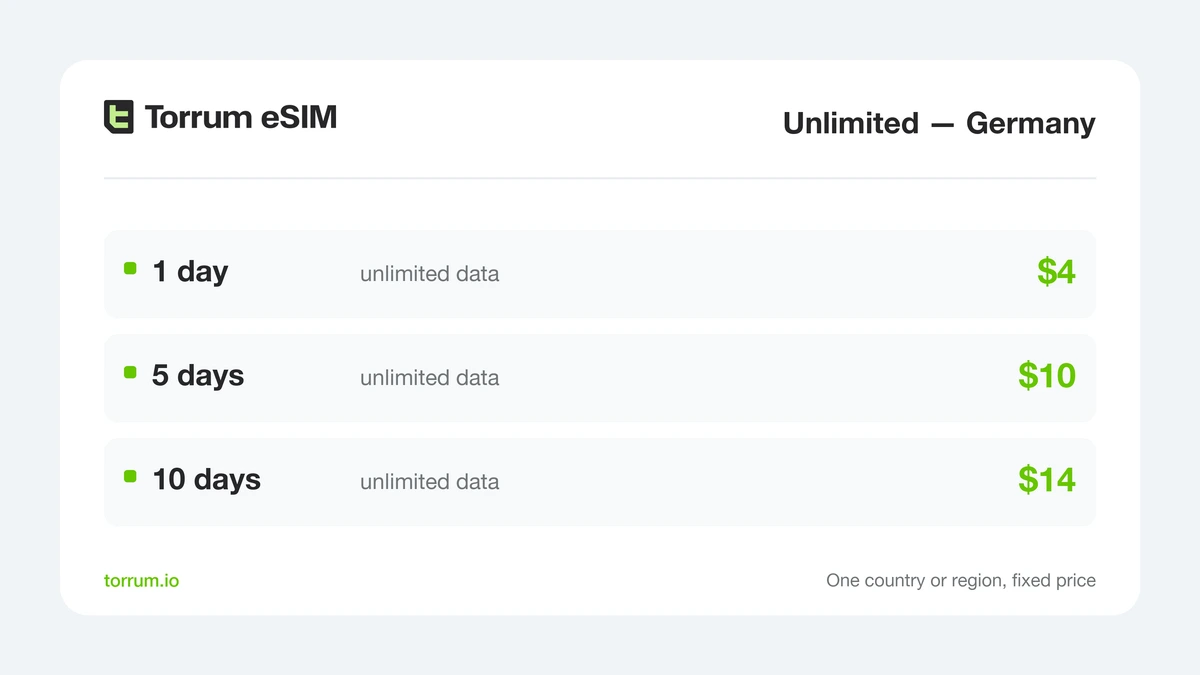
No data counter: a single day for a Frankfurt meeting, five for a trade-fair week, ten for a longer work trip.
If your use is light – maps, train apps, messages – Pay-per-MB deducts each megabyte from a prepaid balance: $0.0011 per MB in Germany, with top-ups from $10. The same balance works in 180+ countries.
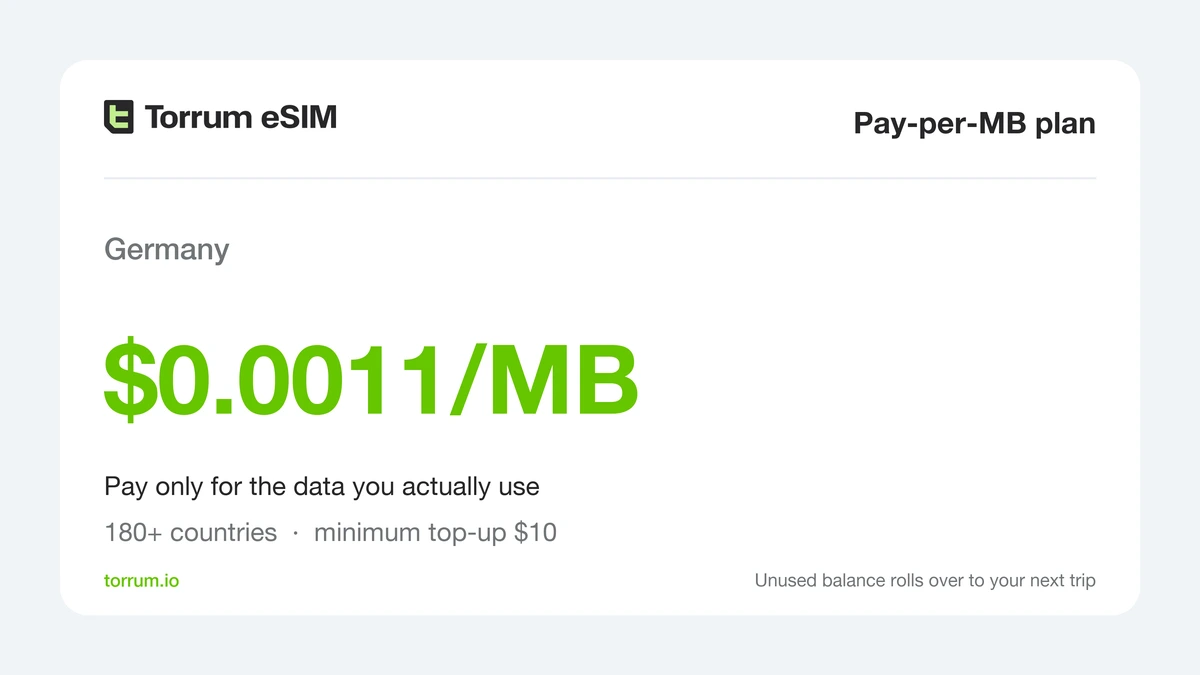
Pay-per-MB in Germany: a balance that follows you to Vienna, Prague or Amsterdam.
On the ICE: WIFIonICE and the signal between cities

Many visitors cross Germany by train, and Deutsche Bahn offers free Wi-Fi on board. The network is called WIFIonICE; it runs on the whole ICE fleet and on part of the Intercity fleet, in first and second class, with no time limit for the journey.
The catch is what sits behind it. The train’s Wi-Fi gets its internet from mobile networks along the track, so speed depends on coverage and on how many passengers are online. Deutsche Bahn says that in tunnels the internet works only where the operators have put signal into the tunnel.
Your own phone can also drop out on some stretches. A few habits make train days easier:
- keep your ticket and booking in the app offline, or as a screenshot;
- download films, maps and work files before you board, not on the train;
- use the eSIM and WIFIonICE as backups for each other: when one stalls, the other may still work.
Oktoberfest crowds and Christmas market evenings

Germany’s big events pack tens of thousands of phones into a few squares. On the first Oktoberfest weekend in September 2026, Telekom counted 57.7 terabytes of data on the Theresienwiese, 18% more than a year earlier. To cope, it put up fourteen temporary mobile sites on the grounds, four of them inside the tents.
Christmas markets are the next wave. Nuremberg’s Christkindlesmarkt runs from 27 November to 24 December 2026, open 10:00 to 21:00 (until 14:00 on 24 December), and most big cities run their own markets through Advent. Evenings are dark, cold and crowded.
Networks usually hold up, but uploads can slow in the busiest hour. What helps:
- agree on a meeting point before you split up – the group chat may lag;
- turn on location sharing with your friends before the square fills up;
- post videos later from the hotel, not from the middle of the square;
- a December evening outdoors is hard on batteries, so bring a small power bank.
Free Wi-Fi at Frankfurt, Munich and BER
All three main airports offer free Wi-Fi, which is handy if the eSIM needs a nudge on arrival:
- Frankfurt: the “Airport-Frankfurt” network is free and unlimited, with no registration;
- Munich: “Free Wifi – Munich Airport” is free once you enter an email address and accept the terms;
- Berlin Brandenburg (BER): free with no time limit once you accept the terms.
In cities, hotels and many cafés have Wi-Fi, but it is less common in public spaces than you might expect.
Setting up the eSIM before you fly
- Check your phone on the device list.
- Sign in to Torrum with Google, Apple or Telegram.
- Choose a Germany package, Unlimited or Pay-per-MB, and pay by card.
- Before leaving home, open the QR code from your Torrum account on a laptop or second screen and scan it with the phone – the step-by-step guide has screenshots for iPhone and Android.
- Set the eSIM as the line for mobile data; leave your usual SIM in charge of calls and bank texts.
- After landing, switch on data roaming for the eSIM line only.
No signal after landing? Join the free airport network and write to the Torrum support bot on Telegram.
Roaming, a German prepaid card or Torrum: side by side
| Question | Home roaming | German prepaid card | Torrum Germany |
|---|---|---|---|
| ID check needed | No | Yes, passport by video, post office or shop | No |
| Working on landing | Yes | No: buy it in Germany, then pass the ID check | Yes |
| EU resident | Included at home prices | Optional | Optional |
| UK or US visitor | Often a daily charge | About $11–17 for 25–50 GB per four weeks, plus a starter set | Fixed package price |
| German phone number | No | Yes | No |
| Home SIM stays in | Yes | Only with a dual-SIM phone | Yes |
| Day trip to Basel or Salzburg | Depends on your plan | Austria under EU rules; Switzerland is outside them | Yes, with Europe x32 |
| A month of heavy use | Expensive | Cheapest per GB | Packages back to back |
Long weekend, rail trip or trade fair: matching the plan
A long weekend in Berlin or Munich. The smallest Germany package covers maps, transit apps and photos.
One or two weeks by train. A larger package; keep WIFIonICE as a backup on long rides.
A trade fair or a day of meetings. Unlimited by the day, so video calls and a laptop hotspot don’t need watching.
Germany plus Austria, Switzerland or Prague. Europe x32 puts all of them on one profile, Switzerland included.
A month or longer. A German prepaid card is cheaper per gigabyte; go through the ID check once, at a shop if the online route fails.
A late arrival. Install the eSIM at home so you are online at the gate, not looking for an open shop.
FAQ
Do I need a passport to buy a SIM card in Germany?
Yes. German law requires an ID check before a prepaid card is activated, and a passport is accepted.
Can I activate a German SIM without a video call?
Yes. PostIdent at a Deutsche Post branch or a check in a network shop are the usual alternatives.
Does a Torrum eSIM need an ID check in Germany?
No. You sign in, pay by card and install the profile; there is no German identity step.
Is roaming free in Germany for EU residents?
Yes. An EU plan costs the same in Germany as at home, up to the operator’s fair-use cap.
Which networks does the Torrum eSIM use in Germany?
Telekom, Vodafone and O2 – the three national networks. It does not use 1&1’s own masts.
Is WIFIonICE free?
Yes, in both classes on ICE trains and part of the Intercity fleet, with no time limit.
Why did my phone show a Swiss network at Lake Constance?
Swiss masts reach across the border. Choose a German network manually, or use Europe x32 if you are heading into Switzerland.
Will the network cope at the Oktoberfest or a Christmas market?
Usually; operators add temporary capacity at the biggest events. Uploads can slow at peak hours.
When does my Germany package start?
On its first connection to a German network. Data that is still unused when the validity ends is lost.
Can I still get calls and bank texts on my own number?
Yes, on a dual-SIM phone with the home line left switched on – see how to run your own number next to a travel eSIM.
How much data do I need for a week in Germany?
For maps, transit apps, messaging and photos, the smallest package is usually enough; streaming needs more.
I live in Germany. Can I use Torrum at home?
No. The service is meant for trips outside your home country, and the terms say so.
Final thoughts: easy networks, one paperwork step
German networks now cover almost the whole country, and local prepaid prices are low. The one hurdle for visitors is the identity check that comes before any German SIM works, plus a few known weak spots: forest valleys, some train stretches and the Swiss border.
For a stay of up to a few weeks, an eSIM installed at home gets you around the paperwork and keeps your home number in the phone. For a month or more, a German prepaid card is worth the trip to the post office.
👉 Ready for Germany? Pick a Germany package, or take Europe x32 if the trip continues across the border.


 Continue with Google
  Continue with Telegram

