
Japan on your own phone: why travellers still rent routers, what a tourist SIM will not give you, and the eSIM that skips both
Contents:
Japan is the destination where router rental never went away.
Not a SIM card and not an app – an actual pocket-sized box with its own battery, collected from a counter in arrivals and posted back at the end of the trip. Plenty of visitors still do exactly that.
And they arrive in numbers: a record 42.7 million foreign visitors in 2025, up 15.8% on the previous high of 36.9 million in 2024 (Japan National Tourism Organization figures, reported January 2026). Every one of them met the same first-day question, and Japan answers it differently from anywhere else.
👉 Short on time? See Torrum data packages for Japan.
Four ways to get online in Japan, and one of them is a rented box

Most countries offer three options. Japan offers four, because the rental habit here outlived the problem it was invented for.
- Roaming on your home plan – nothing to arrange, priced by the day.
- A rented pocket Wi-Fi router – a hotspot handed over at the airport, roughly ¥550–1,800 a day depending on provider and rental length, about $3.50–11.50 at 1 USD = 159 JPY on 25 August 2026 (published rental tariffs from Japanese rental operators, checked August 2026), plus a deposit and a return trip.
- A local prepaid data SIM – bought in a shop or an airport kiosk.
- A travel eSIM – installed before departure, live on landing.
The router made sense when a family of four shared one device, and for a group it still does. For one or two travellers it is a battery to charge and a counter to find twice.
Japan compared: roaming vs pocket Wi-Fi vs local SIM vs eSIM
| What matters | Roaming | Rented pocket Wi-Fi | Local data SIM | Torrum eSIM |
|---|---|---|---|---|
| Ready on landing | Yes | Counter pickup | Kiosk or shop | Yes, installed at home |
| Japanese phone number | No | No | No – residence card required | No |
| Keeps your own number live | Yes | Only if you leave the home SIM roaming | No | Yes – home SIM stays in |
| Cost, one-week solo trip | Seven day passes | Daily rate, deposit, a box to return | Fair, plus the queue | Fixed and known in advance |
| Cost for a family of four | Multiplied by four | Best case – one device shared | Four cards | Four profiles, or one shared hotspot |
| Works on a Korea or Taiwan side trip | Yes, at its own rate | No | No | Yes, on Pay-per-MB |
| Japanese emergency alerts | Yes | Only if the phone itself stays on a network | Yes | Yes |
Buying a SIM in Japan: data yes, a phone number almost certainly not

Here is the detail that surprises people. Data is easy to buy in Japan; a Japanese phone number is effectively out of reach, because voice and SMS lines are sold against a residence card that a tourist does not have (operator terms for prepaid and travel SIMs, checked August 2026). That is why every tourist SIM and tourist eSIM on the shelf is data-only.
Prices are fair rather than remarkable: roughly ¥1,650–5,000 depending on allowance and validity, about $10–31 at the same rate (operator and reseller tourist tariffs, checked August 2026). Airport kiosks sit at the top of that range.
Pros
- Cheap for a long stay, with generous or uncapped allowances.
- Bought on arrival, no advance planning.
Cons
- No Japanese number, so anything gated behind a Japanese SMS stays shut.
- Your own number goes dark while the card is in the phone.
- A counter, a queue and a passport, in an arrivals hall you have never seen.
Compare Turkey, where the local card is a registered premium product, or Italy, where it is genuinely cheap. Japan sits in between: fair value, minus a number.
Where the free Wi-Fi actually holds up
Japanese airports are unusually generous. Narita broadcasts FreeWiFi-NARITA across every terminal and the connecting buses, asking only that you accept the terms. Haneda offers HANEDA-FREE-WIFI everywhere except shops and lounges. Kansai covers both terminals, the station and Aeroplaza (airport operator pages, checked August 2026).
Past the terminal the picture changes. Stations, convenience stores and cafe chains all advertise free Wi-Fi, but sign-up frequently wants an email confirmation or a Japanese number, sessions expire on a timer, and throughput collapses at rush hour. It is a supplement, never an itinerary – and an open network is the wrong place for anything with a password worth stealing.
Roaming to Japan: the day-pass arithmetic
Roaming needs no decision at all, which is exactly why it costs the most. Japan sits outside every regional bundle worth having.
From the UK: all four major networks put Japan in a rest-of-world zone rather than the Europe bundle, typically £5–8 a day (2026 network price comparisons, checked August 2026) – a tier above what Brexit already did to roaming inside the EU.
From the US: the familiar day passes land around $12–15 per line per day (published carrier day-pass tariffs, checked August 2026).
From the EU: Roam Like at Home stops at the edge of the bloc – someone who pays nothing extra in Portugal is on world-zone rates the moment the plane lands in Tokyo.
Do the multiplication before you fly. Twelve days works out at roughly £60–95 or $145–180, for data you could have bought once.
Coverage: the cities, the valleys and the tunnels in between
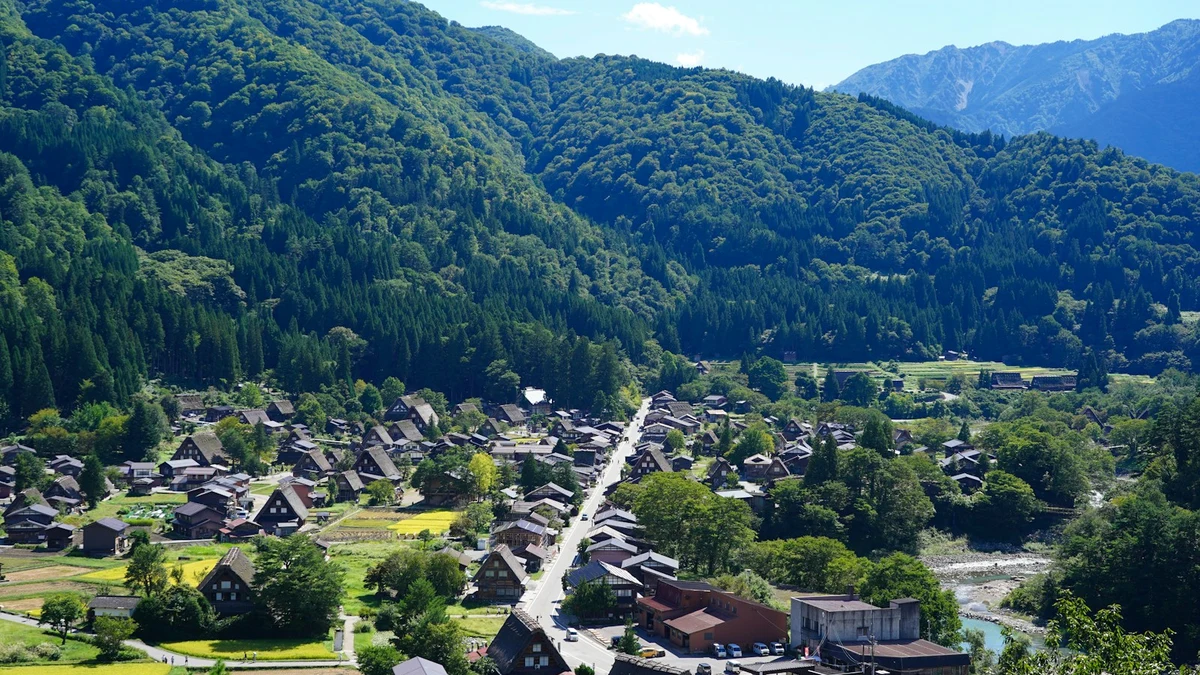
Japan is one of the best-covered countries on earth: nationwide 5G population coverage reached 98.4% by the end of the 2024 financial year (Ministry of Internal Affairs and Communications figures, checked August 2026), with all four national operators running commercial 5G.
One honest caveat: population coverage is not the same as the share of your day actually spent on 5G. Independent measurement put even the strongest operator's 5G availability near 38% (Opensignal, October 2025). The network doing the real work on a Japanese holiday is a very good 4G one.
Where the bars still drop:
- Long rail tunnels. Bullet-train lines are covered end to end, but throughput sags inside the longest bores.
- Deep subway sections. Platforms are reliably covered; the deepest lines can still lose you between stations.
- The Alps and the trails. Mountain huts, passes and anything above the tree line are hit and miss.
- Small islands and the far north. Fine in the towns, thin between them.
Download offline maps and transit routes while you still have hotel Wi-Fi.
Japan switched off its last 3G network in March 2026
This one is new, and it catches returning visitors. On 31 March 2026 the last Japanese 3G network closed, ending a shutdown that began in 2022 and took roughly half a million remaining subscribers with it (operator announcements and telecoms trade press, checked August 2026).
For a traveller it means one thing: there is no fallback layer left. A handset that copes abroad by dropping to 3G will find nothing here. Anything modern is unaffected – but if your phone also worked on a Japan trip five years ago, that is not evidence it will work on this one. Check it against the supported devices list first.
How a travel eSIM behaves in Japan
A travel eSIM is a profile you download; there is no card and no counter. It comes up on landing, rides Japanese partner networks, and sits alongside your physical SIM, which stays in the phone and keeps your usual number reachable. One setting decides whether it works: Data Roaming, enabled on the eSIM profile.
What it does not do:
- It gives you no Japanese number – the same limitation the local tourist SIM has, for the same reason.
- The handset has to support eSIM; many iPhones sold in mainland China do not.
- It is sold for travel, not for use where you live.
Setting up a Torrum eSIM for Japan
- Check the handset is unlocked and eSIM-capable on the compatibility guide.
- Create an account at torrum.io with Google, Apple or Telegram.
- Pick the plan that matches the trip: a Japan data package, the global Pay-per-MB plan, or Unlimited.
- Pay by bank card – $10 minimum top-up, $10–100 per transaction.
- Install the profile from the QR code; the app walkthrough shows every screen.
- Turn on Data Roaming for the Torrum profile and leave the home SIM handling calls.
- Do all of it at home, in your own language. The support bot answers in Telegram if something sticks.
Torrum plans for Japan: how much data costs
Three plans, and the right one follows the shape of the itinerary rather than its length. Current Japanese pricing:
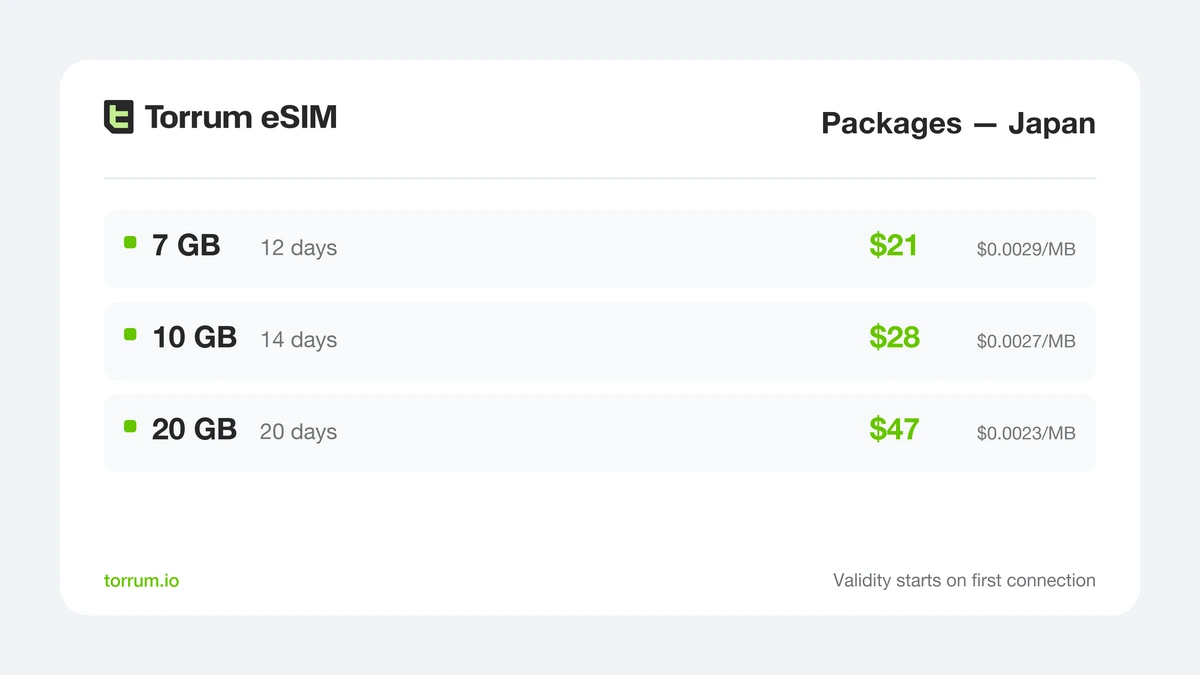
Japan data packages – the clock starts when the profile first finds a Japanese network, so there is no penalty for buying weeks ahead of the flight.
A week of maps, translation, transit apps and photographs sits in the middle tier; two weeks from Hokkaido to Kyushu wants the largest.
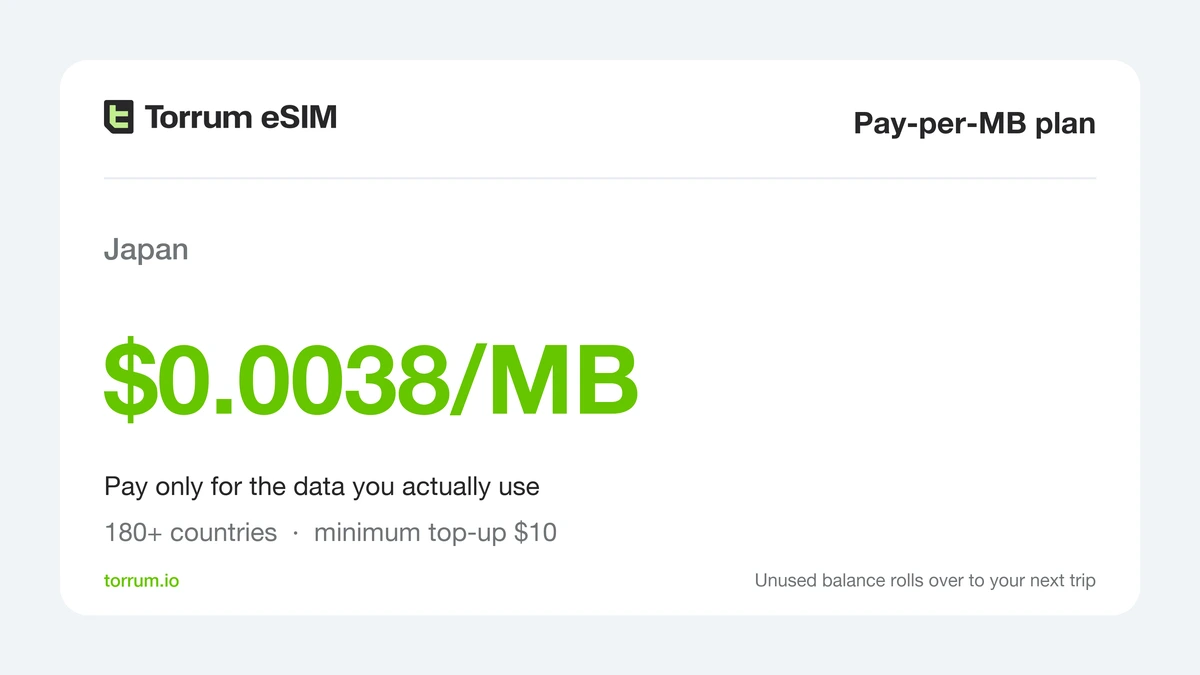
Japan on Pay-per-MB – $0.0038 a megabyte, billed on consumption alone, and anything left over simply waits on the balance.
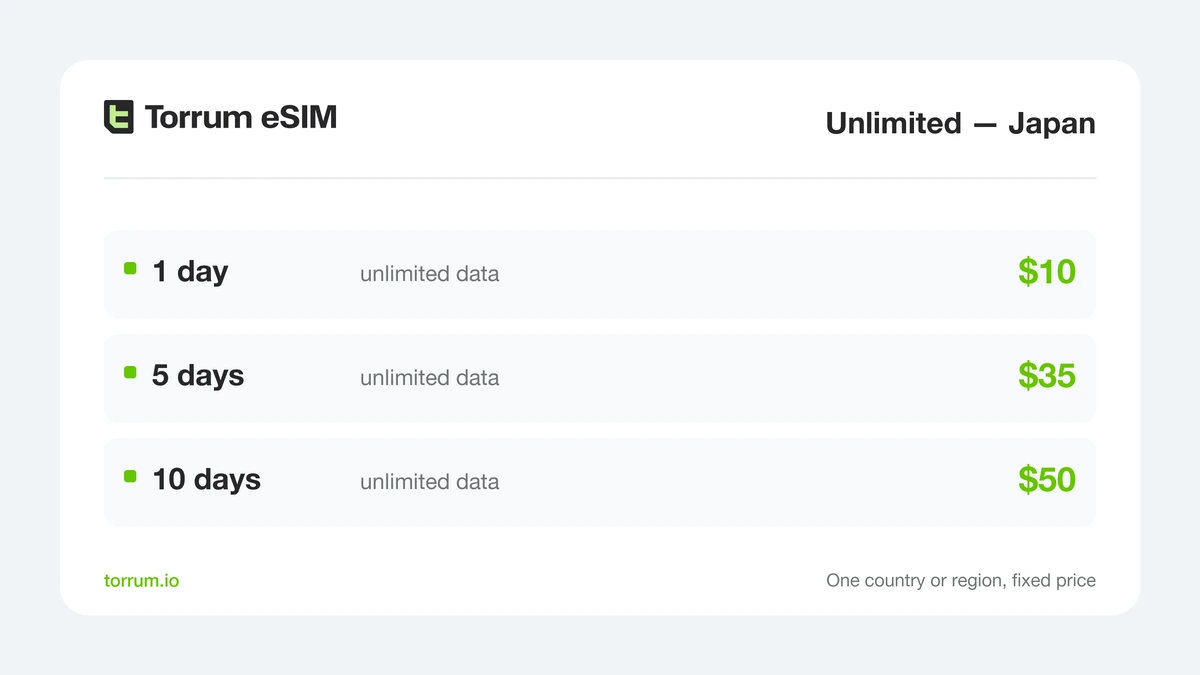
Unlimited for Japan – a flat price per period, which is what a day of video calls and hotspot tethering actually wants.
Earthquake and tsunami alerts: will your phone get them?
Japan operates one of the world's most developed public warning systems, and it reaches phones by cell broadcast – a message pushed by the network to every handset in the affected area, whatever subscription is in it. Earthquake and tsunami warnings are issued in Japanese, with English text supported on many handsets depending on the device and its language settings (J-Alert and Earthquake Early Warning documentation, checked August 2026).
Because it is broadcast rather than addressed to a subscriber, visitors are covered too: a foreign handset receives it provided the device supports the Japanese broadcast channels and emergency alerts are enabled in settings. That holds equally on roaming, on a local SIM and on a travel eSIM.
Before you fly, find the emergency alert switches in your notification settings and check they are on, and install one of the official multilingual disaster apps. The warning itself needs no data; everything you do in the ten minutes afterwards does.
Which plan fits which Japanese trip
The classic first visit: Tokyo, Hakone, Kyoto, Osaka. Heavy on maps and rail apps, light on everything else – a mid-sized Japan package and nothing more to decide. Add a rental car and live navigation becomes the hungry part: take the largest.
A rail-pass itinerary booked as you go. Reserving seats from a platform and re-planning around a delay happen on data, in short bursts, all day – predictability matters more than volume.
Ski season in Hokkaido or Nagano. Resort towns are well covered, the roads and passes between them less so. Download the routes at the hotel and treat the mountain as offline.
Japan plus Seoul or Taipei on the same ticket. A country package stops at the border. Pay-per-MB runs one balance across all three legs; there is a regional Asia package too, but its allowance is small for a multi-week run.
A single day of meetings in Tokyo. Video calls from the hotel, hotspot for the laptop, no arithmetic – one day of Unlimited.
👉 Coming the long way round? Our guide to mobile data in Turkey covers the other big destination that sits outside everyone's roaming zone.
FAQ
Can a tourist get a Japanese phone number?
In practice no. Voice and SMS lines are sold against a residence card, so visitors are offered data-only products.
Is pocket Wi-Fi still worth renting in Japan?
For a group sharing one device, often yes. For one or two travellers an eSIM wins once the deposit, the charging and the return trip are counted.
Does my old phone still work in Japan?
Only if it is 4G-capable. The last Japanese 3G network closed on 31 March 2026, so there is no fallback layer left.
Will I get earthquake and tsunami warnings on a travel eSIM?
Yes – they are broadcast by the network to every handset in the area, provided your device supports them and emergency alerts are switched on.
Is Japan included in EU or UK Europe roaming bundles?
No – all of them treat Japan as a rest-of-world destination charged by the day.
Is airport Wi-Fi in Japan really free?
Yes at Narita, Haneda and Kansai, with no Japanese number needed – you accept the terms and you are on.
How much data does a week in Japan use?
Maps, transit, translation, messaging and photo uploads put most travellers in the middle package tier; car navigation pushes it up one.
Does a Japan package work on a day trip to Korea?
No. Country packages are single-country by design – for a multi-stop route use Pay-per-MB, which meters one balance wherever you land.
Is 5G available everywhere in Japan?
Population coverage is close to universal, but much of the day still runs on 4G – which is more than fast enough.
Does my phone support eSIM?
Most phones released in the last few years do, though some models sold in mainland China are the exception. The device list is the quickest way to be sure.
Final thoughts: the best connection option for Japan
Japan is generous with connectivity and stingy with identity. The networks are superb and the shops sell data at a fair price – but a local number is closed to visitors, and every counter that could help sits behind a queue you join after a long flight.
Roaming solves the timing and bills you daily for it. The rented box solves the cost for a group and hands you a deposit and a battery. A profile installed the night before solves both, keeps your own number ringing, and has you reading the Narita Express timetable instead of queueing for a router.
👉 Flying to Japan soon? Pick your Japan data package before you pack.


 Continue with Google
  Continue with Telegram

