
Why a trip to Britain now begins with a form, what changed when four mobile networks became three, and where the signal still runs out
Contents:
A trip to Britain now starts with paperwork: almost every visa-free visitor needs an Electronic Travel Authorisation, Europeans since 2 April 2025. You apply on a phone, weeks before the phone itself becomes the problem.
And it does become the problem. A line billed in the European Union loses its free-roaming protection at the Channel; a line billed in North America meets day rates that outrun the train fares. Both groups matter here: American visitors alone were forecast to account for close to £1 of every £5 that inbound travellers spend in the UK (VisitBritain, February 2025).
What follows is the other half of the trip: roaming, a British SIM card and a travel eSIM, priced honestly, plus the specifics that catch people out.
👉 Straight to the numbers: the United Kingdom plans.
The form comes before the phone
An ETA is not a visa. It is a digital permission to board, it costs £20, and it covers repeat stays of up to six months each for two years, or until your passport expires. British and Irish citizens, dual nationals included, are outside the scheme.
By the end of 2025 roughly 24.8 million ETAs had been issued across all nationalities (Home Office ETA factsheet, April 2026).
Most decisions through the official app come back in minutes, but the guidance still says allow three working days. Not an airport-morning task, then.
Where your bill lands decides what Britain costs
European roam-like-at-home is geography, not goodwill: it applies across the 27 EU states plus Iceland, Liechtenstein and Norway, under a regulation that runs to mid-2032. Britain dropped off that list in 2021.
So an EU-billed line has no legal cover here. What Britain costs is whatever your own contract happens to say about it, and nothing obliges that contract to be generous. The habit that works everywhere else on the continent – do nothing, pay nothing – is precisely the habit that fails at Heathrow.
A North American line meets the familiar travel add-ons: $10 to $12 a day, charged per line that connects, with one carrier capping the tally near ten such charges a billing cycle (carrier price lists, September 2026). Two handsets over ten days is worth totting up before the statement does it for you.
👉 The mirror image, for readers whose line is British: the Brexit roaming bill seen from the other side.
What a travel profile is, and what it refuses to do
An eSIM is a second line written into the phone by software. Buy it, scan the code that comes back, and the handset runs two identities: your own, which keeps the calls and the bank texts, and a data-only British one at the plan price. The validity clock only starts when the profile first connects in Britain, so buying a fortnight ahead costs nothing extra.
Three caveats. It needs a recent handset – phones built for the mainland-China market are the usual gap, and Torrum’s device list settles that faster than a spec sheet. It carries data but no +44 number, which matters only when a form insists on texting one. And it is made for visiting rather than for living somewhere, so this article assumes you are flying in.
👉 The same argument with no destination attached: weighing up the three options.
Package, meter or unlimited
It comes down to one question about your own trip: do you know roughly how much data you will get through, do you refuse to guess, or do you want the meter off for a fixed number of days?
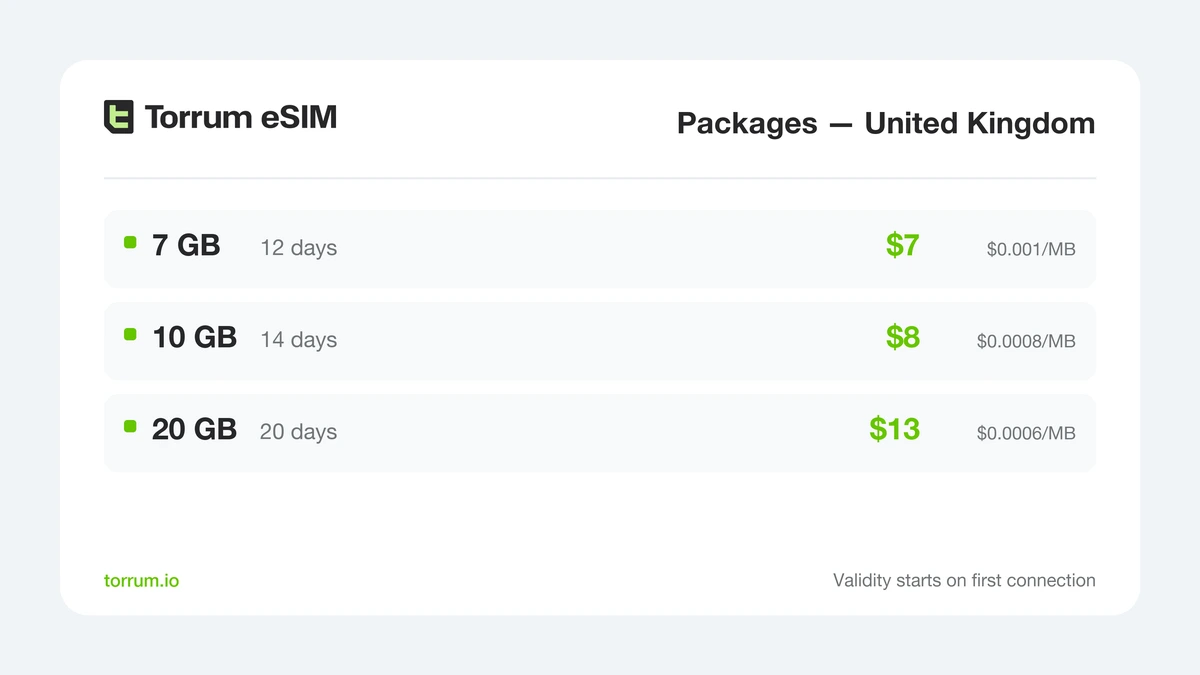
Three sizes of British package. The dates decide which validity you need; after that, the honest question is how small an allowance you can live with.
Almost everyone guesses high. Our note on measuring it off last month’s usage talks most readers down a size.
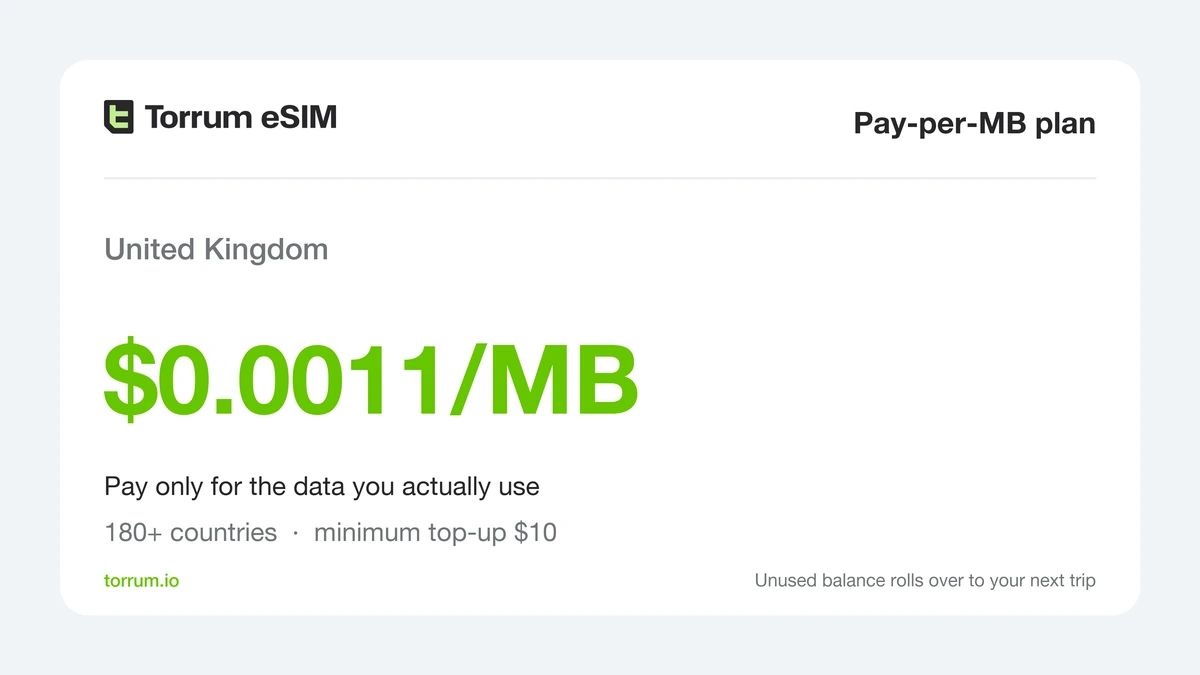
With Pay-per-MB there is nothing to estimate: one megabyte of British data costs $0.0011, and anything unspent waits on your balance instead of expiring.
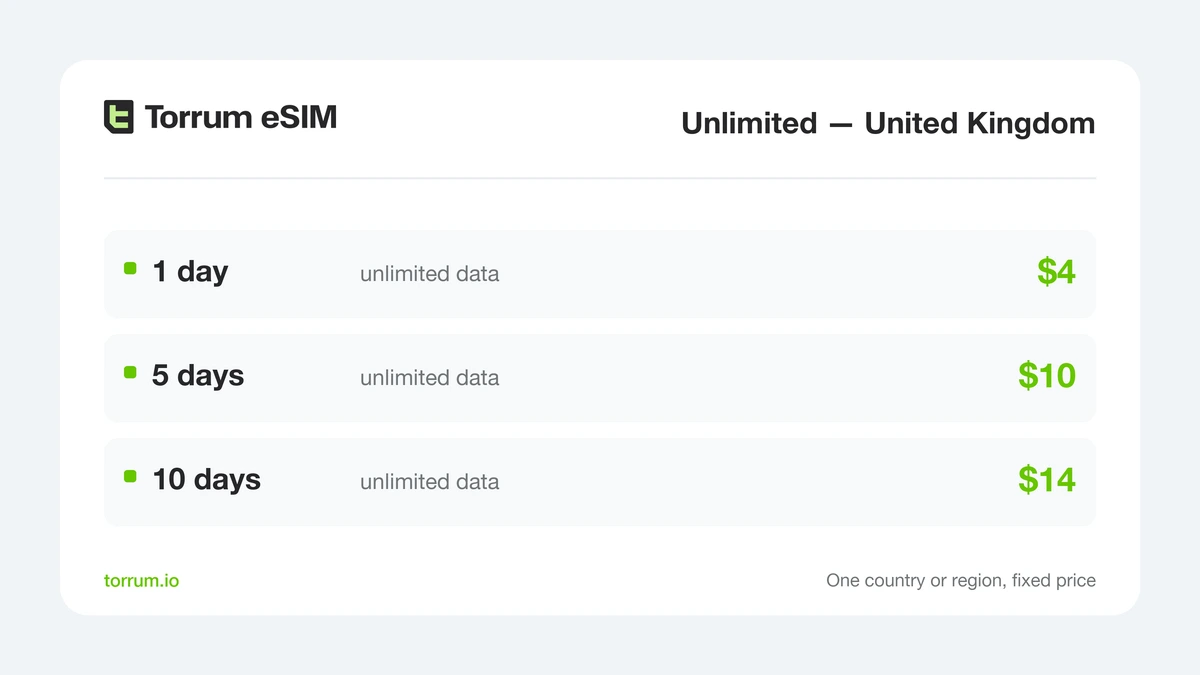
Days, not gigabytes: Unlimited is what you want when the phone is doing the work – tethering a laptop, running a live shoot, standing in for the office for a week.
One point matters for Britain specifically: the United Kingdom sits inside the regional Europe package, so London plus Paris, or Manchester plus Amsterdam, runs on one profile rather than two. Ireland is not in that region and is priced as a country of its own – worth knowing before a Dublin leg is added.
Four networks became three, and the statistics have not caught up
On 31 May 2025 two of Britain’s four mobile operators completed a merger, creating a single business of roughly 27 million customers. Three companies own the masts now, not four.
The masts are a slower story. Combining two national networks takes years, which is why Ofcom’s coverage tables still report four, and why comparing brand names as a visitor measures something that is shifting underneath you.
At the top end the numbers reassure: outdoor 5G reaches 97% of premises from at least one operator, though any single network manages 47–65% (Ofcom Connected Nations 2025, published 19 November 2025). That gap is the useful part. In Britain the distance between a network and your network is enormous, and a travel profile is not tied to a single one: three of the mainland networks are open to it by agreement.
Signal under London, station by station

For decades the London Underground was a guaranteed dead zone. That is being fixed in public, section by section.
On the latest figures, 62 of the 121 below-ground stations carry 4G and 5G through their ticket halls, corridors and platforms, and the Elizabeth line has been covered end to end since December 2024. The programme, run under a concession with Transport for London awarded in 2021, targets the whole network within this year.
A system in transition, in other words. Load the map, the tickets and the route before the escalator, and treat anything that loads underground as a bonus.
Where Britain still runs out of bars

Britain is small, crowded and still full of holes. Measured in July 2025, 4G reached 96% of the landmass from at least one operator but only 81% from all of them; indoors in rural areas the figure falls to 78–84% of premises.
A government-and-industry programme is closing that gap: its 4G landmass target was hit early, and masts are still going up where there is no coverage at all, work running into 2027.
Nothing about that is exotic. Masts follow people, so it is the high ground, the deep valleys and the long coastal paths that thin out – and in a country this compact you reach them on an ordinary afternoon. No plan fixes it. Download the walking route instead of streaming it.
Jersey and Guernsey are not the United Kingdom

This one collects more surprise bills than anything else on the list. The Channel Islands are British in every way a visitor notices and in none that a mobile network does: Crown Dependencies, never in the EU or the EEA, never under European roaming caps. Home tariffs bill them as a separate destination, and the phone rarely warns you.
A travel profile fares better. Torrum’s United Kingdom entry carries the two Jersey networks and the Guernsey one alongside the mainland three, and neither island is listed as a country of its own among the 191 on the per-megabyte page. The Isle of Man is absent from that entry, and is best treated as a separate question.
What a British SIM costs, and when it wins
Britain sells mobile data cheaply, and an article trying to sell you something else should say so first. From one network’s own price list on 11 September 2026: rolling monthly SIMs at £6 for 5 GB, £10 for 40 GB and £20 uncapped, data-only versions from £5. At the ECB rate of 10 September 2026, about $8, $13.50 and $27.
No identity check stands in the way either. The GSMA Mobile Policy Handbook (October 2025) counts some 160 governments that made prepaid registration compulsory; Britain declined.
What you give up. No signal between the jet bridge and the first shop. Ordering online wants a British address to post the card to, so in practice you buy over a counter at an airport or a supermarket, which is its own errand and its own markup. Unless the phone has two slots, out comes the SIM you arrived with – and the number your bank texts goes quiet.
The verdict is arithmetic, not loyalty. Over a week or two, or anything that keeps moving, the shop trip costs more than it saves.
Airport Wi-Fi, and how far it gets you
Heathrow publishes free Wi-Fi across every terminal, quick to join and free for as long as you are in the airport. There is a registration step, but not the trap that catches people elsewhere: it wants no British mobile number, so it works before you have one.
Past the terminal, Britain is generous and unreliable in equal measure: cafés, pubs and hotels nearly all offer something, long-distance trains something that varies by tunnel. Wi-Fi will get you a taxi and a check-in, not a week of navigating a city on foot.
What each shape of British trip needs
Four nights in London. The smallest British package. City coverage is as good as Britain gets, and your first guess at the volume is almost certainly generous.
Ten days: London, the Cotswolds, Edinburgh. A mid-size package. The train hours eat the allowance, not the cities.
Britain and the continent in one trip. One regional Europe profile spans the UK and thirty-one more countries – the sensible answer once Paris, Amsterdam or Copenhagen joins the itinerary. Add Dublin instead, and the meter is what crosses both borders.
A day of meetings in the City. One Unlimited day, and stop thinking about it.
A walking holiday, or a drive with no fixed plan. Pay-per-MB: days spent in a not-spot cost nothing at all.
A month in one city. Buy a British SIM on arrival: nothing here competes with £10 for 40 GB, and it would be a disservice to claim otherwise.
Setting it up while you still have Wi-Fi
- Confirm the handset supports eSIM, on Torrum’s device list.
- Log in through an Apple, Google or Telegram account you already hold.
- Choose by route, not by price: Britain alone, the regional Europe plan if the trip crosses the Channel, or the meter while the route is still being argued about.
- Pay by card, then scan the code that comes back to write the profile into the phone.
- Then one switch, and only one: Data Roaming, enabled on the profile you have just installed. Your own line needs nothing.
Every screen appears in the app walkthrough, and the support bot handles anything that misbehaves.
Side by side: roaming, a British card, a travel profile
| What actually happens in Britain | Roaming on your home tariff | A British prepaid SIM | A Torrum eSIM |
|---|---|---|---|
| Landing at Heathrow before the shops open | Online at once, at your tariff’s rate | Nothing until a counter opens | Online at once, at the plan price |
| A line billed inside the EU | No roam-like-at-home protection applies | Cheaper, once you have queued | The same price as for everybody else |
| Four days riding the Tube | Whatever you pay, where there is signal | Same signal, cheaper gigabytes | Same signal, nothing installed twice |
| A day out to Jersey or Guernsey | Frequently billed as a separate destination | Usually charged as roaming | Carried under the same UK entry |
| Three days walking in a not-spot | Billed as days abroad regardless | Paid for in advance regardless | Costs nothing on the meter |
| Hopping over to Paris midweek | Another country, another daily charge | Stops dead at the border | Regional Europe plan, or the meter |
| Adding Dublin instead | Another country again | Stops dead at the border | The meter; the regional plan excludes Ireland |
| A month in one British city | The most expensive way to do it | The cheapest way to do it | Beaten on price, and we will say so |
| Bank codes still reaching your own number | Yes | Only with a second SIM slot | Yes |
| Knowing the cost before you fly | No | Roughly | Yes on a package or Unlimited; per megabyte on the meter |
FAQ
Do I need an ETA to visit the UK?
If you are visiting without a visa and are neither a British nor an Irish citizen, yes. It costs £20, covers repeat stays of up to six months over two years, and the guidance is to apply three working days ahead.
Is my EU plan still free to use in Britain?
Not automatically. European roaming rules cover the EU plus Iceland, Liechtenstein and Norway, and the UK left that zone in 2021 – so whether Britain is included depends entirely on your own tariff.
Does a UK plan cover Scotland, Wales and Northern Ireland?
Yes – all four nations are one country for mobile purposes. The Republic of Ireland is a different country, and is not covered by a UK plan.
What about Jersey, Guernsey and the Isle of Man?
Jersey and Guernsey sit under the same United Kingdom entry in Torrum’s coverage list as the mainland networks. Home tariffs, by contrast, often bill the islands as a separate destination – which is where the surprise charges come from. The Isle of Man is not in that entry.
Does the Tube have mobile signal yet?
On the Elizabeth line and 62 of the 121 below-ground stations, yes. The rest is being fitted, with completion targeted for the end of this year, so download maps and tickets before you descend.
Is 5G everywhere in the UK?
Outdoor 5G reaches 97% of premises from at least one operator, but any individual network covers 47–65%. Away from the cities much of the day is spent on 4G, which is plenty for maps, chat and check-ins.
Will an old phone still connect?
Only with 4G support. British operators retired 3G between early 2024 and the end of 2025, leaving a 3G-only handset with voice and text and no usable mobile internet.
Is any ID needed to buy a British SIM?
No. The UK never introduced mandatory prepaid SIM registration, so the card is sold over the counter like anything else on the shelf.
Does an unused balance carry over?
On the meter, yes: it stays put until your next trip. Package gigabytes expire when the validity does.
Does the regional Europe plan cover Ireland?
No. The regional plan spans thirty-two countries including the UK and France, but Ireland is not one of them; a Dublin leg runs on the per-megabyte plan instead.
Which British network will the eSIM use?
Whichever of three mainland networks the roaming arrangement puts you on: you buy a rate, not a logo.
Final thoughts: what actually matters
Britain is an expensive country that sells cheap mobile data. The travellers who overpay are the ones who never made a decision.
So: sort the ETA weeks ahead, because that part really is compulsory. Check an EU-billed line against Britain specifically, not against the rules you are used to. A North American one should be doing almost anything other than its default. Staying a month in one city? Buy a British card on arrival. For everything else, install the profile in your own kitchen and land with the map already open.
👉 Ten minutes of admin, done in your own kitchen: the United Kingdom packages.


 Continue with Google
  Continue with Telegram

