
Working from anywhere, online everywhere: what a digital nomad's data setup has to survive, from the four-month roaming check to the ninety-day Schengen shuffle
Contents:
In 2025, 18.5 million American workers described themselves as digital nomads, according to MBO Partners’ State of Independence research – up 153% since 2019.
Travel data plans are sized for trips, not seasons. A nomad’s year is a string of months, borders and video calls, and it stretches each of those products past the point it was designed for.
This guide covers what your home SIM tolerates, where buying locally beats everything else, and which jobs a travel eSIM actually does well.
👉 Based in Europe this season? See what the 32-country block covers before you pick a plan.
A trip with no return date breaks three assumptions
Short-trip advice rests on three assumptions. Working from abroad breaks all of them.
That you will go home soon. Roaming rules, even generous ones, are written for visitors, and a long stay starts to look like something else.
That one bundle fits the trip. A fortnight fits a package; four months across three countries fits no single product.
That the phone is for holidays. For a nomad the connection is the office. A dead signal is not an inconvenience; it is a missed client call.
Your home SIM keeps a four-month diary
Inside the EU, residents get “Roam like at home”, extended by Regulation (EU) 2022/612 until 30 June 2032. It also covers texts you receive, which matters later in this guide.
But the rule has a memory. The EU’s own Your Europe portal explains that your operator can monitor your roaming use over a four-month period, and may contact you only if you have spent more time abroad than at home and used more data abroad than at home (page last checked 7 January 2026). A season on a Spanish coast with a German SIM can easily fit both conditions.
Operators may also ask for proof of normal residence or other stable links with the country, before applying fair-use measures. The rule was written for travel, not for moving your life to another member state on your old contract.
UK customers start from a weaker position. Since Brexit several of the big British networks charge for EU roaming again – around £2 to £2.75 a day, according to Uswitch (updated 6 November 2025) and Which? – and at least one adds a long-stay limit: a large UK network’s fair-use terms treat roaming for more than 63 days in any four-month period as unfair use. If you are British and abroad for a season, read your own network’s fair-use page before you pack.
From outside Europe, a daily roaming pass billed for a whole month adds up fast.
👉 Reading from Britain? Our post-Brexit roaming guide for UK visitors to the EU has the full picture.
The same rule, from our side of the counter
A travel eSIM is not an escape from this kind of rule, and we would rather say so here than in a support ticket.
Torrum’s Terms of Use describe the service as a roaming data service for use while travelling outside your country of habitual residence – and state that it must not be used there. So it is a line for being away, not a replacement home contract.
For a nomad with a home country to return to, that is a non-issue. It becomes relevant the day a place stops being somewhere you visit. Portugal’s D8 visa is a clean example – a residency route, with an income threshold of four times the national minimum wage (€3,680 a month on 2026 figures, per the Portuguese consular portal and government). Once you live there on it, Portugal is home, and home service belongs on a Portuguese contract.
The Terms also make clear what the product is: data. No voice, no SMS, no local number. That shapes the next section.
Keep the number, move the data
The number on your home SIM is not really for calls any more. It is the key to your bank, your tax account and many of your two-factor logins. Switch it off to save money and the next one-time code has nowhere to land.
So the working pattern is two lines in one phone: your home SIM stays in for texts and calls, and data runs over a second profile. Apple’s support pages confirm the mechanics – an iPhone can store eight or more eSIMs, keep a pair of lines live simultaneously, and uses one cellular data network at a time. You pick which line carries data, and switch the other line’s data roaming off.
Inside the EU, receiving a text on a roaming EU SIM costs nothing under the regulation. Outside it, look up the incoming-text rate on your home tariff. And Wi-Fi Calling, where your carrier supports it, can let the home line work over a café or apartment connection – but Apple is explicit that availability depends on the carrier and the country, so test it before you rely on it.
Not sure the phone takes a second line? The compatible device list gives a yes or no in a minute.
A month on one base: when a local SIM simply wins

The honest part: for four weeks or more in one country, a prepaid card bought locally is usually the cheapest data you will find.
Georgia is the sharpest example. One of its networks sells a 20 GB, 30-day prepaid plan for 25 GEL on its own site – about $9.50 at the National Bank of Georgia rate of 24 September 2026. Our own Georgian rates come nowhere near that. Buy the local card, and keep the eSIM for the flight in and the days before you find a shop.
Long stays also meet paperwork a short visit never does:
- Thailand: keep a tourist SIM active past day 60 and you must confirm your identity again with your passport. Details in our Thailand guide.
- Turkey: roughly four months into using a Turkish SIM, a phone bought abroad is cut off until its IMEI is registered and a fee paid – and the count attaches to the handset, not the card. See the Turkey guide.
Pros of a local SIM on a long base: lowest cost per gigabyte, a local number for deliveries and restaurant bookings.
Cons: a new card and a new registration in every country, long-stay rules, and nothing working the minute you land.
The ninety-day shuffle and the edge of the regional block

Non-EU nationals can stay in the Schengen area for up to 90 days in any 180-day period. Since 10 April 2026 the EU’s Entry/Exit System has been fully operational, recording entries and exits digitally at the external border, so the count is kept for you whether you keep it or not.
Hence the rotation: three months in Lisbon, Valencia or Berlin, then a stretch in Albania, Montenegro, Georgia or Turkey before coming back. That stretch is where connectivity plans change shape.
Torrum’s Europe x32 block covers every EU member except Ireland, plus the United Kingdom, Switzerland, Norway and Iceland. It does not cover the Balkan states outside the EU, Georgia or Turkey. Cross into Montenegro on the regional plan and it simply stops.
What to do on the far side depends on the country:
- Turkey has its own country packages, priced in the same band as Western Europe.
- The Balkans outside the EU cost several times the EU rate on Pay-per-MB. Fine for a border day or a weekend; for a month, compare a country package and a local card first.
- Georgia is local-SIM territory, as the previous section showed.
A plan called “Europe” draws its own border: check its list against your next ninety days.
Work-grade data means a second path, not a bigger bundle

Coworking Wi-Fi goes down, and apartment routers reboot during the one call that matters. The real risk is not running out of gigabytes; it is having a single path to the internet.
That makes the travel eSIM useful even on a month when a local SIM carries most of your data. Keep the profile installed, with a small plan or a metered balance on it, and a dead router becomes a thirty-second switch in settings rather than a sprint to a café.
Budget the data honestly: a tethered laptop on a video call behaves nothing like a phone, and our data-appetite guide has the per-hour figures.
For days that are nothing but calls, Unlimited is the obvious shape. Read its one caveat: the Terms describe a high-speed allowance, and past it speeds may drop for the rest of the plan period – messaging and maps should generally keep working, heavy video may not. It is a fixed price, not a promise of infinite full speed.
What each Torrum plan does in a nomad year
None of our plans pretends to cover a nomad year alone. Each shape does one job in the stack.
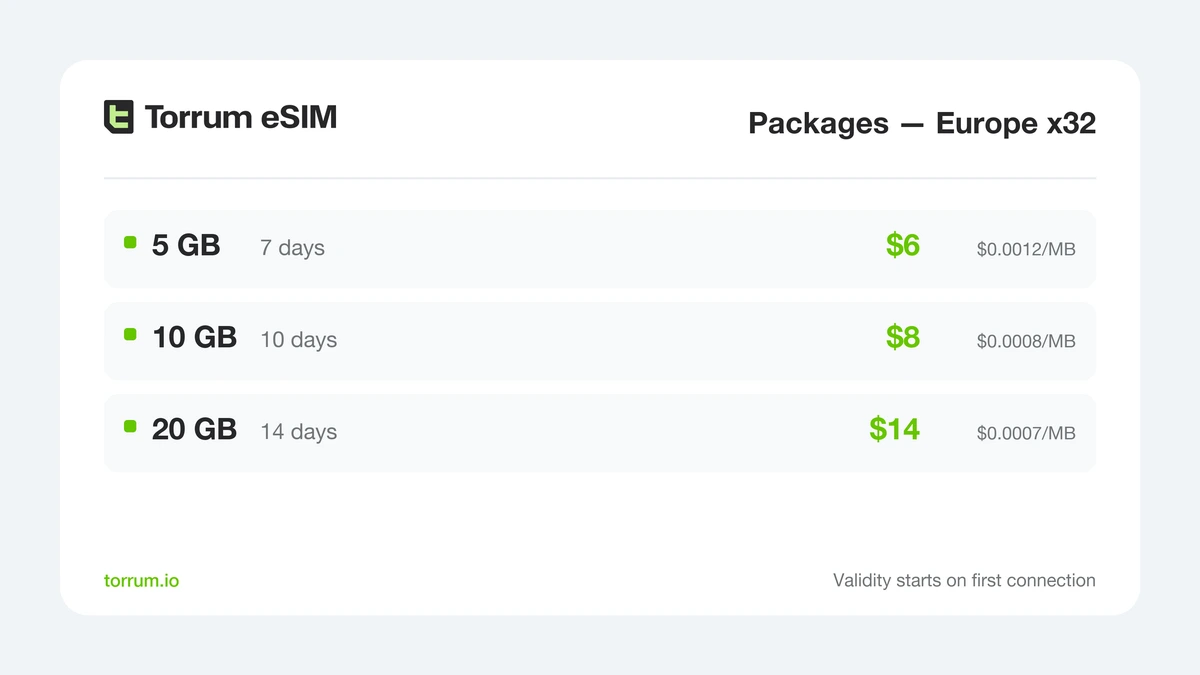
The regional package is the arrival tool: one purchase covers the first weeks in a new base, and a border crossing inside the block, before you have found a phone shop. Its validity counts from the first connection, not from the day you pay.
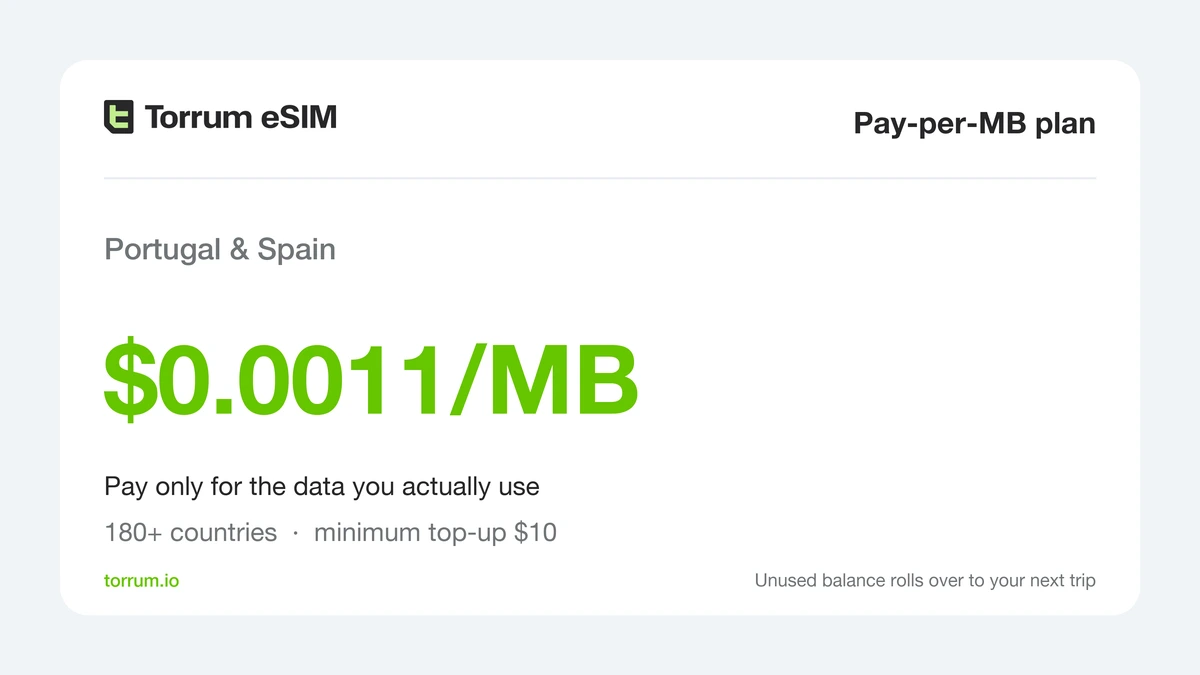
The meter is the backup tool. At $0.0011 a megabyte in Portugal and Spain, a balance that sits on the phone for weeks is only drawn down when the router fails – rates for everywhere else are listed on the Pay-per-MB page.
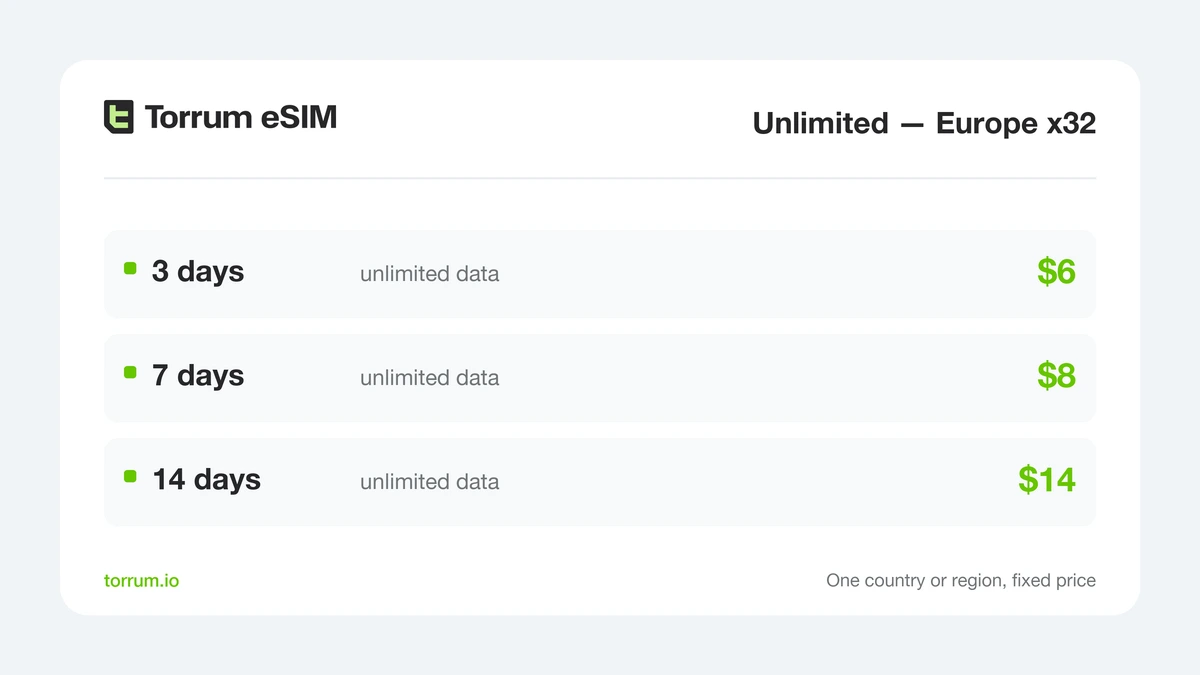
The time tool: Unlimited sells days rather than gigabytes, which suits a launch week or a run of back-to-back calls better than a month of ordinary use.
Two mechanics matter here. A package expires on schedule whether you used it or not, so buy for the stretch you are actually in rather than stockpiling. And each profile’s coverage is fixed at purchase, so a plan bought for Europe will not start working in Georgia.
👉 Heading to Asia next? The Asia block and the Thailand packages are listed separately.
Setting up between bases
The best moment to set up the next country is the evening before you leave the current one, on apartment Wi-Fi you already trust.
- Check the handset once against the device list; after that, every country is the same routine.
- Log in – Telegram, Apple and Google accounts all work.
- Match the plan to where you will be for the next few weeks, including any border you expect to cross.
- Card payment; the profile then downloads over Wi-Fi.
- Turn on Data Roaming inside the travel profile only – the setup walkthrough shows where.
- Set the home line to calls and texts, with its data roaming off.
Stuck on a step mid-move? Torrum’s Telegram helpdesk is reachable from whatever Wi-Fi you are on.
Home SIM, local SIM, travel eSIM: who does which job
| Job | Home SIM | Local SIM | Travel eSIM |
|---|---|---|---|
| Bank and 2FA codes | Yes – keep it active | Different number | No SMS at all |
| A month on one base | Free for EU SIMs in the EU at first; day rates elsewhere | Usually cheapest | Fine, rarely cheapest |
| First day in a new country | Works, at roaming prices | Needs a shop, often ID | Works on landing |
| Crossing a border mid-stay | Depends on zone | Roams on its own tariff’s terms | Works if the plan covers both |
| Backup when Wi-Fi fails | Expensive on data | Often the main line | A second path, ready |
| Long-stay rules | Operator fair-use terms | Registration, SIM and IMEI clocks | Not for your country of residence |
| Local number | Your own | Yes | No |
Four nomad patterns, four answers
The Schengen rotator. Three months in one EU city, then out. Local SIM for the base if you settle, regional package for the first weeks and every weekend trip, a metered balance for the stretch outside the block.
The slow Asia loop. A month each in two or three countries. Country packages on arrival, local cards once the stay is long enough to justify the registration, and our three-way comparison for the ones in between.
The fast mover. A new country every week or two. Here the travel eSIM does most of the work, because a local card per country costs more time than it saves money. Pay-per-MB wherever the route leaves the regional block.
The call-heavy freelancer. Whatever the base, keep a second path installed and put the heaviest days on Unlimited.
FAQ
Could an eSIM be my only connection for months?
For data while abroad, yes – but keep the home SIM active for bank codes, and once you settle for a month a local SIM is usually cheaper.
Will my EU operator really charge me for staying abroad too long?
It can, if over four months you spent more time and used more data abroad than at home.
I am British. How long can I roam in Europe on my UK plan?
That varies by network; some cap long stays. Check its fair-use page before you go.
Can I keep receiving bank codes while my data runs on an eSIM?
Yes. Keep the home SIM active for texts and make the eSIM the data line.
Can I use Torrum after I become a resident abroad?
Not in your new country of residence. The service is for use while travelling outside the country where you habitually live.
Does the Europe block cover Albania, Montenegro, Georgia or Turkey?
No. Each of them has its own country packages, priced separately from the Europe block, and Pay-per-MB works there too.
Is Unlimited truly unlimited for heavy work days?
The price is fixed, but past the plan’s high-speed allowance speeds may be reduced for the rest of the period.
How many eSIMs can my phone hold?
Apple says an iPhone can store eight or more and keep two active at once. On Android, check your model.
Does the Schengen count reset when I leave for the Balkans?
No. Time outside only lets older days drop out of the rolling 180-day window.
What should I do if my coworking Wi-Fi fails before a call?
Switch data to the travel profile and share it to the laptop through the phone’s hotspot.
Final thoughts: build a stack, not a single plan
No single SIM survives a nomad year well. The home line protects your identity, a local card costs least for a settled month, and a travel eSIM covers the gaps: arrival days, border crossings, weekends away and the afternoon the router dies.
Give each one the job it is good at. The expensive mistake is asking one of them to do all three.
👉 Starting the next stretch in Europe? Pick a regional package and install it before you leave. Staying on the Atlantic side? Portugal has its own packages too.


 Continue with Google
  Continue with Telegram

