
Turkey without a roaming bill: what mobile data really costs, the 120-day IMEI clock and how to land already online
Contents:
Turkey is the one big European holiday destination that almost no European roaming deal covers. Not in the EU, not in the EEA, and on most British and continental price lists it sits outside the “Europe zone”.
That catches a lot of people. Turkey counted 52.78 million foreign visitors in 2025, with Germany and the UK supplying roughly 11 million of them (Culture and Tourism Ministry figures reported January 2026) – travellers who roam freely across the continent, then land in Antalya on world-zone rates.
There is a second Turkish speciality that guides tend to skip: a device registration law that can switch your handset off mid-trip.
👉 In a hurry? See Torrum data packages for Turkey.
Roaming in Turkey: the destination your Europe bundle leaves out

Roaming needs no preparation – the phone connects on landing. What it costs depends on where the plan was bought, and Turkey is awkward in every direction.
From the EU: Roam Like at Home does not reach Turkey. Someone who pays nothing extra in Greece is billed at world-zone rates across the border, commonly through day passes of €6–15 (published roaming comparisons, checked August 2026) – the rare destination where EU travellers face everyone else’s problem.
From the UK: all four major networks place Turkey in an international or “rest of world” zone rather than the Europe bundle, at typically £2.50–7.50 a day (2026 network comparisons, checked August 2026). Post-Brexit EU fees are one problem; Turkey is a separate, dearer one.
US travellers face day passes of around $10–15 per device per day (published carrier tariffs, checked August 2026). Whatever your plan says about “Europe”, look Turkey up by name before you fly.
The 120-day clock: Turkey’s IMEI rule and who actually trips it
Turkey registers handsets, not just SIM cards. When a foreign phone connects to a Turkish network with a Turkish SIM or eSIM in it, its IMEI is logged and a clock starts. After roughly 120 days an unregistered device is refused service until the IMEI is registered and the state fee paid.
The fee is not a formality: 54,258 lira from 1 January 2026, up 18.95% on 2025 (presidential decision, reported January 2026) – roughly $1,130 at 1 USD = 48 TRY on 21 August 2026, more than many of the phones it applies to are worth.
Two details do the damage. The count is cumulative, so returning home does not reset it and repeat visits add up. And it follows the device, not the SIM – a fresh Turkish SIM does not buy a fresh 120 days.
This rule gets oversold, so be clear on the scope: a fortnight on the coast is nowhere near the limit. It bites long stays, remote workers, property owners and frequent returnees.
One quieter point: the clock is started by a Turkish subscriber identity in the phone, and roaming does not put one there. A home SIM or a travel eSIM leaves the device on a foreign identity, so the question never arises.
Buying a local SIM: passport, a 90-day window, a tourist tariff of its own

Every prepaid SIM is registered against your name and passport number, in person. There is also a window most travellers have never heard of: a foreign visitor may only buy one within 90 days of their most recent entry stamp.
Then the price. Residents pay very little for data; visitors buy a different product. Tourist packs from the three national operators run roughly 1,000–3,200 lira in 2026 – about $21–67 at 1 USD = 48 TRY on 21 August 2026 (operator tourist tariffs and traveller price surveys, checked August 2026). Airport counters sit at the top of that range.
Pros
- A Turkish number, which unlocks the Wi-Fi that demands an SMS code.
- Large allowances – the right answer for months rather than weeks.
Cons
- Passport, counter and queue, plus the 90-day purchase window.
- It starts the IMEI clock on your handset.
- The tourist tariff is a premium product, not a bargain.
This inverts the usual advice: across much of Europe the local SIM is the cheap option and the only question is the queue, as in Italy. Here it is the expensive one for a short trip.
Where the signal stops: underground cities, valleys and the Lycian coast

Turkish networks are strong where the population is. The gaps sit precisely where the photographs get taken:
- The underground cities of Cappadocia – no signal down there, and no plan fixes it. Agree a meeting point above ground.
- The valleys around Göreme – fine on the ridges, unreliable on foot below them.
- The Lycian coast and the eastern interior – boat-reached coves, the mountain road linking them, and long gaps between towns.
None of this is fixed by the country’s newest headline. Turkey came late to 5G and moved fast: all three national operators launched together on 1 April 2026 across all 81 provincial centres, on spectrum bought at the October 2025 auction, with nationwide coverage a licence obligation due by April 2028 (auction results and operator launch announcements, checked August 2026).
Read that carefully: “all 81 provincial centres” means the city centres, not the provinces. Through 2026 the network doing the work on a holiday is still 4G – roughly 95% population coverage (operator disclosures, checked August 2026), strong in Istanbul, Antalya and the resort strips, and unchanged in the valleys.
Download offline maps before you leave the hotel Wi-Fi.
How a travel eSIM works in Turkey
A travel eSIM is a mobile profile you download instead of a card you queue for. It wakes up on landing and roams on Turkish partner networks; your plastic SIM never leaves the phone, so your usual number keeps ringing. The one setting that matters is Data Roaming, enabled on the eSIM profile itself. Where it falls short, plainly:
- The handset has to support eSIM at all – the supported devices list settles that.
- No Turkish number is attached, so anything gated behind a Turkish SMS stays shut.
- Nothing blocked inside Turkey becomes reachable because of it.
- It is sold for travel, not for use where you live.
Turkey compared: roaming vs local SIM vs eSIM
| What matters | Roaming | Local Turkish SIM | Torrum eSIM |
|---|---|---|---|
| Set-up effort | None | Counter visit with passport | Installed before you fly |
| ID required | No | Yes – passport, by law | No |
| Starts the 120-day IMEI clock | No | Yes | No |
| Cost, one-week trip | World-zone rates on EU, UK and US plans alike | Tourist tariff, not a bargain | Fixed and known in advance |
| Keeps your own number | Yes | No | Yes – home SIM stays active |
| Purchase restrictions | None | Only within 90 days of entry | None |
| Day trip to a Greek island | Billed as a separate country | Not covered | Add a plan, or use Pay-per-MB |
| Blocked services | Same restrictions apply | Same restrictions apply | Same restrictions apply |
Setting up a Torrum eSIM for Turkey
- Confirm the handset is unlocked and eSIM-capable on the compatibility guide.
- Create an account at torrum.io through Google, Apple or Telegram.
- Choose what suits the trip: a Turkey data package, the global Pay-per-MB plan, or Unlimited.
- Settle up by bank card – $10 minimum top-up, $10–100 per transaction.
- Install the profile from the QR code; the app walkthrough shows each screen.
- Turn Data Roaming on for the Torrum profile and leave the home SIM handling calls.
- Do all of this at home – Turkish counters want a passport and airport ones charge for the privilege. The support bot answers in Telegram.
Torrum plans for Turkey: how much data costs
Three plans, and the right one depends on the shape of the week. Current Turkish pricing:
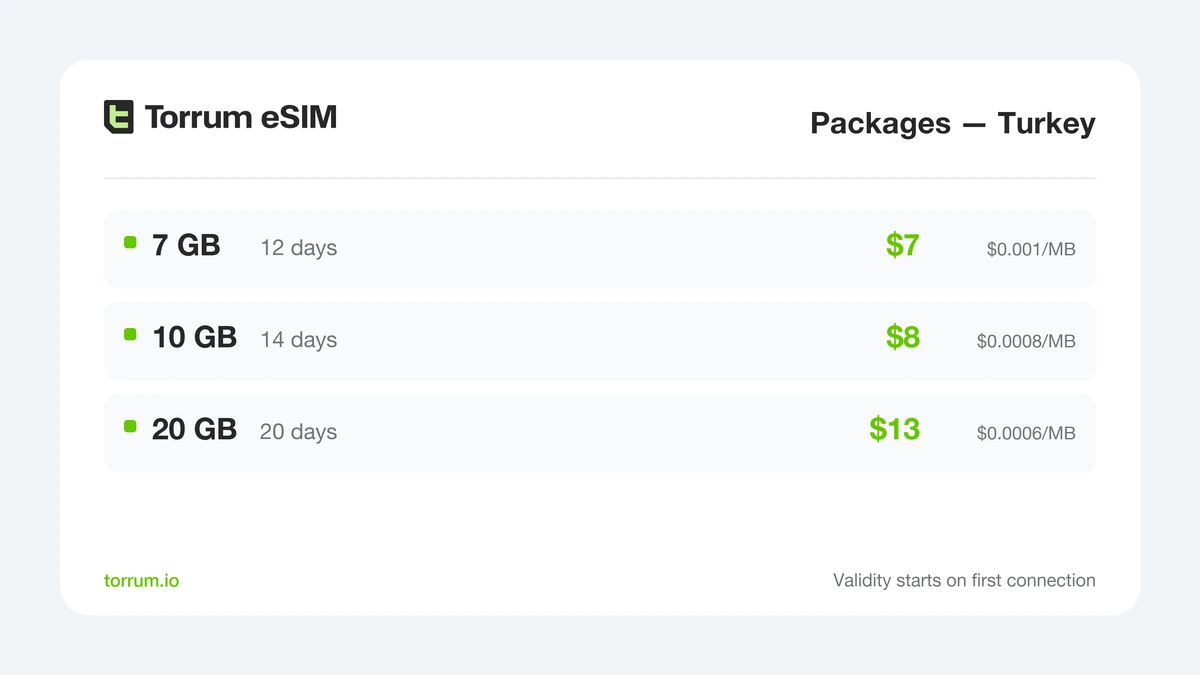
Turkey data packages – the countdown begins at the first network handshake, not at checkout, so an early purchase costs nothing.
A coastal week of maps, messaging and photographs sits in the middle tier; two weeks of driving between Cappadocia and the sea wants the largest.
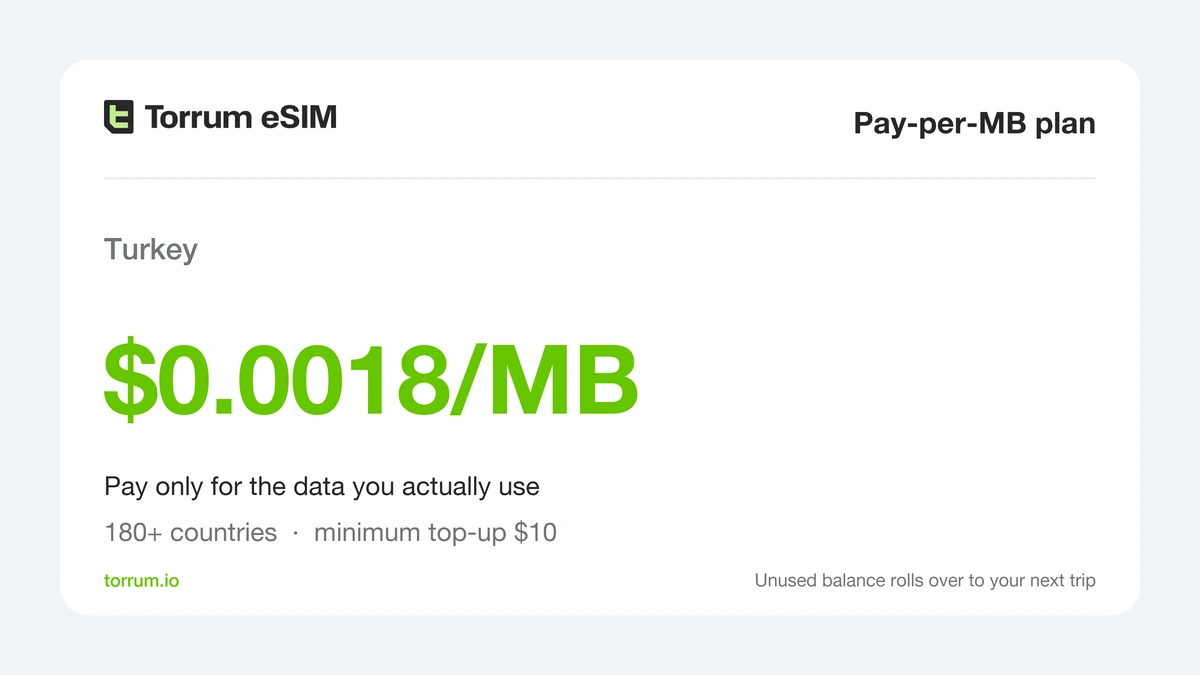
Turkey on Pay-per-MB – $0.0018 per megabyte, metered against what you actually use, and whatever is left stays on the balance for the next trip.
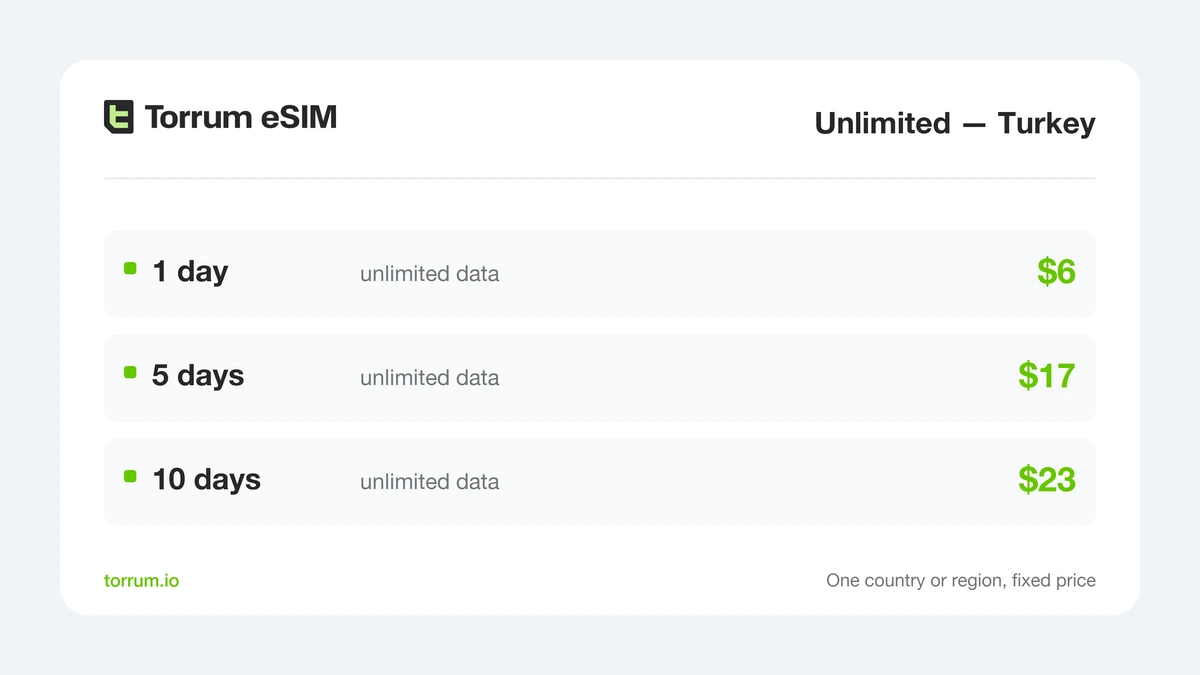
Unlimited for Turkey – one price for the whole period, however heavily you lean on it.
What may not work: blocked services and throttled days
Turkey restricts a substantial part of the internet at network level, and travellers notice. A free-expression monitoring report counted around 232,000 domains newly blocked during 2025. Discord has been blocked since 2024 and was still unavailable in mid-June 2026; Roblox was restored that month after a 680-day block. Bandwidth has also been throttled nationally around major incidents (monitoring report and press coverage, checked August 2026).
The honest point: none of this is something you can buy your way out of. A blocked service is blocked on a local SIM, on roaming and on a travel eSIM alike, because the restriction sits in Turkish networks, not in your subscription. Agree a messaging app before you fly, and download the maps and tickets you will need.
Free Wi-Fi in Turkey: the airport is the easy part
Istanbul Airport is unusually good: free, unlimited Wi-Fi with two ways in – a phone number and SMS password, or a passport scan at a terminal kiosk for an access code (istairport.com, checked 21 August 2026). Remember the kiosk, because the SMS path fails on a foreign number – the same failure you meet in cafés and hotels across the country. Treat Wi-Fi as a supplement, and keep banking apps off open networks.
Which plan fits which Turkish trip
A week on the Aegean or Mediterranean coast. Predictable usage, predictable price – a mid-sized Turkey package, nothing further to decide.
Turkey plus a Greek island hop. The ferries from Bodrum and Marmaris cross into another country and price list – one balance across both is what Pay-per-MB is for.
One day of meetings in Istanbul. A single day of Unlimited removes the arithmetic entirely.
A long stay, or a fourth visit this year. Here the IMEI clock stops being trivia – a roaming plan keeps a Turkish identity out of the handset.
👉 Planning the European leg too? Our guide to roaming in Europe from the UK covers what happens once you land back inside the EU.
FAQ
Is Turkey included in EU roaming?
No. Turkey is in neither the EU nor the EEA, so EU residents pay world-zone rates there.
Do UK travellers pay to roam in Turkey?
In practice yes – all four major UK networks place it outside their Europe bundle, in a zone charged by the day.
What is Turkey’s 120-day IMEI rule?
A foreign handset used with a Turkish SIM has its IMEI logged and is refused service after about 120 days unless registered and the fee paid.
Does the count reset if I leave the country?
No – it is cumulative across entries, so repeat short visits add up.
Does a travel eSIM start the IMEI clock?
No – the clock needs a Turkish subscriber identity in the device, and a roaming eSIM uses a foreign one.
Do I need my passport to buy a Turkish SIM card?
Yes, in person and registered to your name – and only within 90 days of your most recent entry stamp.
Is Istanbul Airport Wi-Fi really free?
Yes, free and unlimited – log in by SMS, or take a code from a passport kiosk in the terminal.
Will all my usual apps work in Turkey?
Not necessarily. Some platforms are blocked at network level, equally on a local SIM, on roaming and on any travel eSIM.
Is 5G available everywhere in Turkey now?
Not yet – it launched on 1 April 2026 in the 81 provincial centres, with nationwide coverage due by 2028. 4G still carries most of the country.
Will my package keep working on a day trip to a Greek island?
No – it stops at the border. Cover both sides with Pay-per-MB, one balance across 180+ countries.
Does my phone support eSIM?
Most recent flagships and mid-range Androids do; iPhones sold in mainland China do not. The device list answers it in a second.
Final thoughts: the best connection option for Turkey
Turkey rewards preparation more than most destinations. It sits outside every European roaming arrangement, so continental instincts are wrong here for British and EU travellers alike – and its SIM cards, cheap for residents, reach visitors as a tourist product with a registration clock attached.
For a holiday or a business week, a profile installed before departure sidesteps all of it: no counter, no passport at a shop, no Turkish identity in the phone, and a price fixed before you leave.
👉 Flying to Turkey soon? Choose your Turkey data package – or see how the same decision plays out on the Spanish coast.


 Continue with Google
  Continue with Telegram

