
A French SIM, roaming in, or an eSIM loaded before you fly: what each one costs and where French coverage actually breaks
Contents:
Every underground platform in Paris has a mobile signal. A good deal of the countryside two hours away has one the regulator would not call good.
France counted 102 million international visitors in 2025, arrivals from the United States up 17% past five million (French Economy Ministry figures, published 20 February 2026). Most arrive assuming French coverage is uniformly excellent – true of the cities, less true of the map.
Three ways to be online there. Which of them suits you turns less on France than on which country issues your phone bill.
👉 Just want the plan? France sits here on the packages page.
Four networks, and four maps that do not match

Orange, SFR, Bouygues Telecom and Free Mobile each run a national network, and all four will tell you they cover France. Arcep, the French regulator, measures that claim two ways – and the answers are far apart.
Share of the country with what Arcep classes as “very good” 4G coverage, October 2025 data:
| Network | By population | By territory |
|---|---|---|
| Bouygues Telecom | 93.9% | 65.9% |
| Orange | 92.8% | 61.2% |
| SFR | 86.5% | 57.2% |
| Free Mobile | 77.6% | 43.4% |
Two gaps matter. Across the columns, people and ground are not the same country: Bouygues reaches 93.9% of the population but 65.9% of the territory, a drop of twenty-eight points – thirty-four for Free Mobile. Down the rows, sixteen points of population and twenty-two points of map separate best from worst. A French SIM means picking one of those four footprints.
Arcep also reports 88.5% of the population with very good coverage from at least three operators, leaving roughly one person in nine without it. The thin patches tend to be where holidays happen: parts of the Landes and the Gironde, stretches of Corsica, and the valleys of the Alps and Pyrenees.
Underground and at 300 km/h: where the French signal actually breaks

Start with the good news, because it is genuinely unusual. The Métro was the first historic metro network anywhere to put 4G across its entire system. The four operators built a shared network reaching all 304 underground stations then in service and the tunnels between them – roughly 300 km of cable and 3,000 antennas, threaded through infrastructure in places more than a century old (RATP, June 2020).
Now the part nobody puts in the brochure. Arcep’s quality-of-service audit, built on more than a million field measurements and published 26 June 2025, tested the same networks aboard moving trains:
| On a TGV | Calls held for two minutes | Pages loaded within 10 seconds |
|---|---|---|
| Orange | 78% | 82% |
| Free Mobile | 60% | 72% |
| Bouygues Telecom | 59% | 68% |
| SFR | 56% | 69% |
Read the first column slowly. On the best network roughly one call in five does not survive two minutes; on the weakest, more than two in five drop. Motorways score 87% to 92% on the same call test, so it is the high-speed line specifically that eats connections. Load the route and the tickets before boarding, and treat a video call from a TGV as optimism rather than a plan.
Roaming into France: three passports, three different bills
Here the honest answer turns entirely on where you started.
From inside the EU, roaming into France is free, and pretending otherwise would be a lie. Roam-like-at-home means a Belgian or German phone in Paris bills exactly as it does at home, within the plan’s fair-use allowance. If that is you, this section ends here.
From the UK the position reversed after Brexit. Three of the four large British networks reintroduced daily EU roaming charges; 2026 price lists put the common range at £2–6 a day, with one operator still including EU roaming on most pay-monthly plans under a 25 GB fair-use cap (UK network price comparisons, checked September 2026).
From the US it is a bigger line. The standard international day pass sits around $10–15, charged per handset for every day used (published 2026 roaming comparisons, checked September 2026). Two weeks lands between $140 and $210 – and a family of four pays that four times over.
👉 The British bill deserves its own page, and it has one: what EU roaming costs after Brexit, taken apart network by network.
French prepaid SIMs: cheap, and not built for a five-day trip
France has no shortage of cheap mobile data. The cheap part is written for residents.
No French line is sold anonymously: the Post and Electronic Communications Code obliges operators to hold the civil identity behind every number, prepaid included, which at the counter means a passport and a form. Some go further – Free restricts its prepaid range to people with a stable link to mainland France (published prepaid terms, checked September 2026), so its headline prices are not on offer to a visitor at all.
Published prices, checked 1 September 2026, converted at 1 EUR = 1.16 USD (ECB euro reference rate, 31 August 2026):
| What you can buy | In euros | Roughly in dollars |
|---|---|---|
| Starter SIM in a shop, credit only | from about €3 | about $3.50 |
| Prepaid pack, 31 days, with a European allowance | from €9.99 | about $12 |
| Prepaid pack, 15 GB / 15 days | €14.90 | about $17 |
| Travel SIM or eSIM, 20 GB / 14 days | €24.99 | about $29 |
| Travel SIM or eSIM, 50 GB / 30 days | €44.99 | about $52 |
Now compare the second row with the fourth. The month-long pack written for residents runs to roughly €10, against €25 for the fortnight-long tourist bundle – less money for more days, though a holiday would use a fraction of either. Mobile data for people who live in France is not expensive; getting hold of it as a visitor is.
What you pay is the shop, the queue, the document, and a French number replacing yours – which matters the moment a bank texts a code to the number on file.
Airport Wi-Fi you can simply join, and everything after it
Paris Aéroport runs free Wi-Fi across both Charles de Gaulle and Orly on a network named WIFI-AIRPORT: no time limit, no password, no registration (Paris Aéroport, checked September 2026). Select it, open a browser, done – a striking contrast with Switzerland, where the law requires the airport to identify you first.
Beyond the terminal it gets patchy. Hotel Wi-Fi is generally fine and generally slow at eight in the evening; cafés range from an open network to a portal wanting an email address. Watch the municipal and station hotspots, which often confirm you by texting a code that a foreign number may or may not receive. Anything open is effectively unencrypted – keep it for maps and menus.
A travel eSIM in France: what it does and where it stops
Nothing physical changes hands: you scan a code and a second line appears in the phone’s settings. On French soil it joins the local networks as any visiting line does, running in parallel with the SIM you already have, which keeps answering your own number. One toggle governs it – Data Roaming, for the travel line only.
Where it falls short:
- Only the hardware can rule you out: the phone must handle eSIM and must not be carrier-locked. Half a minute on the supported devices list is enough to know.
- It carries data and nothing else. A form demanding a French mobile number will not be satisfied by it.
- Whatever the local mast manages is what you get, which is precisely the point of the first two sections.
- The terms make it a travel product, not a tariff for wherever you happen to be resident.
France compared: roaming vs a French SIM vs a travel eSIM
| What matters | Roaming | French prepaid SIM | Torrum eSIM |
|---|---|---|---|
| On the phone before you land | Yes | No – the shop comes first | Yes, installed at home |
| Paperwork to obtain it | None | A passport and a form, by law | None |
| Calls to the number you already have | Unaffected | You are given a French one instead | Unaffected, on the SIM you keep |
| Cost from inside the EU | Nothing extra, roam like at home | Rarely worth the errand | Rarely worth it either |
| Cost from the UK or the US | A charge for each day used, per handset | Cheap, once you have it in hand | Settled in advance, in dollars |
| Thirty days in one town | Poor value | The winner on this row | The wrong shape |
| A rail leg into Italy, Spain or Germany | Priced country by country | Stops at the frontier | Held by the Europe regional package |
| An afternoon in Monaco or Andorra | Andorra falls to rest-of-world rates | Not included | Distinct countries, each priced on its own page |
The fourth row is the one most guides quietly skip: no travel plan beats free.
Torrum packages for France, and which trip wants which
Two shapes cover almost every French itinerary, and the difference between them is borders, not gigabytes. The countdown ignores your purchase date and starts at the first handshake with a foreign network, so booking a month early costs nothing.
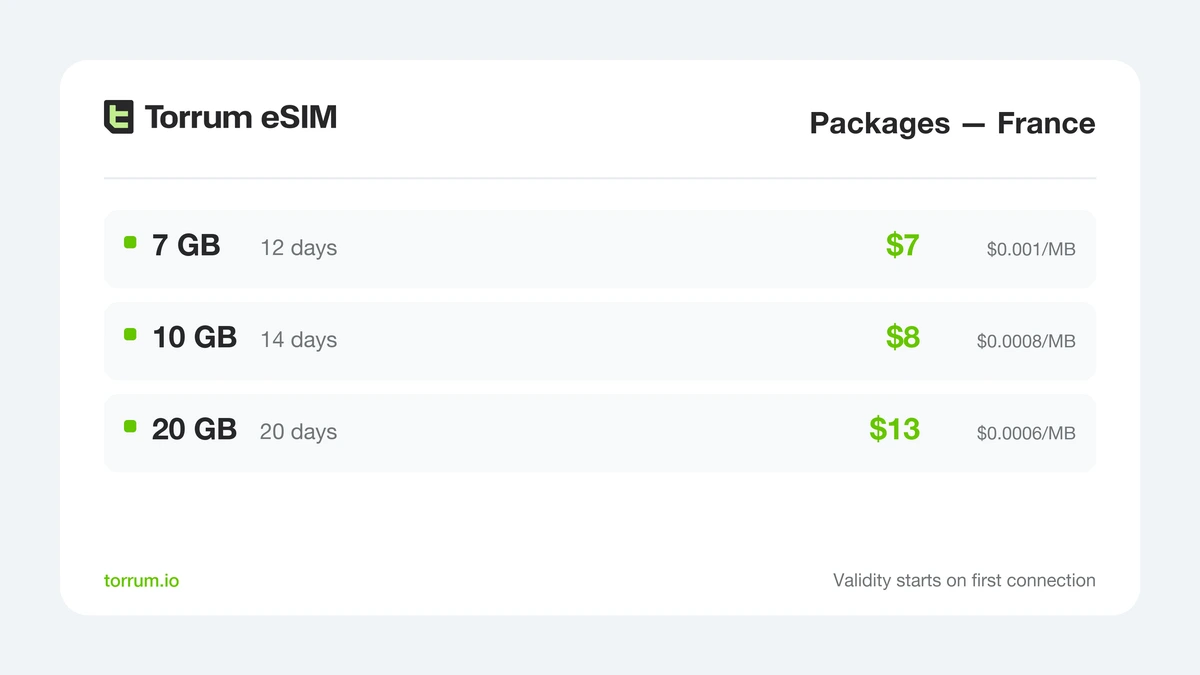
What a France package buys, at the three sizes offered. Match the size to your own consumption estimate rather than to the length of the holiday.
One country, one package. A week of Paris, a fortnight between Lyon and the coast – if the itinerary stays inside France, the country package is the whole decision. Sizing is the only real question, and our breakdown of what a week of travel really consumes hands you a figure to match against.
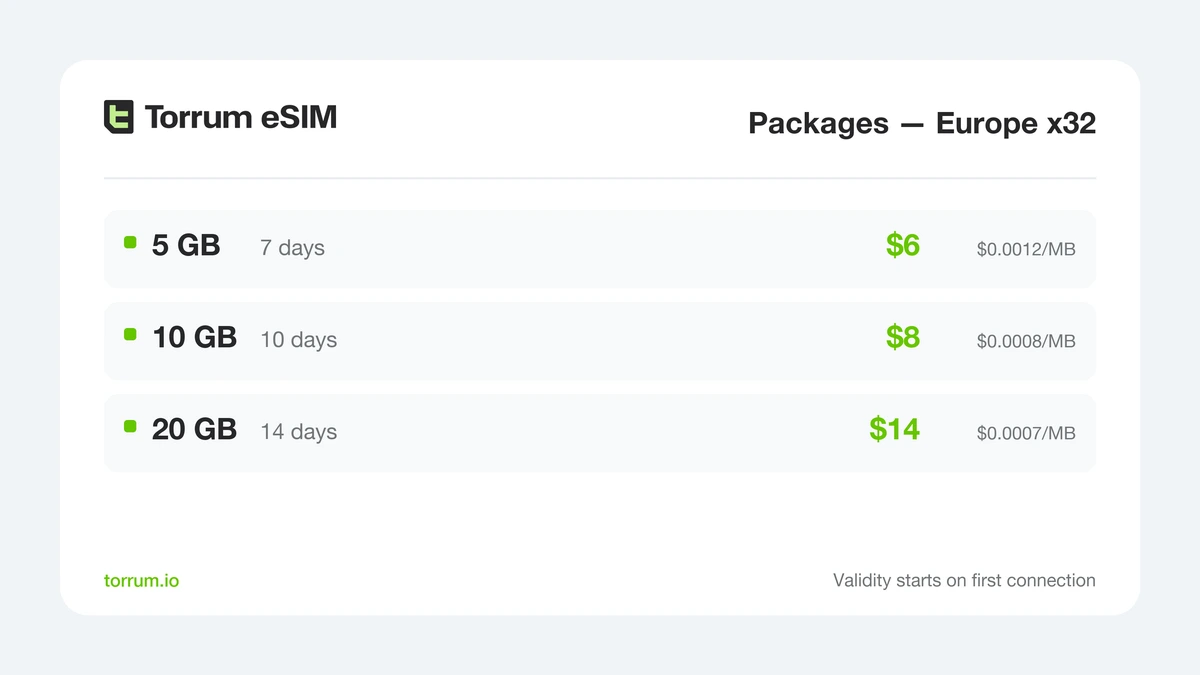
The same three sizes for the Europe region – the shape a multi-country route wants. France is one of the thirty-two countries inside it.
A route, one regional package. Paris then Barcelona, a Rhine trip out of Strasbourg, anything involving a night train. The Europe regional package spans thirty-two countries on one purchase, so the border stops being a billing event.
Two other plan shapes sit alongside these: Pay-per-MB, billed on consumption, and Unlimited, bought as a block of days. Per-country rates live on those pages.
France on a plan list is smaller than France on the map

France has pieces of itself scattered across three oceans, and mobile plans follow network borders rather than political ones. Four distinctions worth knowing:
- Corsica counts as France. Same metropolitan networks, so a France plan travels there – though the interior is one of the thinner parts of Arcep’s map.
- The overseas départements do not. Réunion and French Guiana have their own entries on the plan pages. Réunion sits inside the Europe regional package; French Guiana does not.
- Monaco is a country. Two square kilometres of it, with its own networks and its own line on every plan list. Half a day in Monte Carlo is half a day abroad, as far as the phone is concerned.
- Andorra is the expensive one. Outside the EU, and therefore outside the roaming zone: a European phone that roamed free the length of France reverts to rest-of-world pricing on entering the Pyrenean valleys (roaming price comparisons, checked September 2026).
Monaco, Andorra and a ferry to Corsica are ordinary items on French itineraries. Check the country list before the day trip, not after it.
Setting up a Torrum eSIM for France
- Confirm the phone can do it at all – eSIM support, no carrier lock. It is the only step capable of stopping you, and the compatibility guide resolves it.
- Register at torrum.io – the sign-in options are Google, Apple and Telegram – then choose by itinerary: a France data package for a trip that stays inside the country, the Europe regional package for one that crosses out. No French address, bank account or ID document is involved.
- Pay by card; checkout displays the minimum top-up and the per-transaction ceiling.
- Scan the code you are sent and the profile installs itself; the app walkthrough pictures every screen.
- Then the setting people miss: Data Roaming, on for the new line and touched nowhere else. Anything that refuses to install is what the support bot is for.
FAQ
Does my EU phone plan work normally in France?
Yes. France is inside the EU roam-like-at-home area, so an EU line bills as it does at home, within its fair-use allowance.
Has EU roaming come back for UK phones?
Usually. Three of the four large UK networks brought back daily EU roaming charges after Brexit, commonly £2–6 a day in 2026; one still includes it on most pay-monthly plans.
Can I buy a French SIM without showing a passport?
No. Operators are obliged to record the civil identity behind every line, prepaid ones included, so a document is requested at the point of sale.
Is there mobile signal in the Paris Métro?
Yes, throughout – a shared operator network covers all 304 underground stations and the tunnels between them.
Will my phone work properly on a TGV?
Intermittently. Arcep puts two-minute call success on high-speed trains between 56% and 78% depending on the network, so download what you need before boarding.
Does a France plan cover Corsica?
Yes – Corsica runs on the metropolitan French networks. Coverage inland is thinner than on the coast, which is terrain rather than plan.
Does a France plan cover Monaco or Andorra?
No. Both are separate countries with their own plan entries, and Andorra also sits outside the EU roaming zone.
Which French network has the best coverage?
Bouygues Telecom led Arcep’s October 2025 figures on both measures – 93.9% by population, 65.9% by land area – with Free Mobile last on each.
Will an old backup phone still work in France?
Increasingly not. French operators are switching off 2G during 2026, with 3G scheduled to run until 2028–2029 (published operator sunset plans, checked September 2026), so a handset predating 4G is on borrowed time.
Will my handset accept an eSIM?
Across the major brands, anything reasonably recent almost certainly does; a handful of regional variants ship without the hardware. The device list takes less time than guessing.
Final thoughts: the best connection option for France
France rewards knowing where you are standing. Inside the EU your plan already works and nothing here needs solving. Arriving from Britain or North America, the default is a daily charge that quietly compounds, and the alternative on the ground is a shop, a passport and a number not your own.
A profile loaded before departure removes the errand and settles the price at home. What it cannot do is invent signal – not in a Pyrenean valley, and not at 300 km/h between Paris and Marseille. Save the map, size the package to the itinerary rather than to the anxiety, and remember that Monaco and Andorra are abroad twice over.
👉 So which is it – one country, or a route? The France package settles the first. For the country the EU roaming deal never reached, our Switzerland guide starts where this one stops.


 Continue with Google
  Continue with Telegram

