
What mobile data costs in Greece, and why a phone on Kos or Corfu can be billed as though it had crossed a border
Contents:
Somewhere between the harbour at Kos and the beach at the far end of it, a phone can receive a message welcoming it to Turkey. Its owner has not left Greece. The charges are real anyway.
Greece is easy to be online in and strange to be billed in, for one reason: fast networks, thousands of islands, and a sea border running close to some of Europe’s busiest coasts.
👉 Straight to the purchase: Greece on the packages page.
There is a border in the Aegean and your phone cannot see it
Lesvos, Chios, Samos, Kos and Rhodes all sit within sight of the Turkish coast, the narrowest channels barely a couple of kilometres wide; Corfu lies about as close to Albania. Masts ignore coastlines, and a handset picks the strongest signal, not the one under the right flag.
The consequence is out of proportion to the distance. Inside the EU your bill is protected by law; one hop onto a Turkish or Albanian network and none of that applies, because neither country is in the roaming area. British consumer reporting through 2025 gathered the same account repeatedly – a “welcome to Turkey” message on a Greek island, sent to someone who never boarded a boat.
One habit reduces it to nothing: on the eastern islands, turn off automatic network selection and pick a Greek network by hand.
👉 If a day crossing is on the itinerary, the water has another side: what data costs in Turkey.
Two hundred and twenty-seven inhabited islands, three networks

Greece has roughly six thousand islands and islets, 227 of them inhabited (Greek National Tourism Organisation, checked September 2026). Three networks serve the country – Cosmote, Vodafone and Nova – with 44.4%, 34.1% and 21.5% of active connections at the end of 2024 (EETT Market Review, published February 2026).
The headline figures are good: Cosmote reported 5G past 99% of the population in Q1 2025, Vodafone its own above 95% in January 2026, and independent testing scores Cosmote 8.4 out of 10 on Coverage Experience (Opensignal Greece, March 2026).
The caveat is older and stranger. On 2024 measurements, Greek users spent the second-highest share of time on 2G of any European market, behind Luxembourg. All three operators have retired 3G, so where 4G runs out there is no middle rung – you get 2G, which will not load a map. The thin spots are island interiors, mountain roads in the Peloponnese and Epirus, and small islands served by a single site. Athens, Thessaloniki and any island town of size are quick, so save the route while you are still in port.
What a ferry crossing does to the rules
Island hopping is the standard shape of a Greek holiday, and the one leg where every option on this page performs badly. A fortnight here is not one crossing but five or six short ones, which is what makes the habit worth forming.
Out of sight of land, some vessels put you on a maritime network of their own, and traffic carried over satellite systems is explicitly unregulated, with no price ceiling at all (Your Europe roaming guidance, checked September 2026). No travel plan repairs that, this one included – a ship’s network is a different network, not a bad day on a familiar one. The remedy costs nothing: aeroplane mode when the coast fades, off again at the next island.
Roaming into Greece: your billing country decides the price
Greece sits inside the EU roaming area, which splits readers into three groups paying very different sums for the same fortnight.
An EU line pays nothing extra. Your domestic allowance travels with you, and where a fair-use limit applies, the surcharge beyond it is capped at the wholesale rate – €1.30 per gigabyte plus VAT in 2025, dropping to €1 from 2027 (Your Europe roaming guidance, checked September 2026). Germany alone sent 5.95 million visitors in 2025 (Bank of Greece, February 2026), and for a line billed inside the zone there is honestly nothing here to buy.
A British line pays daily again. Most big UK networks charge around £2–3 for each day the handset is used in Europe, one still folding European use into its bundles up to a 25 GB fair-use ceiling (UK network price pages compared, September 2026). Britain sent 4.89 million of Greece’s visitors in 2025.
A US line pays most. Published day passes run $10–15 per line for every day used overseas (international roaming price lists, September 2026). Two handsets across ten island days land between two and three hundred dollars, with nobody streaming anything.
👉 The British arithmetic is worked through in our guide to post-Brexit roaming in Europe.
Greek prepaid: a passport, a €13 floor and a twelve-month clock
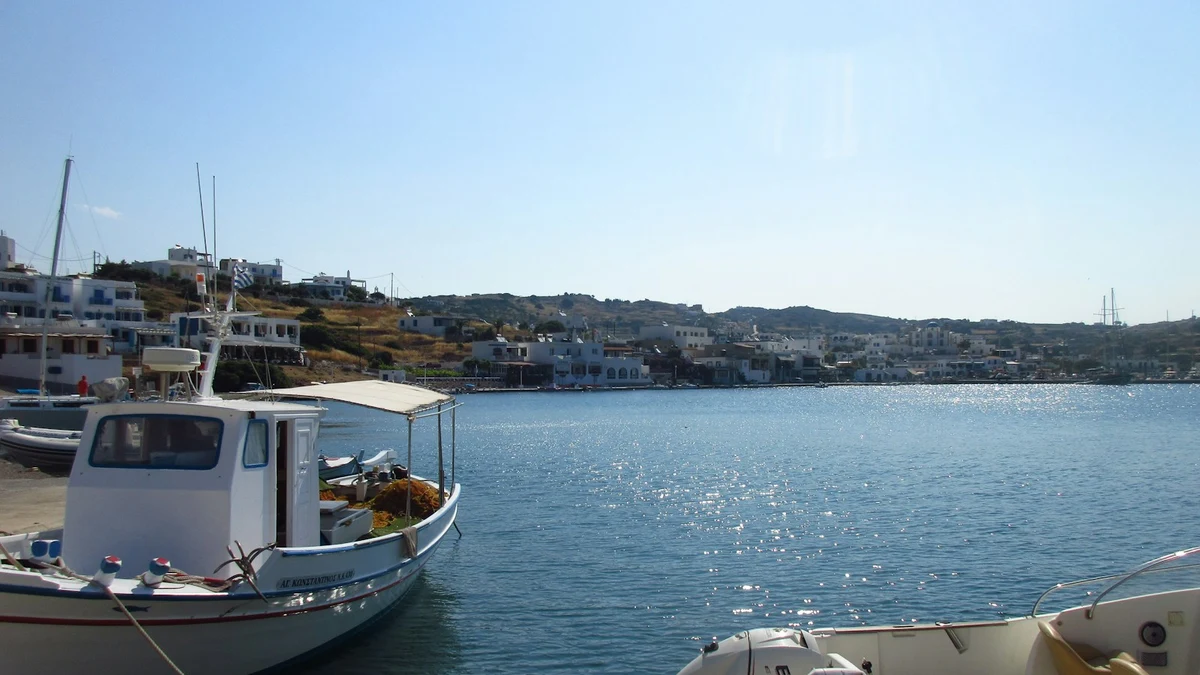
Greek prepaid data is fair value with conditions attached at the counter. Registration is compulsory, the shop copies your passport, and the buyer must be over 18. Tourist bundles cluster between €13 and €20 a month, carrying roughly 3.5 GB to 20 GB depending on the pack – call it $15 to $23, converting at the ECB reference rate of 1.16 dollars to the euro on 2 September 2026.
Two details rarely reach the guides. The smallest top-up any Greek network accepts is €13, so the cheapest entry is not cheap; and the card runs down, lasting twelve months while its credit needs topping up every two or it is written off (Prepaid Data SIM Card Wiki, Greece entry, checked September 2026). One saved for next summer will not be waiting. What makes the errand worthwhile is length of stay, not price on the shelf.
August is the stress test: crowds, wildfires and the 112 alert
Visitors do not arrive evenly. Santorini has around 15,000 permanent residents and logged 1.34 million cruise arrivals in 2024 (Greek cruise-arrival figures reported in 2025).
Cell sites feel that arithmetic: equipment sized for a village in March carries a small city in August, and the symptom is not a dead phone but full bars moving slowly. Congestion beats every tariff ever sold; loading tomorrow’s route over breakfast beats congestion.
Summer’s other feature is the alert. Greece leans heavily on 112 for wildfire warnings and evacuation orders, and these travel as cell broadcasts rather than text messages – pushed to every handset on a mast in the affected area, needing no app, no sign-up and no Greek number (General Secretariat for Civil Protection, checked September 2026). On a foreign phone, check that emergency notifications are on. The number itself works from any handset here, in English.
The line that arrives without a counter, and its three limits
The chip is already inside a modern phone; what you buy is a profile delivered to it over the internet. It registers on the same three networks as everybody else, so the coverage above is exactly what arrives – no better, no worse. What changes is everything except the signal: the cost is settled at home in dollars, no counter asks for identification, and your usual number stays live on your usual line, where your bank and your airline send their codes.
Three limits, plainly. It carries data and not a Greek number, so a booking page demanding a local mobile still needs a local card. It wants a compatible handset, settled by the device list. And its terms cover travel only, never your own address.
Torrum plans for Greece: what data actually costs
Three shapes fit a Greek trip, separated by how much you are prepared to predict: a package wants a rough figure, a metered balance wants none, unlimited days want only a date range. Buying weeks ahead costs nothing, since a plan starts counting on the first foreign network rather than at the receipt.
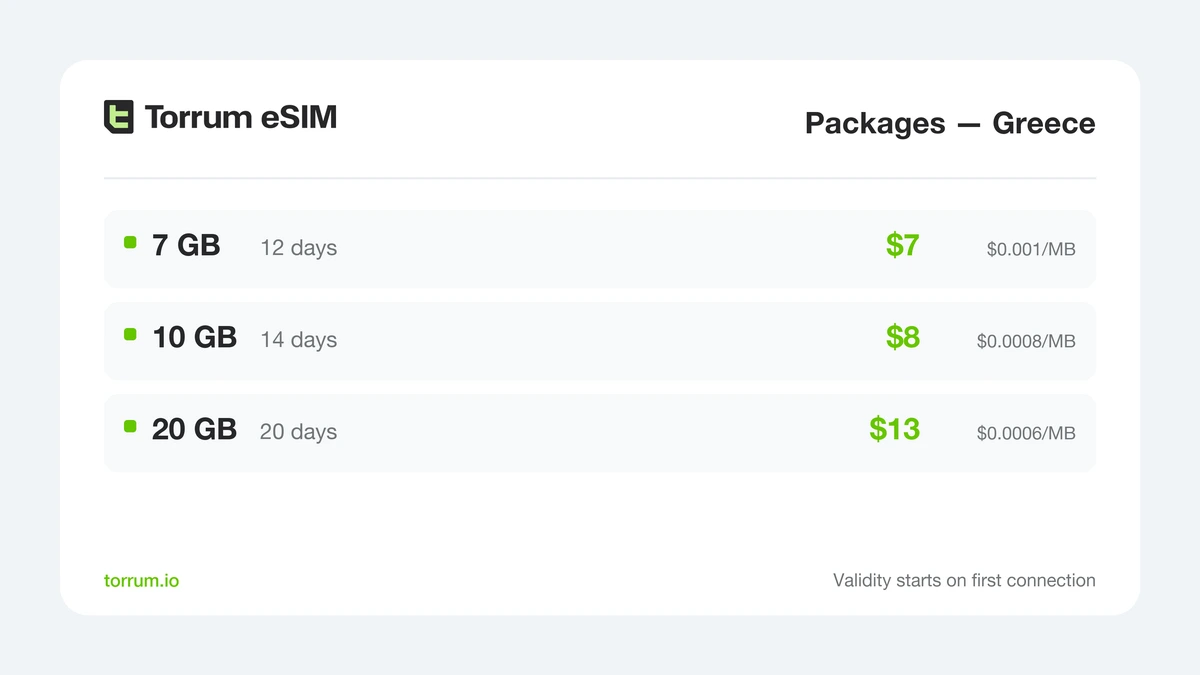
Greece, priced by block. Look at validity before you look at cost – an island itinerary overruns its own schedule far more readily than a mainland one.
Most finish a Greek week well under what they feared; our guide to finding your own figure reads it off your phone.
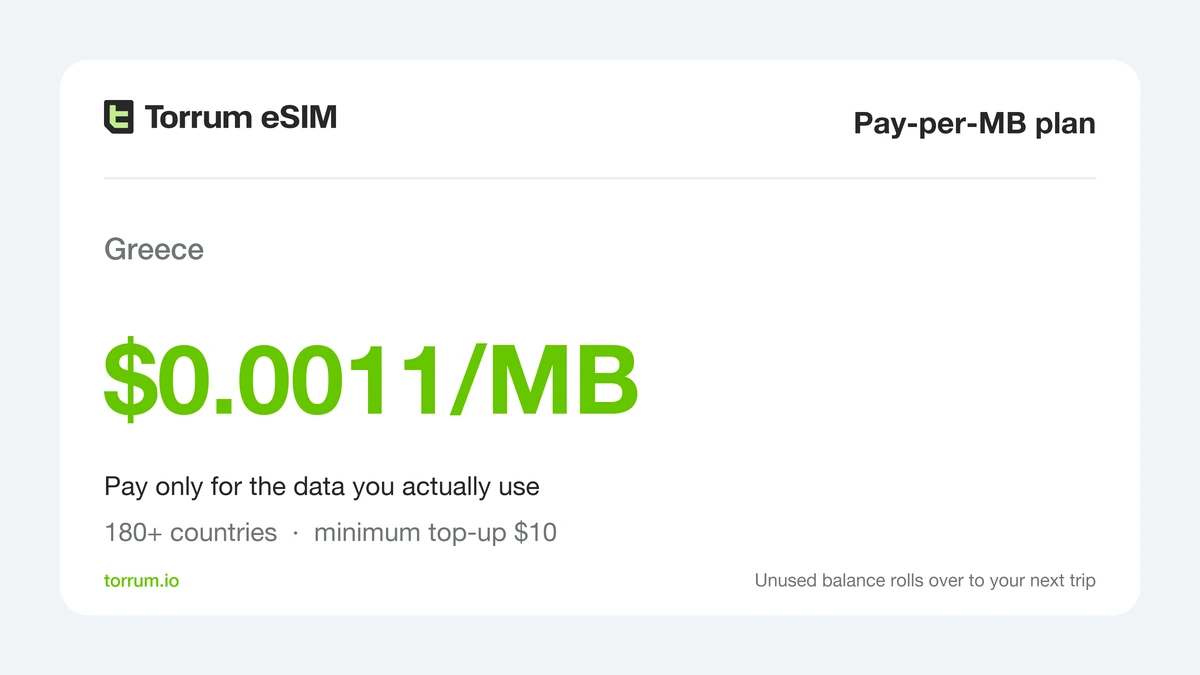
Where the others sell you a plan, Pay-per-MB hands you a meter: Greece reads $0.0011 a megabyte, and it is the account rather than the calendar that decides when the money runs out.
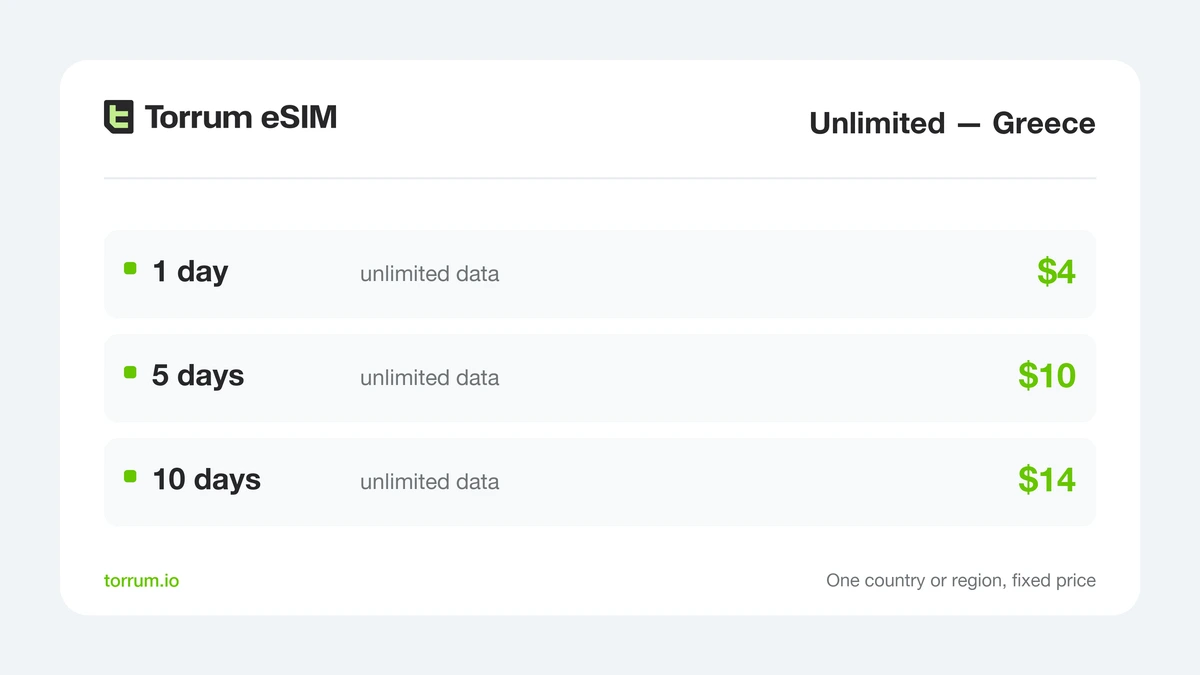
Unlimited is priced off the calendar. Tethering a laptop from a terrace for a fortnight costs precisely what a fortnight of sending postcards would.
Loading the Greek profile: four steps in trip order
Easier described against the calendar of the trip than as a list of settings.
- At home, on your own Wi-Fi. Check the handset against the compatibility list, sign in at torrum.io with an account you already own, pay, and scan the QR code from the order. Installing needs a connection; using it afterwards does not, and the walkthrough exists for the screen you were not expecting.
- At the departure gate. Nominate the new profile as the line carrying mobile data; your own line stays on for calls, its data off.
- Wheels down in Athens or Heraklion. Leave aeroplane mode; with Data Roaming permitted on the travel profile, it finds a Greek network itself. The Telegram support bot picks up anything that stalls.
- Before the first island. Two Greek settings worth thirty seconds: emergency alerts on, so a 112 broadcast reaches you, and manual network selection if you are heading for Kos, Samos or Rhodes.
Wi-Fi in Greece: free in Athens, and the code you cannot receive

Athens International Airport runs ATH Free Wi-Fi throughout the terminal, landside and airside, at no charge and with nothing to buy first (Athens International Airport, checked September 2026). That covers the arrival, which is the part that matters: a profile installs on very little of it.
Beyond the terminal it thins. Hotels and tavernas nearly always have a network; whether it reaches the far terrace, or survives forty guests at once, is another question. And some venue log-ins still text a code to a phone number – simple on the line you kept, impossible on one you replaced.
Greece compared: roaming vs a Greek SIM vs a travel eSIM
| On a Greek trip | Your own operator, roaming | A Greek prepaid SIM | A Torrum eSIM |
|---|---|---|---|
| An EU line, the whole trip inside Greece | Included already | Paying twice for one thing | Paying twice for one thing |
| A UK or US line, ten days | Charged per day, per handset | Inexpensive once you have it | Whole trip priced up front |
| Landing at 01:40 on a summer charter | Live on arrival | Shop shut until morning | Live on arrival |
| What the counter asks for | Nothing | Passport, copied and filed | Nothing |
| Phone latches onto a Turkish mast | Non-EU rates, found out later | Non-EU rates, against your credit | Nothing on a Greece package; Turkish rates on a balance |
| Mid-crossing on a ship’s own network | Outside every allowance | Outside every allowance | Outside every allowance |
| Five islands, still one country | Billed as one country | One card throughout | One plan throughout |
| Codes from your bank | Still arrive | Arrive on a number nobody has | Still arrive |
| A month or more on Naxos | Poor value well before the end | The cheapest there is | Close, but beaten |
Read the Turkish-mast row across: only one cell is open-ended. A Greek card risks its credit, a balance risks what sits on it, a Greece package will not register across the channel at all – and the first column learns its number when the statement arrives.
Four Greek itineraries and what each should buy
One island or five. Greece is one country either way, so a package covers both. If the ferries rewrite the plan daily, a metered balance bills only what you used and rolls the rest forward.
Greece plus a crossing to the Turkish coast. A Greece package stops at the frontier, so a balance that follows you beats buying again at the quayside.
A laptop along, up to about a month. Video calls make any gigabyte figure unreliable, and buying days removes the sums. From roughly a month at one address, take your passport to a Greek shop instead: at that length the local card genuinely wins.
FAQ
Do I need anything extra if my phone plan is European?
No. Greece is inside the roaming area, so an EU line spends its home allowance here at no surcharge.
Why did my phone say “welcome to Turkey” while I was on Kos?
A Turkish mast across a narrow channel was briefly the strongest signal, and Turkey is outside the roaming area, so the price protections stop. Select a Greek network by hand on the eastern islands.
Which Greek operator performs best?
Cosmote leads independent measurement for coverage and consistency and holds the largest share of connections. All three are strong in towns; gaps appear inland and on small islands.
Will there be a signal on the ferry?
Near the shore, usually. Further out you may attach to a maritime network, outside EU roaming rules and priced accordingly – aeroplane mode is the safe setting.
What does a Greek shop ask for when selling a SIM?
Identification. Registration is mandatory, your passport gets copied at the counter, and the buyer must be 18 or over.
Can one plan cover Greece and a Turkish day trip?
Not a Greece package – it ends at the frontier. A metered balance works in both, at each country’s own rate.
Is 5G available on the Greek islands?
In island towns and resorts, generally. Coverage figures above 95% describe people rather than terrain, so remote beaches stay on 4G or less.
How long does a Greek prepaid SIM stay usable?
Twelve months, and the credit on it needs a top-up every two or it is written off. One kept for next summer will not be waiting.
Does 3G still work in Greece?
No. All three operators retired it, and very old handsets drop to 2G, which will not carry maps.
Do 112 emergency alerts reach a foreign phone?
They are broadcast to handsets on the local masts rather than sent to numbers, so a foreign phone gets them provided emergency notifications are switched on.
Final thoughts: what to actually do about data in Greece
Greece rewards a decision taken before departure, and not because the networks disappoint – they are good, and on the mainland fast. It is that the awkward moments cluster where fixing anything is hardest: a late arrival on a small island, a deck out of sight of land, a beach where the nearest mast is foreign.
If your bill comes from an EU country, do nothing; the law has handled it. Otherwise price the trip at home, keep your own number for the codes that matter, and let a second line carry the data – prepaid, capped, unable to surprise you.
👉 Two starting points: the Greece package list if the length of the stay is settled, or the three-way comparison if a shop, your operator and a download are still competing.


 Continue with Google
  Continue with Telegram

